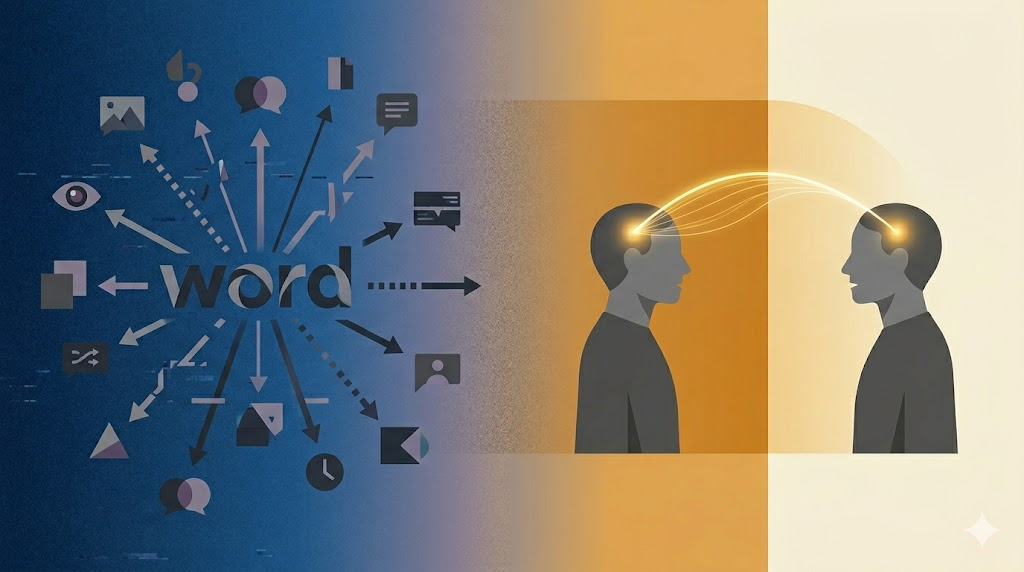
I was thinking the other day about why I spend so much time choosing the right words. Not just in writing, but in conversation. In code reviews. In meetings. It’s not that I’m trying to sound smart or show off vocabulary. It’s something deeper.
Nowadays, the trigger is hearing someone say, “Oh, I vibe-coded this app, and I didn’t even look at the code.” How do you vibe with something you didn’t look at? The phrase doesn’t match the experience it’s supposed to describe.
That mismatch bothers me. And I’ve been asking myself why.
Two Reasons Precision Matters
I see two reasons why word choice matters to me.
The first is practical: I’ve watched disagreements unfold that had nothing to do with actual disagreement. One person uses a word with one meaning in mind. The other person hears it with a completely different meaning. Neither realizes they’re not on the same page, and the conversation goes sideways. The conflict isn’t about the idea. It’s about the word.
The second reason is personal.
The Scars of Speaking a Second Language
All it takes to make someone pay closer attention to word choice is to speak a language that isn’t the one they were raised in.
When you’re expressing something emotionally charged in a language you learned as an adult, and you reach for a word you believe is correct, and then people laugh or mock you, that leaves a mark. It gives you scars. And those scars make you think harder about what you say.
People who have only ever spoken one language throughout their adulthood don’t fully appreciate what it feels like to be mocked for using the wrong word in the wrong context. I remember specific moments over the last couple of decades of speaking English: I was explaining something, I used the word I thought was right, and I could see people grinning, or something in the room shift, and I knew the emotion I was trying to convey wasn’t landing.
That makes you more anxious. It makes you feel frustrated. Because people want to be understood, and in those moments, you feel you are not.
I documented one case a few years ago where I used the word “lame” as I had learned it in American English, in the context I’d learned it, and I got my hand slapped for it on an online channel. Someone associated that word with a meaning unrelated to my intent, and they felt offended. I didn’t even understand why at first.
Words Don’t Always Translate
When you speak more than one language, you also learn that some words translate from one language to another, but not with the same meaning or the same weight.
You use a word thinking it will lead to mutual understanding, but the word doesn’t hit with the same intended impact, or it hits harder than intended. You end up diluting the importance of something, or inadvertently offending someone, because the connotation in your primary language simply doesn’t exist in the receiving culture.
This is why I’m specific about words. It’s not about showing off vocabulary. It’s about making sure the word I use actually represents what I’m thinking, what I’m seeing in my mind, what I’m feeling.
The Same Pattern in Software
This connects naturally to how language works in software development, particularly in domain-driven design.
The concepts of ubiquitous language and bounded context capture exactly this: the same word can carry different meanings across different contexts. Take “order.” In purchasing, it means a purchase order. In sales, it means a sales order. A seller might say, “A customer called in to put in an order,” and that is entirely correct within their context.
But clarifying the context matters, because the same word in a different context carries a different meaning.
Precision in language isn’t pedantry. It’s the foundation of understanding. When intended that way.
What I’m Left With
I think hard about words because I’ve learned what happens when they fail. When they don’t carry the meaning I intended. When they land wrong, or don’t land at all.
It’s not about being perfect. It’s about being understood.


Leave a Reply