It’s 1990. I go to record stores almost every weekend to hang out with metalheads and check out the latest releases. The new albums by Suicidal Tendencies and Kreator have a sticker that reads “Parental Advisory.” I ask the store owner what that’s about, and he says, “The lyrics probably have some bad words.” We speak Portuguese in Brazil, so we’re not sensitive to bad words in English. To Brazilian teenagers, those stickers were simply an invitation to buy the album and hunt for the bad words. It’s the best way to learn a new language, isn’t it?
(If you prefer listening to reading, and with added images…)
Continuing my journey of taking the Read to Lead Challenge, the next activity invited me to read a banned book. It didn’t have to ask me twice, but it kind of did:
For any important lesson, any idea that has the power to help you hone your wisdom and better yourself, there exists a group of people whom it threatens.
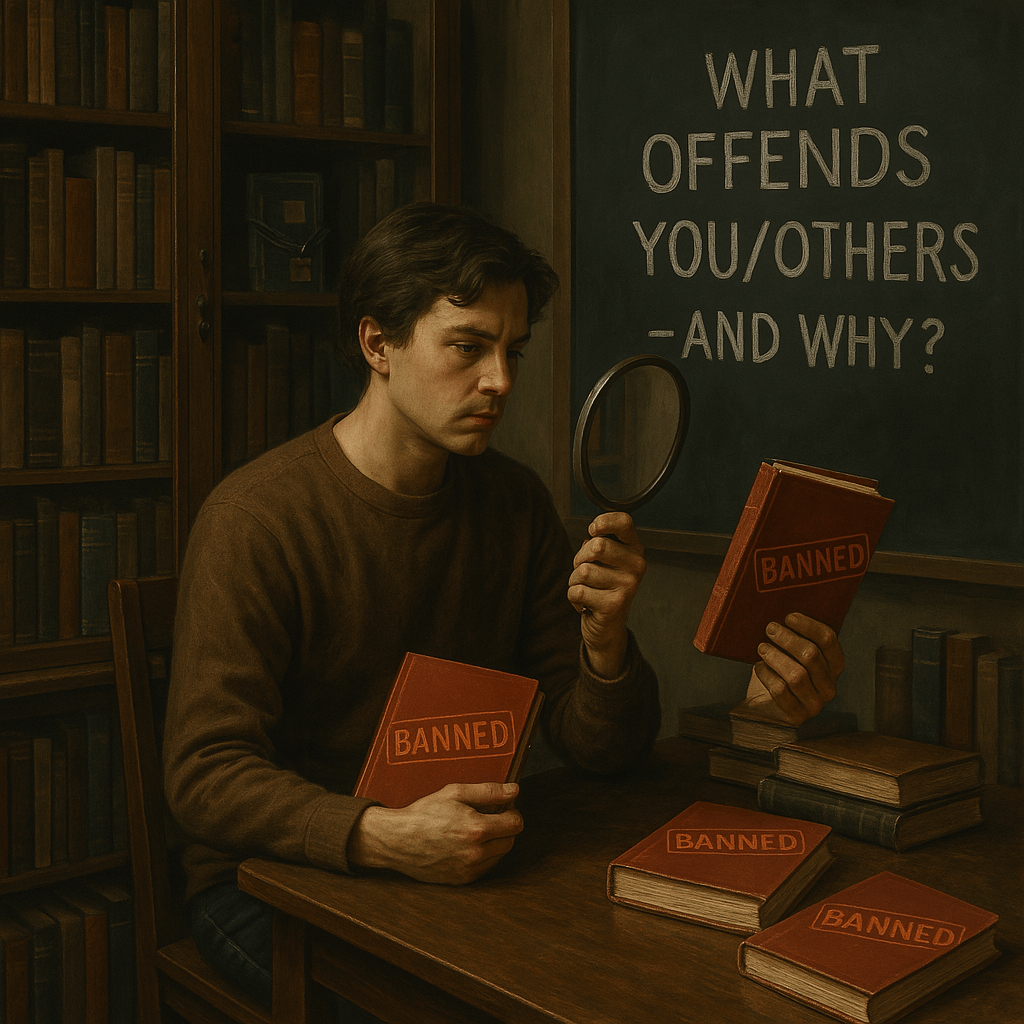
The activity made me think of close-mindedness. What are people close-minded about? What gets them offended, and why? What about me? What gets me offended? And why? It suggests we research when, where, and why books were banned.
Being born and raised in one country and spending several other years in another exposed me to different perspectives.

Before taking the challenge, I couldn’t think of any book I had read that had been banned, so I looked at the list of suggestions and picked one: Ray Bradbury’s Fahrenheit 451. I loved it! Books are burned, and people are turned into thoughtless creatures surrounded by their massive TV screens. This book was released in 1953.
My edition includes 100 pages of additional content about the book, and I enjoyed those pages almost as much as the story. When I found a graphic novel version of it, I read it too. When I saw a movie released in 1966 based on this story, you guessed it: I watched it too.
I also looked up videos online about the book and found illustrated summaries. Some comments in those videos caught my attention: some viewers watched the summary because they had an upcoming school test about the book, which they hadn’t read. Others did read the book but hated it because they had to. I could relate to that. I hated any book I was told I had to read in school.
Thinking about my school years, I remember one book I had enjoyed, even rereading it later as an adult. The English title is Captains of the Sands, by Brazilian author Jorge Amado. I hadn’t thought of that book in at least 30 years. When I looked it up, I discovered something I didn’t know: the book was released in 1937, when Brazil was a dictatorship. Shortly after its release, the book was banned, and several copies were seized in bookstores and burned in public squares. Fast forward to another period when Brazil was under a Military Dictatorship, 1964-1985, and the book is banned again. I was born in that period. I had forgotten about that.
I have an old but vivid memory of a quote I read in a book as a kid. I don’t remember the book. I don’t know how old I was. I remember the quote was the only thing on the page. It said, “Nação desenvolvida é povo que lê,” which translates into “A developed nation is a people who read.”
Here’s the list of so-called banned books I have read as of this writing since taking the Read to Lead Challenge:
- Fahrenheit 451, by Ray Bradbury
- 1984, by George Orwell
- Animal Farm, by George Orwell
- Brave New World, by Aldous Huxley
- The Alchemist, by Paulo Coelho
One of the songs I wrote during that period, Divide and Conquer, drew inspiration from that content. Check it out.


Leave a Reply