I’m preparing a one-hour presentation for my colleagues at Improving about travel—specifically, about what travel teaches us about ourselves. The title that emerged from the process is “Learning Who You Are by Leaving Where You Were.” But this post isn’t about the talk itself. It’s about how I’m using AI as a thinking partner in ways that feel genuinely useful.
Starting with Voice
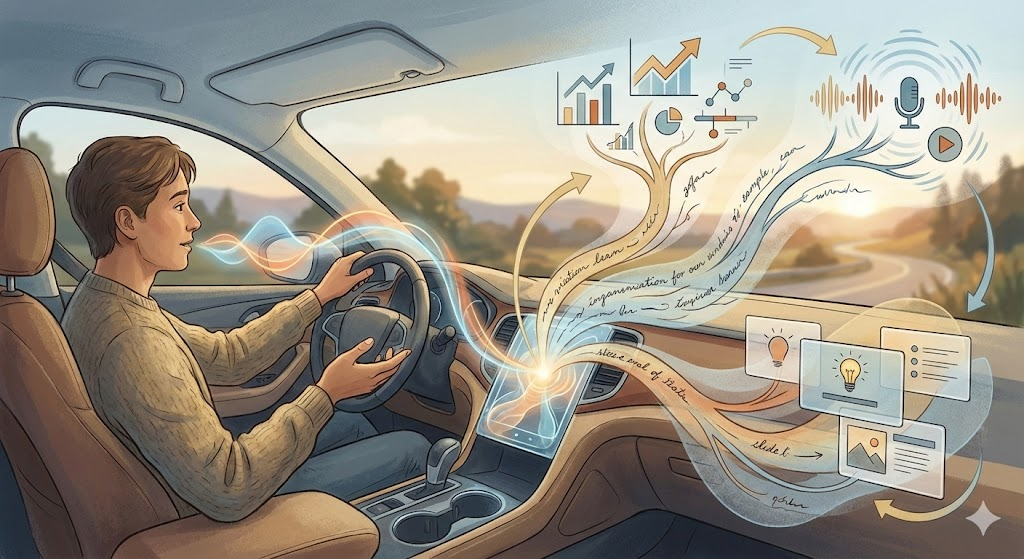
A couple months ago, when I signed up to give this talk, I spent 15 minutes voice journaling while driving. Just stories I normally tell people about my travels—moments that stuck with me, patterns I’ve noticed. I didn’t organize them. I just let them flow.
That transcript became the seed. I dropped it into NotebookLM and asked it to suggest titles and abstracts. The title it helped me land on—“Learning Who You Are by Leaving Where You Were”—immediately resonated. It captured something I’d been circling around but hadn’t quite articulated.
Using Every Feature to Think
When it came time to actually prepare the content, I used pretty much every feature NotebookLM offers. Not because I wanted to try all the tools, but because each one helped me think differently about the material:
- Infographics to see what themes emerged from my initial thoughts
- Audio overviews (the brief “elevator pitch” version, the deep dive, the longer form) to hear my own ideas reflected back in different ways
- Slides to identify what might be unclear or need more development
I’d listen to an audio overview while driving and take voice notes for new thoughts that came up. Then I’d feed those back in and generate new overviews. Back and forth like that.
The Dry Run
Eventually, I did a full dry run—just me in my car, imagining someone sitting next to me, walking through the entire presentation out loud. No slides, no notes. Just talking.
This was valuable in ways I didn’t expect. I could feel when I was rambling, when I was using too many words to make a simple point. I kept an eye on the time and realized I was only halfway through my stories but already 40 minutes in. Saying it out loud made the timing problems obvious in a way that outlining never does.
The whole thing took about 70 minutes. I knew I’d skipped stories I wanted to include, but I also knew where I was losing the thread.
What Comes Next
Now I’m going to take that recording, transcribe it, and feed it back into NotebookLM. But this time, I’m going to be much more specific with my prompts:
- For the brief overview: Help me tighten the core message
- For the deep dive: Expand on the stories that landed well
- For the debate: What hard questions might people ask about the points I’m making?
- For the critique: Focus on timing, pacing, and structure—how should I open, develop, and close?
I’ll also ask it to generate slide decks. I’ve done this before and been impressed—when I mentioned the Munich town hall and standing there alone on a rainy day, it created a photorealistic image that captured the mood.
These aren’t my personal photos, but they might work as placeholders while I tell the story—like a biopic where actors portray real people, then you see the actual photos during the credits. I might try that approach.
The Real Work
After I generate all these materials, I’ll export the slide deck and apply Improving’s branded templates. This will be good practice for streamlining content creation for future talks—figuring out how to move quickly from AI-generated drafts to polished, on-brand presentations.
But here’s what I keep noticing: the AI isn’t doing the work for me. It’s helping me think. Each audio overview surfaces something I hadn’t quite seen. Each infographic shows me where my ideas cluster. Each generated slide deck reveals which moments have visual weight.
The voice journaling, the dry run, the back-and-forth with the tool—it’s all just different ways of thinking out loud. The AI is a mirror that reflects my thoughts back in forms I can examine from new angles.
Why This Matters
I’ve been doing this kind of preparation for years, but usually it’s all in my head until I sit down to write slides. By that point, I’ve already committed to a structure that might not work.
This approach—voice journaling, feeding transcripts into AI tools, generating different views of the same material, doing dry runs, refining—lets me explore the shape of the talk before I lock anything in. It’s messier, but it’s also more honest. I’m not pretending I know exactly what I want to say before I’ve said it.
The AI amplifies my ability to think by giving me more ways to encounter my own ideas. That’s what makes it useful.
I’ll probably write another post after I give the talk—about how the preparation translated to the actual delivery, what worked, what didn’t. And maybe a separate post about the travel content itself. We’ll see.


Leave a Reply