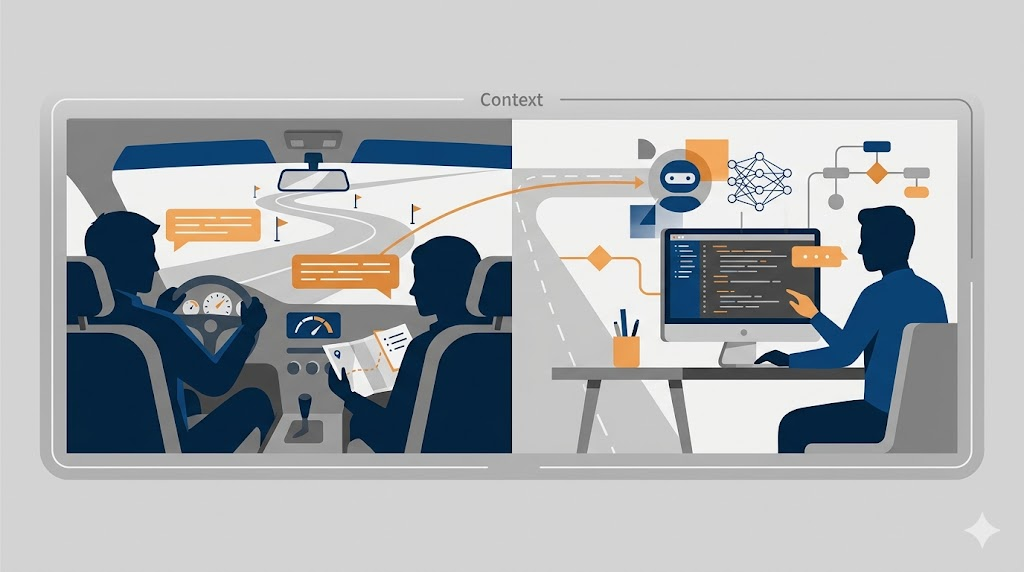
I’ve been circling back to something I wrote about earlier: the idea that what looks like multitasking is often just different parts of the same context working together. A drummer plays different rhythms with each limb, but it’s all one song. A guitarist sings while playing, but it’s the same piece of music. Try to play one song with your hands and a completely different one with your feet? Not happening.
That constraint isn’t a bug. It’s how context works.
The Phone Call vs. the Passenger
The book The Invisible Gorilla explains why talking on the phone while driving is more dangerous than talking to a passenger. It’s not about distraction in the way most people think.
When you’re on the phone, the person on the other end exists in a completely different context. They can’t see the road. They don’t know you just merged into traffic or that the car ahead is braking hard. The conversation pulls you into their context, which has nothing to do with the one you’re actually in.
A passenger, though, is sitting right there with you. They see the same road, the same hazards. If something goes wrong, they can stop talking or even call it out. They’re in the context that matters.
But here’s the catch: if both of you are deep in a conversation about something unrelated to driving, you can both drift out of the context that actually matters. Neither of you is fully present in it anymore.
The Rally Racing Model
This made me think about rally racing. I’ve never done it in real life, only in video games, but the structure is clear.
The driver is at the wheel, focused on the road immediately ahead. The navigator sits beside them with the map, calling out what’s ahead: sharp left, crest, hairpin right. The driver can’t see those things yet, but they have to trust the navigator completely. And the navigator, without a driver, goes nowhere. The car doesn’t move.
Both roles are essential. Both are operating in the same context: getting the car through the course as fast as possible. The driver handles execution. The navigator provides information that the driver doesn’t have access to yet.
It’s not multitasking. It’s a collaboration within a shared context.
Where Does AI Fit?
I started wondering how this maps to working with AI tools.
When I’m building something with an AI, we’re both operating in a shared context: the problem I’m trying to solve, the codebase I’m working in, the constraints I’m under. But who’s the driver? Who’s the navigator?
Is the AI calling out what’s ahead, things I can’t see yet because I’m focused on execution? Or am I the one providing the map while the AI does the driving?
Maybe the roles shift depending on the task. Maybe it doesn’t matter who’s in which seat as long as we’re both in the same context.
But here’s what I do know: if the AI and I aren’t operating in the same context, the collaboration breaks down. If I’m thinking about one problem and the AI is solving a different one, we’re like the phone call and the driver. Disconnected. Dangerous, even.
Defining the Context
So how do we define that shared context?
In rally racing, it’s clear: the course, the car, the goal. In software development with AI, it’s murkier. Is it the user story? The codebase? The constraints? The mental model I’m holding about how the system should work?
I think it’s all of those things, and maybe more. And I think the human’s job is to make sure the AI knows what context we’re operating in. Not just the task, but the why behind it, the constraints, the things that matter.
The AI’s job, maybe, is to provide information I don’t have access to yet. Patterns in the code I haven’t noticed. Edge cases I haven’t considered. Solutions I wouldn’t have thought of on my own.
But if I don’t trust the AI’s information, or if the AI doesn’t understand the context I’m in, we’re stuck.
Still Figuring It Out
I don’t have a clean answer here. I’m still building the mental model.
But I think the rally racing analogy helps. It reminds me that collaboration isn’t about one person (or one system) doing everything. It’s about two entities operating in the same context, each contributing what the other can’t see or do alone.
And it reminds me that context is everything. Without it, we’re just two people on a phone call, talking past each other while the car drifts off the road.



Leave a Reply