I wrote recently about how you can’t play one song on guitar while singing a completely different one. You can play and sing, but it has to be the same song: the same context. That constraint stuck with me, and it’s been reshaping how I think about working with AI agents.
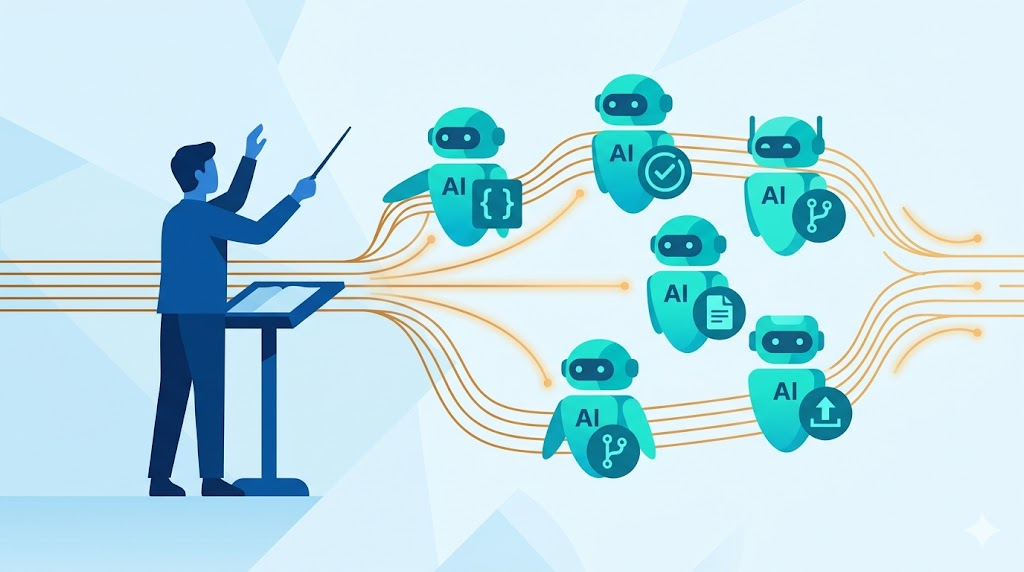
People keep saying developers are becoming “orchestrators” now. We orchestrate the work, and AI agents execute it. That sounds clean on paper, but when I actually sit down to think about what orchestration means (really means, from a music standpoint), the metaphor gets a lot more interesting.
What Orchestration Actually Involves
When I think of an orchestra, I picture several musicians playing their individual instruments. They play together in a synchronized manner, respecting each other’s moments according to the piece of music. Some players pause. Some come in strong. It’s all written in the score.
But here’s what I didn’t fully appreciate until recently: orchestration and conducting are not the same thing.
The orchestrator works in isolation, looking at the entire piece. They decide which instruments carry which lines. Should this melody be a solo flute or a wall of brass? How do the different parts connect? That’s orchestration: designing the system.
The conductor comes later. Once the piece has been orchestrated, someone has to stand in front of the musicians and guide them through it in real time. The conductor doesn’t play an instrument. They ensure every musician plays in time and with the right expression. They manage the performance as it unfolds.
So if we say developers are now orchestrators, what does that actually mean? Are we designing the system, or are we executing it? Or are we doing both?
Three Roles, One Developer
As I’ve been working with AI agents on real projects, I’ve noticed I’m playing three roles at once:
The Composer: I define the intent. What are we building? Why does it matter? What problem are we solving? The AI can help me brainstorm or draft requirements, but I’m the one who decides what the “piece” is about. I’m the source of the original vision.
The Orchestrator: I design the system. Which agent handles coding? Which one writes tests? Which one manages documentation? I’m choosing the instruments and deciding how they work together. I’m designing the flow and the hand-offs.
The Conductor: I guide the execution in real time. I monitor the agents’ “performance”. When a sub-task goes off-key or the logic drifts from the requirements, I step in. I provide a continuous feedback loop.
Some conductors can conduct an orchestra while playing the violin. That’s what this feels like. I’m not just directing. I’m collaborating with the AI agents throughout the entire process: composing, orchestrating, playing, and conducting.
It’s a shift from writing lines of code to directing a technical performance.

Context Is the Score
The most critical insight in this model is the piece itself.
In an orchestra, every musician (regardless of their instrument) is looking at the same musical score. You cannot have the violins playing Mozart while the cellos play Metallica.
In software development, context is the score.
Whether an agent is writing a unit test or refactoring a service, it must be operating within the same shared context of the codebase and the project goal. If the context is fragmented, the music turns into noise.
This connects directly to what I wrote about multitasking and multithreading. Your brain can’t multitask, but it can multithread, as long as the threads are woven into the same context. The same principle applies here. AI agents can work in parallel, but only if they’re all playing the same song.
When I’m working on a feature, I can have one agent drafting code, another writing tests, and another updating documentation, but only if they’re all working from the same understanding of what we’re building. The moment one agent drifts into a different context, everything breaks down.
Who Sets the Tempo?
Here’s where the metaphor gets tricky.
In music, there’s a tempo that everybody follows. The conductor sets it. The musicians respect it. But in software development, who sets the tempo? Who decides when to speed up or slow down?
Is it the human developer? Is it the AI agent managing the workflow? Is it the project deadline? Is it the pace of learning and discovery?
I don’t have a clean answer yet. What I’m noticing is that the tempo isn’t fixed. Sometimes I’m conducting the agents, keeping them in sync. Sometimes I’m letting an AI agent take the lead on a sub-task while I supervise. Sometimes I’m stepping back to re-orchestrate because the original design isn’t working.
The tempo shifts depending on where we are in the piece.

The Role of the Modern Developer
The reality of AI-assisted development is that the human developer is no longer just a “player” (someone who writes code). We’re often playing all three roles simultaneously: composing the vision, orchestrating the workflow, and conducting the execution.
And that requires a different kind of skill. It’s not just about knowing how to code. It’s about knowing how to design systems, guide collaboration, and keep everything aligned with the same context.
It’s about understanding that the agents aren’t replacing us. They’re instruments in an orchestra we’re conducting.
And the music only works if we all play the same song.






Leave a Reply