As a visual thinker, I need images to anchor meaning. When I encounter a word I don’t fully understand, I can see the word itself floating there in my mental picture, disconnected, with no image behind it. That gap makes it harder to connect the word to everything else I know. The surrounding picture exists, but the word just sits there.
That’s where I found myself with the word insight.
The Problem with “Insight” in Portuguese
A while back, I was working through the data-to-impact spiral: data, information, knowledge, insight, wisdom, impact. It’s a concept I return to often. I wanted to be able to explain it in Brazilian Portuguese, so I turned to AI for help.
First, I asked a simple question: what’s the word Brazilians use for “insight”?
The answer was a list of options:
-
Percepção (perception, clear understanding)
-
Discernimento (discernment, judgment)
-
Perspicácia (perspicacity, acumen)
-
Introspecção (introspection, self-insight)
-
Ideia (idea, glimpse)
Each one made sense. The explanations were clear. But when I then asked AI to explain the data-through-impact idea using only Portuguese words briefly, this is what came back:
O conceito descreve a jornada que leva os dados através da informação, conhecimento, insight e sabedoria, culminando no impacto positivo.
It used the English word insight anyway. Not because it was wrong — it’s very common to see English borrowed directly into Brazilian Portuguese in business and technology contexts. But it told me something: even the language itself doesn’t have a clean native substitute. The concept doesn’t map neatly to a single Portuguese word.
That only deepened my curiosity.
The Gorilla That Was Always There
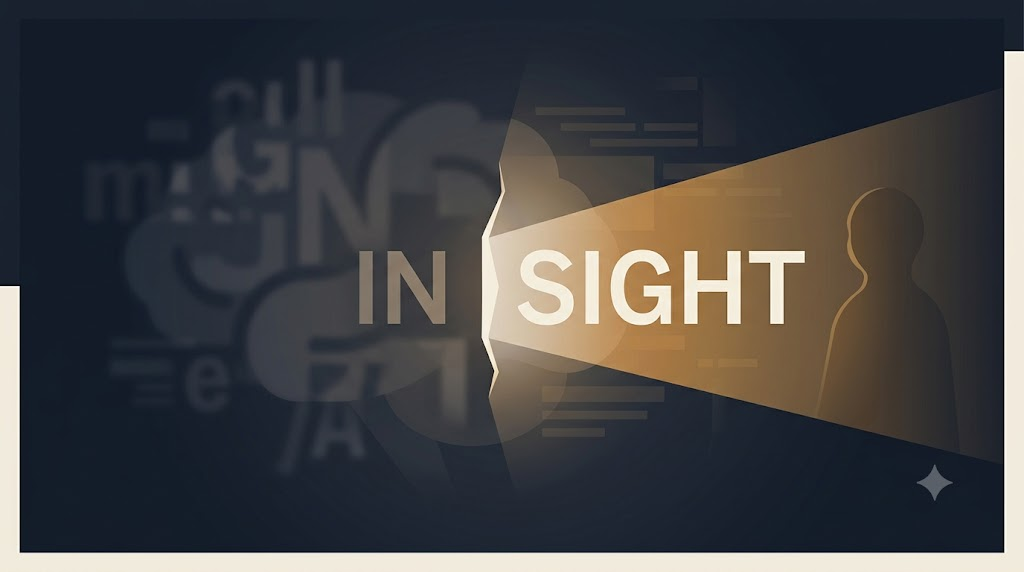
In sight.
Two words, hiding inside one. That split opened up the image I’d been missing.
Think about the invisible gorilla experiment. Participants are asked to count how many times players in white shirts pass a basketball. While they’re focused on that task, a person in a gorilla suit walks through the middle of the scene. Most people don’t see it. Not because the gorilla isn’t there, but because it isn’t in their sight. Their attention is pointed elsewhere.
When someone finally reveals the experiment, and you watch the video again, the gorilla is suddenly unmissable. It was always there. The data was always there. But now it’s in sight.
That’s what insight actually means in the spiral from data to impact. Going from data to information to knowledge builds the foundation, but insight is the moment when something that was previously invisible becomes visible. Not new information, but a new connection. The gorilla walks in.
Seeing Through Different Languages
Failing to find a Portuguese equivalent forced me to slow down and examine what the word actually means. The search for a translation became an act of reflection.
I’ve noticed this with other words too. Some concepts in Portuguese have layers of meaning that English flattens. Some English words carry connotations that Portuguese simply doesn’t have a container for. That gap is uncomfortable, but it’s also rich. It makes you stop and ask: what am I actually trying to say here?
Thinking in multiple languages, at least to the point where you can genuinely reason in them rather than just translate, opens up angles you wouldn’t otherwise see. Each language carves up meaning a little differently. Each one is a slightly different lens.
What I’m learning is that the moments when language fails are often the most interesting ones. They’re the moments when something that was always there finally becomes in sight.





Leave a Reply