
Most self‑assessments are based on vibes.
You sit down with a questionnaire, read a series of questions about your skills, and check the boxes that feel about right.
But memory is a leaky bucket.
We tend to overestimate what we do consistently, conflate what we want to do with what we actually do, and fall victim to recency bias.
If we want to grow, we need something better than vibes. We need evidence.
When I started evaluating my place on Improving’s eight‑stage AI maturity scale, I wanted to avoid the “vibe check” trap. I did not want to guess whether I was at a Stage 2 or Stage 3. I wanted to prove it.
So, I built a multi‑agent AI pipeline to run the assessment for me.
The Evidence Base: What We Leave Behind
You cannot evaluate what you do not document.
The key to this entire workflow is not the AI. It is the trail of evidence we leave behind during our normal work day.
If you are already practicing “Learning Out Loud,” you are already producing this evidence. In my workspace, that trail of text is dense:
-
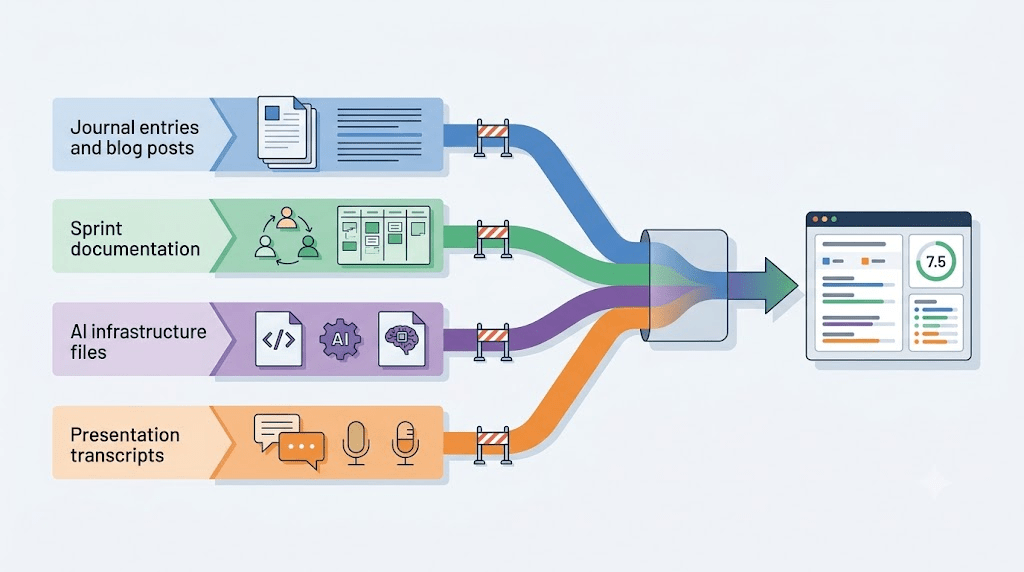
Daily Journal Entries: Raw notes of my daily experiments, successes, and frustrations.
-
Blog Posts: Drafts and published articles refining what I have learned.
-
Sprint Documentation: Daily scrum transcripts, sprint review scripts, and lessons learned documents.
-
IDE Infrastructure: The
.devin(or.windsurf) skills, workflows, and plan files inside my code repositories. -
Transcripts: Meeting recordings and presentation transcripts.
This is the raw material. The pipeline connects the dots.
The Multi‑Agent Pipeline
To turn this raw pile of text into an objective assessment, I designed a multi‑agent workflow using Devin Desktop.
Five agents. Four gather evidence in parallel. The fifth consolidates and scores the final output.
It may sound complicated, but it is only a Markdown file with 202 lines of instructions.
It started as a conversation I’ve had with Devin; I added folders to a workspace and gradually told it to analyze them. Some of the folders are subfolders in my Obsidian vault. Once I got the first assessments and summary, I prompted Devin to turn that into a multi-agent workflow I could run every month.
Agent A: Journals & Blog Posts
This agent filters my personal journaling files and blog posts from the last 30 days. It looks for personal usage patterns, specific tools used, and individual reflections. It does not write summaries. It pulls exact quotes, dates, and file paths.
Agent B: Sprint Documentation
This agent scans our project sprint documentation. It looks for collaborative behaviors. It analyzes how we onboard team members, how the team is adopting shared workflows, and what governance decisions were made during sprint reviews.
Agent C: Project AI Infrastructure
This agent does not read prose. It inspects files in my active code repositories. It looks at our .devin/skills/ and .devin/workflows/ directories, analyzing whether our automation is built as single‑file prompts or structured, multi‑file reference libraries.
Agent D: Presentations & Transcripts
This agent focuses on knowledge transfer. It searches for transcripts, like our internal or external talks, to find evidence of mentoring and coaching others.
Agent E: The Consolidator
Once the first four agents complete their work, the consolidator steps in. It reads our latest questionnaire rubric, maps the gathered evidence to the 21 questions, and scores each dimension.
But the consolidator has a critical job before writing the final files: it runs strict quality gates to keep the other agents honest.
flowchart TD

Start[Devin Desktop] --> Devin[Start Workflow]

Devin --> Parallel{Parallel Analysis}

Parallel --> A[Agent A
Journals & Blog Posts]

Parallel --> B[Agent B
Sprint Documentation]

Parallel --> C[Agent C
AI Infrastructure
Skills, Workflows, Plans]

Parallel --> D[Agent D
Presentations & Team Transcripts]

A --> EvidenceA[Evidence A]

B --> EvidenceB[Evidence B]

C --> EvidenceC[Evidence C]

D --> EvidenceD[Evidence D]

EvidenceA --> Consolidate

EvidenceB --> Consolidate

EvidenceC --> Consolidate

EvidenceD --> Consolidate

Consolidate[Agent E
Consolidates Evidence] --> Questionnaire[Answers Questionnaire]

Questionnaire --> Output[Scored Assessment & Summary]

Output --> End[End Workflow]

style Parallel fill:#e1f5ff

style Consolidate fill:#fff4e1

style Questionnaire fill:#e8f5e9

style Output fill:#f3e5f5
Enforcing Reality over Intent
AI is eager to please. If you ask it to grade your work, it will give you an A. Every single time.
To prevent this, the Consolidator uses strict quality rules:
-
The Double‑Source Rule: Any score above a B must have at least two distinct, concrete pieces of evidence from different sources. If only one piece of evidence exists, the score gets downgraded.
-
The Automation Gate: We do not count automated pipeline gates unless they demonstrably trigger on feature branches, not just on master.
-
Fluency over Artifacts: The presence of a sophisticated 1,200‑line workflow file does not mean the team has adopted it. The agent must find evidence of independent use by team members.
These rules bridge the gap between design intent (what we want the tools to do) and execution reality (what we actually do consistently).
The Output: Scores and Gaps
The pipeline generates two markdown files:
-
The Full Assessment: Detailed, question‑by‑question scoring with direct citations.
-
The Summary: A high‑level dashboard showing the total score, maturity stage, and our largest gaps.
When I ran this in May, the pipeline gave me a total score of 69 out of 84.
I did not trust that number. It felt too high. The AI was probably still being nice. But the score did not matter. The gap analysis did.
The summary clearly pointed out that while my personal workflows were highly sophisticated, my output evaluation and team fluency were lagging behind.
I did not have to guess what to work on next. The pipeline gave me a clear, prioritized roadmap.
Closing the Loop
There is a neat symmetry to this.
We use AI to measure our own maturity in using AI.
It is a practical, demonstrable meta‑workflow. It turns self‑assessment from a subjective chore into a repeatable, data‑driven engineering practice.
This is the kind of concrete story I will be sharing in part two of my AI maturity series, and it is a great candidate for an upcoming talk.
Because the best way to trust your AI tools is to build systems that hold you—and them—accountable.


Leave a Reply