Matthew and I kick off episode 26 with a simple question about cost. I’ve been running local models through LM Studio before paying for cloud ones. That small habit opens a much larger conversation about constraints, creativity, and how differently two minds can approach the same problem.
We record on a Thursday morning at the Improving office, two people trying to make sense of tools and thinking patterns. By the end, we’re talking about meetings, visual thinking, and why an hour on the calendar may be the worst possible unit for a good idea.
Cheap Models First
I tell Matthew I had LM Studio installed for months but never touched it. The interface felt clunky. Everything I needed came from ChatGPT, Gemini, or the other web tools.
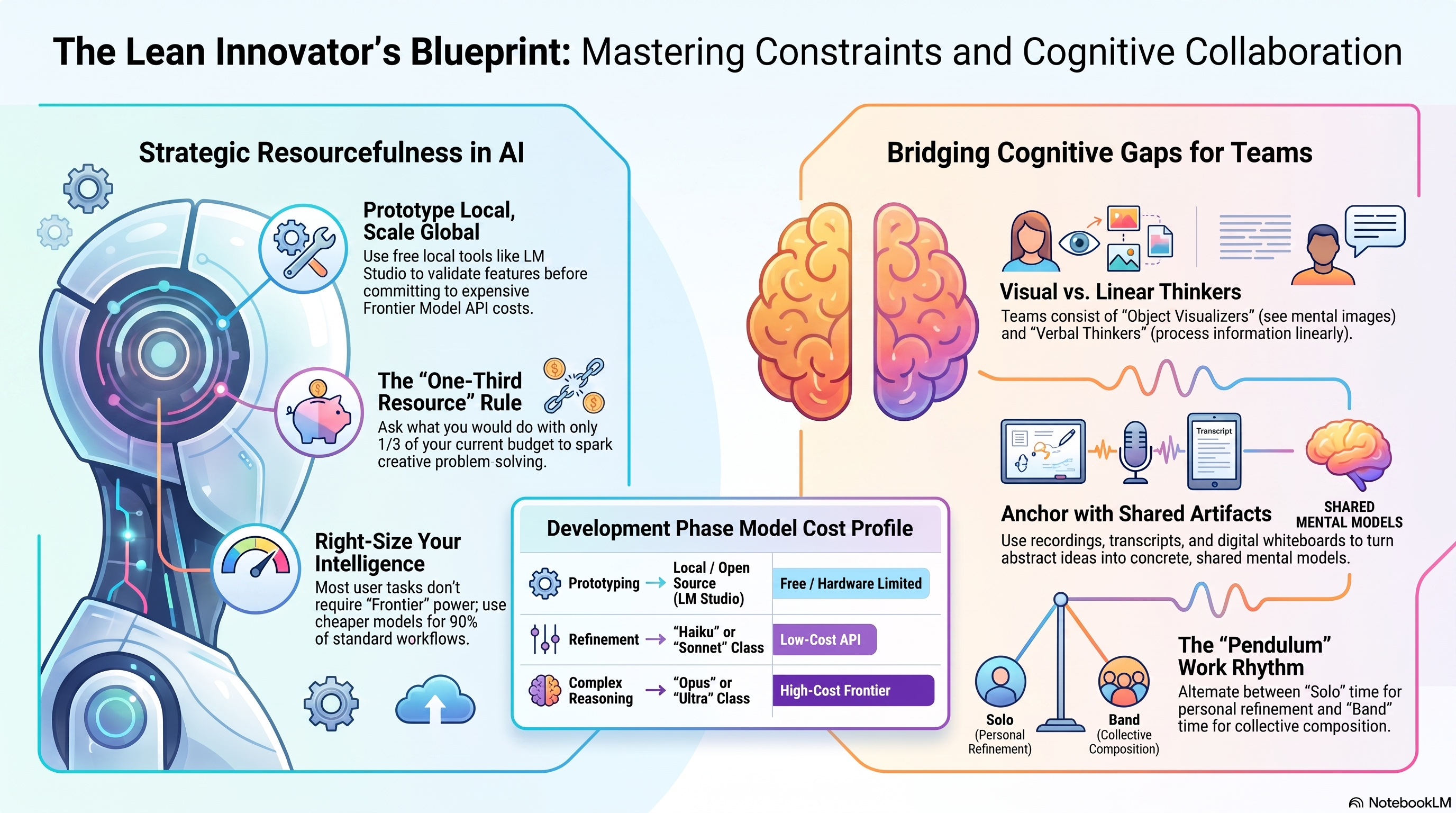
Then I want to prototype an AI feature in an app. Every cloud path points back to Azure AI Search and a pile of setup pain. So I try the local model. It is slower. It is weaker. But it is enough. I can prove the idea without spending tokens. If the prototype works, I flip a setting and move it to the cloud.
Matthew sees the opposite everywhere: people reach for Claude Fable or the newest frontier model before trying anything cheaper. Sometimes the problem genuinely needs that power. More often, it does not. If you never test Haiku or Sonnet against your use case, you are not solving the problem. You are outsourcing your judgment to the highest price tag.
He points out that most users ask ChatGPT to plan trips or review pitch decks. Those tasks do not require a frontier model. The current lineup is overkill for most day-to-day work, and the price gap is real.
Constraints as a Budget
This month, we get a dashboard at work that shows our AI token spend by project. It changes how I use tools. I can now see where the tokens go and connect that to actual output.
I adopt a mental exercise I heard from Tim Ferriss. If I think I need a $10,000 budget, what would I do with $3,000? The constraint forces a different kind of thinking. I switch to the free model for almost everything. When it stalls, I refine my prompts, write a small script, or break the problem into smaller pieces. The result surprises me: much of what I build this month still runs on that free model.
Matthew compares it to grocery shopping. If you only have room in the budget for the month, you cannot buy the best steak for every meal. You buy what you need, and the constraint makes you a better cook.
Creativity Grows Under Limits
We land on a pattern. The Chinese AI market has operated under hardware embargoes and chip shortages. That pressure produces innovations like mixture-of-experts and distillation. They cannot just buy the best NVIDIA cards, so they have to get more out of what they have.
I bring up the immigrant experience I have watched for over two decades. People who grow up with scarcity learn to solve problems when the process breaks down. They follow the rules, then get creative. Matthew expands on this. In the U.S., abundance can cover for a lack of creativity. Throw money at it is a reflex. When the money runs out, the reflex fails.
This is not nostalgia for hardship. It is a reminder that constraints build a muscle. Necessity teaches you that the problem does not disappear when resources do. You just need a different path to the destination.
Some Minds See the Boxes, Others See the Pieces
The conversation turns to a tension I have been sitting with. Some people look at my process and see structure. Others look at the same process and see a mess. Why?
Matthew has a name for part of it: Temple Grandin’s distinction between verbal, linear thinkers and visual, object thinkers. Verbal thinkers string words together in order. Visual thinkers hold images and rearrange them like Lego blocks. They see the pieces, not the rulebook.
Matthew describes his own mind as a la carte. When he sees my process for writing or preparing a talk, he does not copy it step for step. He takes what he needs, leaves the rest, and builds something new. He spent years developing this out of necessity. As a child, without the toys he wanted, he learned to imagine them.
I realize this is why the same instructions land differently. For a linear thinker, a process is a sequence. For a visual thinker, it is a set of components. Neither is broken. They are just different operating systems.
Making Meetings Work for Both Thinkers
That difference makes most hour-long meetings awkward. Linear thinkers can name the next step before the idea has fully formed for visual thinkers. The meeting ends with a decision that looks solid in the moment but may not be the best one.
Matthew uses a music analogy. A musician does not practice a solo while the whole band is playing. The band agrees on the song, then everyone goes off to work on their part. The same should be true for teams. Use the meeting to set the baseline. Let people think alone. Come back with better parts.
We imagine a future where an AI agent listens to the meeting and draws a shared picture on a screen in real time. Both kinds of thinkers can point to the same visual and ask, “Is this what you meant?” That shared artifact would catch misinterpretations early instead of letting them travel downstream.
The Cost of Shared Understanding
We keep circling back to language. The same phrase can mean different things to different minds. Matthew mentions a manager whose meetings he records. They are on the same page, but they are reading different books.
A line like “pass me my glasses” could mean eyeglasses, drinking glasses, or something else entirely. Context helps, but only if both people share the same context. And context drifts. By the next day, the agreement may no longer hold.
The real cost of collaboration is not the meeting itself. It is the invisible work of building and rebuilding shared understanding. The better we get at making that visible, the less time we waste solving the wrong problem.
What I’m learning is that constraints and differences are not obstacles to fix. They are information. Cheap models reveal what a problem actually needs. Diverse thinkers reveal angles I would miss. The work is learning to make those differences visible and useful.
Watch the full conversation to hear Matthew’s music analogies, his childhood Lego-block imagination, and why an AI-generated meeting sketchpad might be closer than we think.






Leave a Reply