
In September 2016 I wrote a short post called “Time for me to Improve.” The pun was intentional, if a little cheesy. I had just joined Improving full-time, after a couple of years of contract work with the company in Brazil and Argentina, and I was looking forward to working with people I already knew from conferences and user groups. I ended the post by saying I was ready to “Improving myself as a professional and a person.” I did not know I was naming the next decade.
Ten years is a long time in software. It is long enough for tools, frameworks, and job titles to cycle through more than once. It is long enough to forget which version of Angular you were angry about. But a decade at one company is not a measurement of endurance. It is a measurement of fit. The relationship has to keep fitting, or it stops.
For me, the numbers caught up with the story on April 5, 2025. That was the day Improving became my longest-running employer: 3,133 days, matching the previous record I had set in 2011. I noted it privately on my Now page and did not blog about it.
The Origin
I first noticed Improving around 2007, the way most people first notice a company they later join. I was at conferences, sitting in the back of sessions, refining my own talks, and the presentations that consistently made me put my laptop down were being delivered by Improvers. That was my first clue that my interests and theirs overlapped.
In 2008, I gave a talk at a user group in Harrison, Arkansas. A group of developers drove hours to attend. We stayed in touch. Years later, one of them moved to Houston to start Improving Houston, and our connection continued. When I tell that story, people sometimes call it networking. It does not feel like networking. It feels like the long consequence of showing up to small rooms and sharing what you know.
By 2014, I was living between the United States and Brazil when an email about a Ruby on Rails project turned into an opportunity to interpret for an Agile training in São Paulo. The timing was right, and that work led to more training and consulting with Improving. When I returned to the U.S. in 2016, I did not look anywhere else. I had already tested the fit.
The threshold that changed things
Anniversaries invite you to look for turning points. One of mine came in 2019. In June of that year I became a technical director. A month later, in July, I was taking Improving’s Integral Business Program, an invite-only course. Titles have never been the thing that motivates me, so I accepted the director role for the same reason I accept most things: it expanded the range of impact I could have. The course, though, did something different. It gave me a set of tools around productivity, focus, and time management that lined up with practices I already cared about, but sharpened them.
The effect showed up in my involvement data. My quarterly activity spiked during IBP. There is a watermark on my involvement chart from that period, and almost everything after it sits above that line. Before IBP, my involvement fluctuated. After IBP, it found a new floor. That is not because the course made me busier. It made me clearer about what to say yes to.
 Each dot is a quarter. After IBP, the watermark stays above the earlier baseline.
Another view of the same shift is my education and coaching activity over the years. Before mid-2019, the weeks where I was teaching, mentoring, or coaching are scattered. Starting in Q3 2019, the boxes start filling in almost every week. The empty ones are mostly vacations.
 One box per week. The darker pattern after Q3 2019 is the IBP threshold in action.
A few months ago, in January, I learned that I am in the Involvement Lifetime Top 5 Improvers group. I knew I was involved. I did not know I was that high on the list. The number is nice, but what it represents is the part I care about: a decade of small yeses stacking up.
The balance of impact
One thing I like about Improving’s involvement program is that it produces data you can reflect on. In my nine-year retrospective, my involvement broke down to roughly 68% internal impact and 32% external impact. Coaching, mentoring, leadership, and community-building inside the company made up the larger share. Talks, blog posts, client engagements, and community events made up the rest.
That balance still feels right. It reflects the belief that the most useful thing I can do externally is grounded in what I am learning internally. The company has programs that make that easier, not harder: Come Together, ImprovingU, PATH, Trust Pods, the Learning Circle. Sometimes we may overwhelm newcomers with the sheer number of programs, but I would rather solve the problem of too many good things than the problem of none at all.
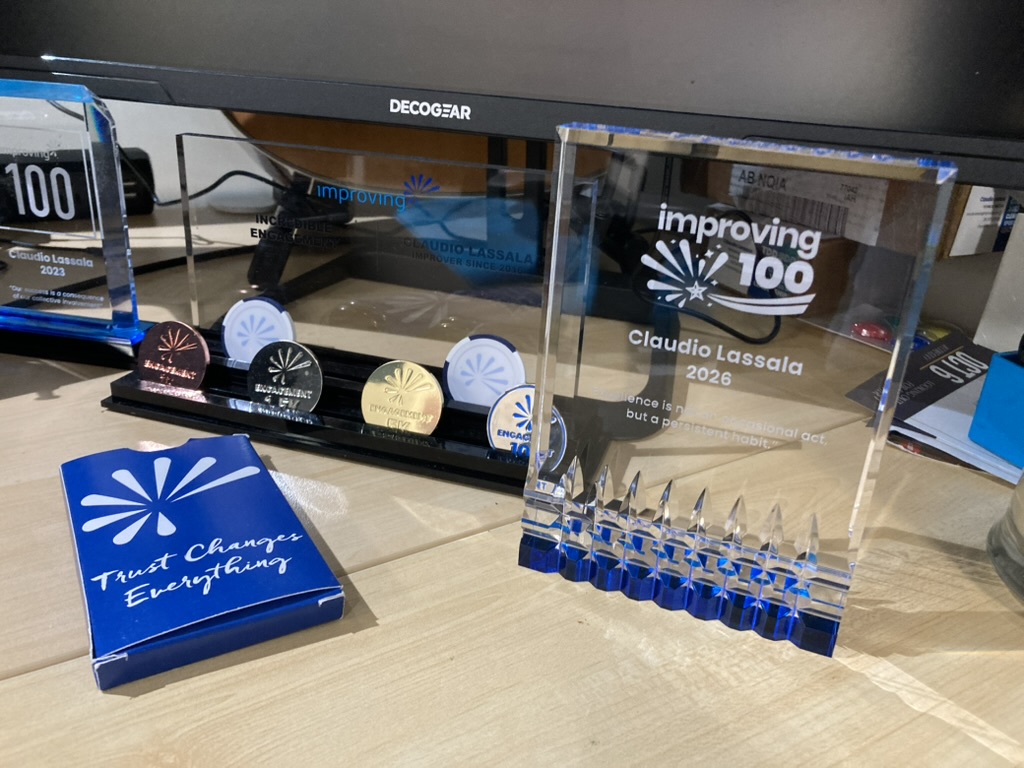
Recognition has shown up along the way. I was honored to be nominated by my fellow Improvers for the Improving100 recognition in 2023 (for Community Impact) and in 2025 (for Technical Innovation). Those are not the reason I stay, but they are useful checkpoints. They tell me that the things I value are visible to other people too.
Looking ahead
Last year, in my nine-year post, I wrote that I wanted to continue shaping culture, formalize and share frameworks for coaching and productivity and AI adoption, and expand my impact as a mentor and thought leader. Year ten has delivered on all three. The frameworks I was trying to make explicit have become talks, tools, and working prototypes. The mentoring has expanded into product work and team coaching. The AI adoption has moved from personal experimentation to something the company is building around.
Ten years in, I still believe the best thing Improving does is bet on its people.




Leave a Reply