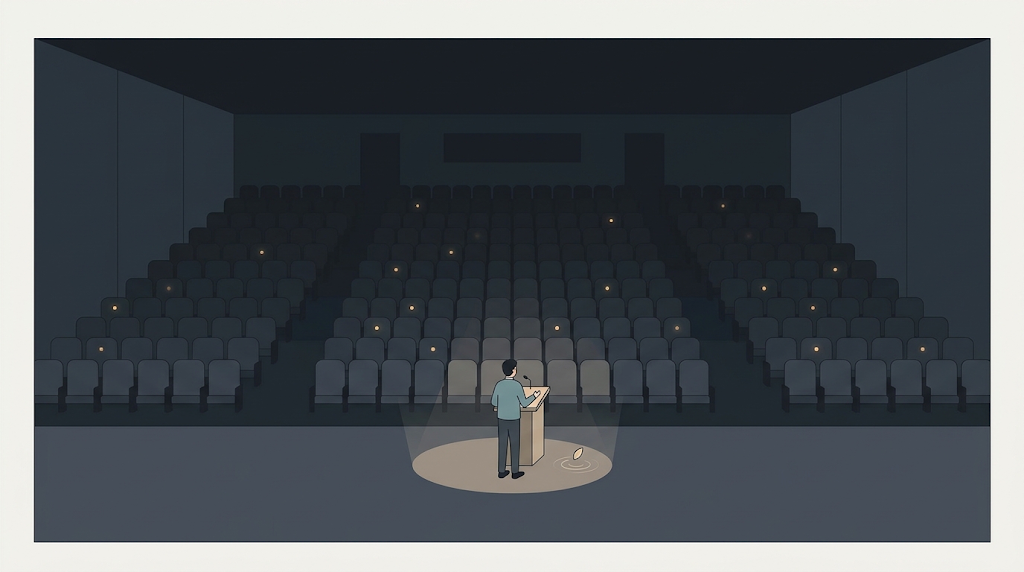
I remember the room. I had prepared for weeks, cut a talk down until every slide had a reason to be there, rehearsed the transitions until I could feel the rhythm instead of just hearing it. When I stood up and delivered it, there were no questions. No hands raised. A couple of polite nods, then the meeting rolled on to the next agenda item. For a long time, that silence bothered me. I read it as a verdict. I had put all that effort in, and it fell flat.
It took me a long time to learn a different way to read that silence. The quiet was never about me. It was just quiet.
The question nobody had asked out loud
During the Lunch & Learn we held for my tenth anniversary at Improving, an Improver on the call asked me the thing directly. They said, roughly, you always share, you always want to see others grow, you learn something, and you teach it the next day. So how do you deal with the apathy and the lack of motivation of others, when you prepare something, you put a lot of effort into it, and at the end of the day you do not get the engagement you expected?
What I can actually control
Most of the answer came to me from reading about Stoicism over the last several years. The core idea is simple, and accepting it took a while. You can only do what you can do. You only control what is in your control.
When I learn something and I want to share it, the only things in my control are the preparation and the offering. I can make sure I have prepared as much and as well as I could. I can let people know what I am going to do. I can put the thing out there and deliver it as well as I know how. That is the whole list.
Whether it lands with people, whether they feel moved by it, whether they actually take action afterward, none of that is in my control. It was a hard idea to accept, because I used to take it personally. I used to feel like I had failed. Detaching from that way of thinking changed the entire relationship I have with sharing. I wrote about that side of things more in Time, Presence, and the Speed We Choose, about choosing how fast you move through the parts of life you can influence and letting the rest be.
The test I run now is simple. Can I look at myself and honestly say I have done everything I could? Is there anything I left on the table? And most of the time the answer is no, I gave it everything I had. Here it is, take it, make it your own. If I can say that and mean it, my mission is done. The reaction is not the mission.
Inspiration will go away
The other thing I have learned is that people will tell you the nicest things after a talk or after reading a post. Someone will come up and say, the way you shared that made me feel so inspired. I am always grateful for that. I have been blessed that people say that to me.
But I try to remind people of this, including myself. Inspiration is fine, and inspiration is temporary. It will go away. The most important thing is what you do while you are inspired. As you are inspired, ask yourself what you now aspire to. Is it something that will actually make you take action?
Being inspired is cheap in a way. There is always something inspiring to see. A good book, a great talk, a teammate doing something bold. The inspiration is everywhere. The question is whether it moves you into aspiration, into the thing you actually want to build or become. I wrote about exactly this in The Goal Is to Take Action Now, about how inspiration is nice but not reliable, and how the goal has to be the action, not the feeling.
Do not rely on motivation
That connects to the third piece, which I think is the most practical. Do not rely on motivation.
Motivation comes and goes. Some days you wake up and you want to do the work. Other days you wake up and you want to do anything but the work. If I only did things when I was motivated, I would not do very much, because I am not always motivated. Nobody is.
What actually brings growth is what you do when you are not motivated. That is the whole trick. The days you show up anyway are the days that compound. The days you write the post anyway, make the call anyway, practice the thing anyway. Those are the days that add up over a year, and over ten years.
So when I share something and it does not land, I do not read too much into the momentary reaction. I did my part. I prepared, I offered, I delivered. Whether the person in the quiet room acts on it later is between them and their own motivation. And if they do not, that is not a judgment on the work.
People are always listening
There is one more thing worth saying, because it is the reason I keep sharing even when the room feels flat.
A while ago I received nominations for an internal recognition program, and reading the comments that came up with them surprised me. People described talks I had given and posts I had written that I had assumed nobody cared about. I remembered giving those talks and hearing nothing. No applause, not even a like on the post, just silence.
But people had been listening the whole time. They just had not said anything at the moment. Then, months later, I got the email, or the hand wave, or the comment in a meeting. Oh, that thing you did. I thought about it for a long time, and then I actually did it. I just did not tell you because it felt too small to mention.
That is the whole reason the quiet room does not scare me anymore. Silence is not the same as nobody listening. People are always listening; they just may not say it at the time. So when someone shares something that makes you think, and especially if it makes you act, let the person know. It matters a lot, more than you realize. It is the feedback that keeps the sharers going.
The quiet is not my problem to solve. My job is to prepare well and offer well, and then let go. Inspiration will come and go, and motivation will come and go, and neither of them is a reliable foundation for anything. The reliable thing is the habit of showing up, and the willingness to keep offering even when the room does not clap.





Leave a Reply