Matthew and I had been away from the microphone for a while. Vacations, trips, PTO. When we finally sat back down, something in the logs caught my eye: we had started Reflective Practice Radio over a year ago. Twenty-eight episodes in, and it went by fast.
We didn’t plan a retrospective, but the timing was right. I opened NotebookLM (where I have every transcript) and asked it to pull out the core topics we’d covered, the recurring themes, and the insights that came out of the year. Then we talked through what came back, and that reflection turned into a conversation about what stays human when the tools keep getting better.
What a Year of Talking Out Loud Looks Like
Before NotebookLM finished its work, Matthew asked me to guess what would come up. AI, obviously. Philosophy, to a level that’s not deep but real. The speed at which things move and how we’re not wired to process it. Music, and the comparisons between AI and racing.
He caught me off guard. The summary was done before we finished talking about what we expected it to say.
The list itself wasn’t a surprise. Software development and workflows, which is what we do for a living. Personal knowledge management and frictionless journaling. User experience and system design. Educational models and public speaking. Software values and ethical technology.
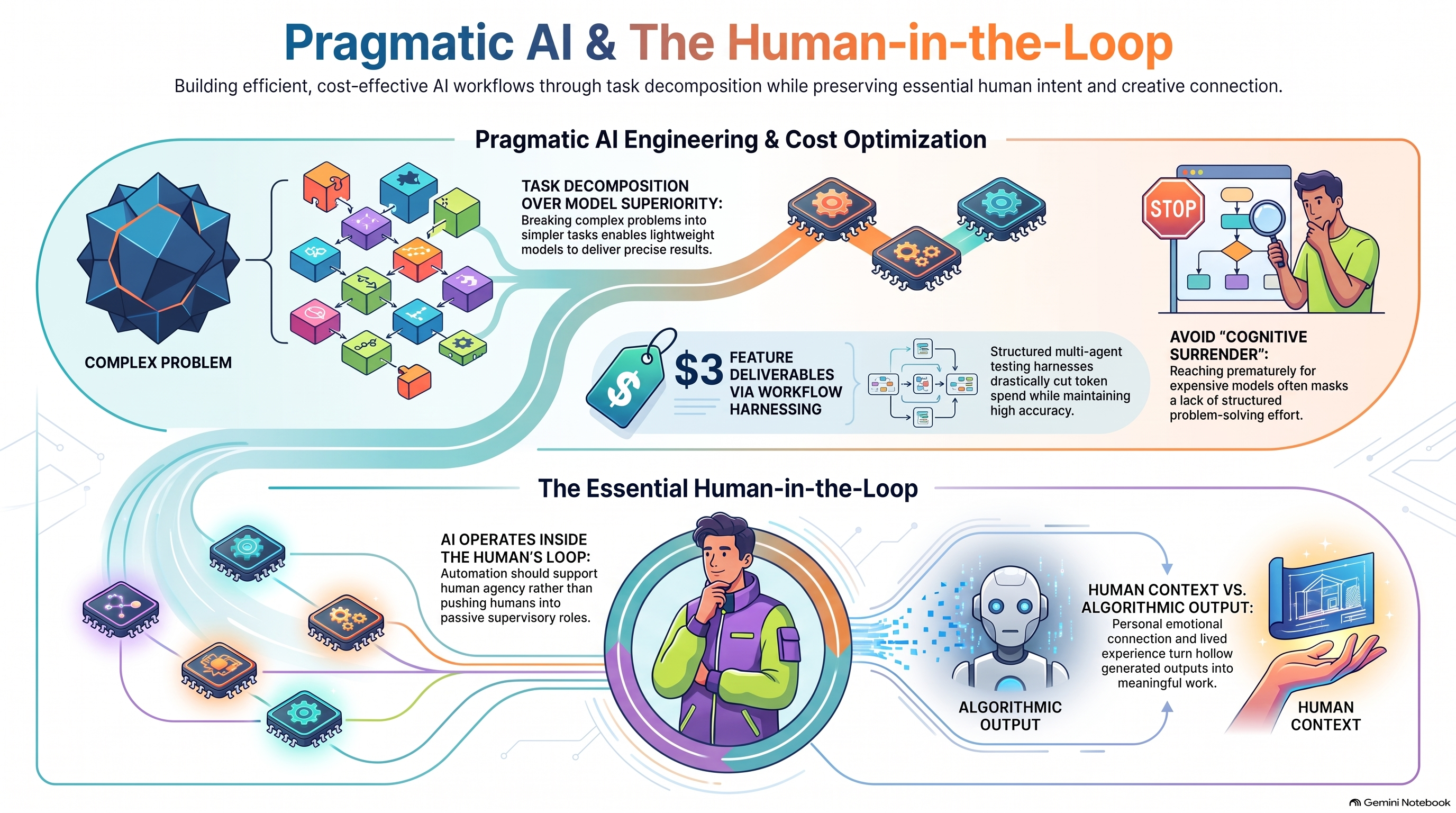
What stuck with me were the insights the year kept returning to. Reimagining the human in the loop, where AI operates inside our loop instead of us inside theirs. Outcomes over output. Context over model superiority. The power of constraints. State versus culture.
Then the touchstones, the phrases that became shorthand between us. The racetrack analogy. Slowing down to speed up. Reflection versus rumination. Context switching and human hallucinations, where you type into the wrong window because you’re holding too many threads at once. The human delta and craftsmanship. Pulling the andon cord.

The Speed We’re Not Built For
Matthew opened his reflection with how fast everything is going.
A year ago, AI struggled with basic math. People on social media would ask it to count the letters in a word and it would give silly answers, and that gave a lot of people a sense of relief. Just two days before we recorded, OpenAI released a stack of papers on advances in mathematics, and the relief started to fade.
Those of us who work with these models every day never had the luxury of relaxing. We’ve been pushing them to their limits for a while, so we already knew how capable they were. We’ve gotten good enough that we don’t always reach for the frontier models. Kimi K2 handles most of the work. Cheaper models handle the rest.
But the party is coming to an end. OpenAI rolled out a $500 tier. NotebookLM caps how many video overviews you can generate in a window. The free ride is closing, and it’s going to force people to choose differently.
Don’t Drive a Ferrari to Get Milk
We spent a good stretch on model selection, because it’s where a lot of people get it wrong.
There are YouTubers with big followings telling people to set their default to Opus because it’s the best model. Matthew’s take is that you don’t buy a Ferrari to drive the speed limit, and mine is that you definitely don’t buy one to go get milk. If you spend your weekly usage on a grocery run, you won’t have any left when you finally reach the track.
His version of the analogy is a fleet. Haiku is a Toyota Camry. It gets the job done, it’s reliable, and the parts swap out easily.
I added one more. A friend of mine has a Marshall JCM 900 amp. That thing only does what it was built to do when you crank it, and he lives in an apartment, so he can’t. Hand a simple task to a model built for the hardest problems and it will overthink it. Same problem, different direction.
The Harness Is Where the Work Lives
I’d just finished building real features through a proper harness, and it changed how I think about this.
Improving has been working through the AI maturity stages for a while, with one short video per stage and certifications to match. Stage three is an agent that does one thing and does it well, wrapped in evaluations that keep it honest. Stage four is automating the whole workflow, so those agents hand off to each other, with guardrails that stop the line and punch up to a human when something doesn’t check out.
The part that blew me away was the cost. I built a feature made of a dozen stories, and the whole thing ran about three dollars, because I used the cheapest model available at every step. No planning model, no frontier model. The harness and the task decomposition did the heavy lifting, so by the time the AI touched the work, the problem had been broken down to something simple.
The harness also told me what the rework cost at each step. That column is the next thing to optimize, because that’s money thrown away. You only see it if you do the work of building the harness and understanding each step.
Matthew called out the other side of this: cognitive surrender. People reach for the biggest model to cover a skill gap, or a gap in willingness to put in the effort. If it’s easier to throw Opus at everything, why spend the time getting the problem in order? Because at some point that costs more than hiring a person.
When the Music Is Hollow
Matthew told a story about playing a song at his church.
Someone handed him the title of a song on a crumpled piece of paper and said the congregation would love it. He’d never heard it. He cued it up at the end of the service, and about ten seconds in, he realized it was AI-generated gospel. There was a vocal, there were instruments, it was mixed well enough. But it was hollow, and it was extreme in ways human singers aren’t.
I have no interest in AI-generated music when there’s no human connection attached to it. I just came back from Brazil, and on the bus I passed a spot that used to be a music store. It was someone’s garage, the size of a VW Beetle, right off the avenue. Every Saturday I’d stop in, flip through the crates, and the owner would say, Claudio, check this out, you’re going to love this. That’s where I learned about a lot of the artists I still love. The music is tied to those people.
The feeling predates AI. When Pandora first suggested a band because I liked Metallica, I felt the same way. A bunch of ones and zeros doesn’t know me. The bands that stuck came through a friend who said, “You like Metallica; I thought of you when I heard this”.
So when I use Suno, it’s different. I feed it my own guitar parts and tell it not to invent anything. I fed it lyrics pulled from journals I wrote between 2020 and 2022, dropped into NotebookLM and turned into lyrics. When I listened the first time, it gave me goosebumps, because those were my thoughts and my melody. It’s the same reason an orchestrated version of a Metallica song moves me. There was no orchestra, but the melody and the people I associate with it are real.
Matthew compared it to hiring a band to play a song you wrote. You didn’t play the bass, but you wrote it. The human fingerprint is what makes it land.
Skipping the Journey
The math papers came back up, and Matthew had more to say about them.
OpenAI threw tens of thousands of agents at a Navier-Stokes problem that two researchers had been working on, and beat them to a solution. The researchers had been using OpenAI’s tools to think about the same problem, which raised a fair question about what happens to the work you feed into the machine.
The bigger issue is what gets lost. If a service let you watch only the endings of movies, you’d lose the point, because the value is the journey. Mathematics works the same way. Even when researchers don’t solve the problem, the attempt opens new areas to explore. Produce only the final answer and all of that disappears.
We landed on chess. Deep Blue beat Kasparov and people still play, and more importantly, people still watch other humans play. Nobody wants to watch two bots. What makes it worth watching is the human reacting to a move they didn’t see coming.
Building in Public
Matthew shared something he’s been building, and it reframed the whole conversation.
It’s a virtual gallery of the projects he and his family have worked on. You take the wheel and drive to each one. The first stop is Ponderare, his journaling app, with the problem, the build, the timeline, the status. Then he showed the cabin, a small 3D room that represents his office: his cats, his record player, a guitar in the corner, a bookshelf made of the things he’s written in public.
The idea is to make the why visible. When I saw it, I wanted the same thing for my music. I’ve been gathering material for a talk about music as the soundtrack of my life, the bands and songs that marked different periods, and the music I wrote and why. This was the shape I’d been missing.
I brought a drum machine and a DAT tape, my first demo with a band when I was fifteen, to our office for a nostalgia display this month. Each object has a story: what it let me do, the people I met, the people I taught to use it. That’s the experience I want to build.
Matthew’s point is that our work habits transfer. Look at the problem, explore the space, plan, talk to people who know more. If those practices work at work, they work everywhere else. The only limit left is imagination.
While the Power Is Still Yours
We closed on the note the last episode left us with: the apocaloptimist.
Matthew’s position is simple. Whatever the future brings, start getting prepared for it, because you do have power in what you can do today. Worrying is almost a form of surrender. Take action, however small, while the power is still yours. So you can say that while you had some say, you used it.
A year of these conversations has taught me the same thing. The tools will keep getting better. The part that matters is still the part that’s ours.
If any of this resonates, the full episode is worth watching.


Leave a Reply