
After the Stage 3 certification in Improving’s AI Maturity model raised my limit, I still had a budget problem. So I made a decision that felt reckless at the time and turned out to be one of the best things I did all year.
I stopped using the good models. Not “I’ll use them less.” I stopped. I moved everything onto the cheapest model available, and I told myself I’d see how far I could get before I had to crawl back.
At the time, that was SWE 1.6, which was free to use. So I did every single thing in it. Planning, implementation, tests, reviews, writing. If I was going to work with a cheaper brain, I wanted to find the edge of it myself rather than assume where it was.
What the constraint exposed
The results were not good, and that was the point.
The same skills I’d been running with the better models produced noticeably worse output on the cheap one. Where I’d gotten used to a result I could use with light editing, I was now getting things I had to fix. Same prompt, same skill, worse outcome.
My first instinct was to blame the model. My second instinct was more useful. If the skill only works with an expensive model, maybe the skill is doing less of the work than I thought. Maybe the model was papering over weaknesses I’d never had to notice.
So I iterated. I’d look at the weak output, figure out where the skill left too much to the model’s judgment, and tighten the skill. Then I’d run it again. And because I’d already built the evaluation habit by then, I could do more than eyeball it. I could score the output, change one thing, and see whether the score actually moved.
That loop improved every skill I had been using to produce the most valuable work. The cheap model was the forcing function I never would have chosen for myself.
The model ladder audit from the certification package is what this looks like on paper. Same prompt, two models, one row per test:
| Provider | Test | Score |
|---|---|---|
| SWE-1.7-Max | Full problem | 1.00 (12/12) |
| SWE-1.6 | Full problem | 1.00 (12/12) |
| SWE-1.7-Max | Scope focus | 1.00 (11/11) |
| SWE-1.6 | Scope focus | 1.00 (11/11) |
The gap closed to zero because I made the prompt explicit enough for the cheaper model to follow. That’s the trade I kept making: pay in prompt clarity instead of in model cost.
Two months of features on a cheap brain
Once the skills caught up, the productivity came back, and then some.
I built a large number of features on a client’s product over about two months. It was a ridiculous amount of output. The kind of stretch where you look back at what shipped and wonder how the calendar math works out.
I didn’t get there by using a smarter model. I got there by using a dumber one and refusing to accept the dumber results. Every weak output was a signal that a skill needed another pass. By the time I’d made enough passes, the cheap model was doing work I used to reserve for the expensive ones.
That’s a strange thing to notice. The model I was forced onto made me a better engineer of prompts than the models I had chosen.
The dashboard that said I wasn’t using AI
When the free model stopped being free, a teammate mentioned that DeepSeek had become the cheapest option. So I did the same thing again. Replaced the model everywhere, ran everything through it, and kept going.
The funny part showed up on our AI usage dashboard. It tracks usage in a unit that doesn’t map cleanly to cheap models, so my numbers looked tiny.

Anyone glancing at that would conclude I wasn’t using AI for much of anything. Then the model breakdown tells a different story:
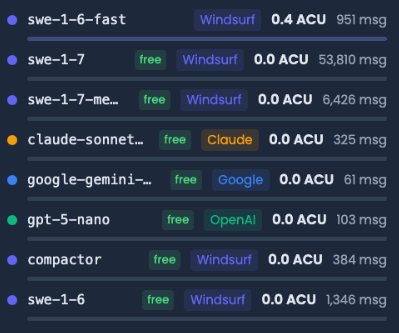
The free model alone logged more than 53,000 messages for zero ACUs. I was doing an enormous amount of work and paying close to nothing for it. The dashboard measured the wrong thing, which is its own little lesson about metrics.
What I learned
I’ve kept this habit since. I haven’t gone back to the expensive models for my day-to-day work, except when I need to because that’s what we’re teaching or because a specific task demands it.
The lesson I keep drawing from this isn’t “cheap models are fine.” Sometimes they aren’t, and I’ll switch when the evidence says to. The lesson is about constraint.
When you have a capable model, it’s easy to let the model absorb the slack in your prompts. The skill gets a little vague, the prompt gets a little loose, and the model fills the gaps. You never see the gaps because the output is good enough. Then you move to a cheaper model, and every gap turns into a visible failure.
I found a lot of gaps that way. Fixing them made my skills portable. They work on the cheap model, they work on the expensive one, and I can swap models without my quality falling apart.
I’ve since moved my skills to another model and re-run the whole suite to see what the scores say. The fact that I can do that, on demand, and get a straight answer about what broke is the whole payoff of the work I’d been doing since the self-assessment.
Constraint did what comfort never would have.
And it left me with the same question the certification had. I’d now done this evaluation work by hand more than once, on a deadline, for a new model. There was going to be a next time. There always is.



Leave a Reply