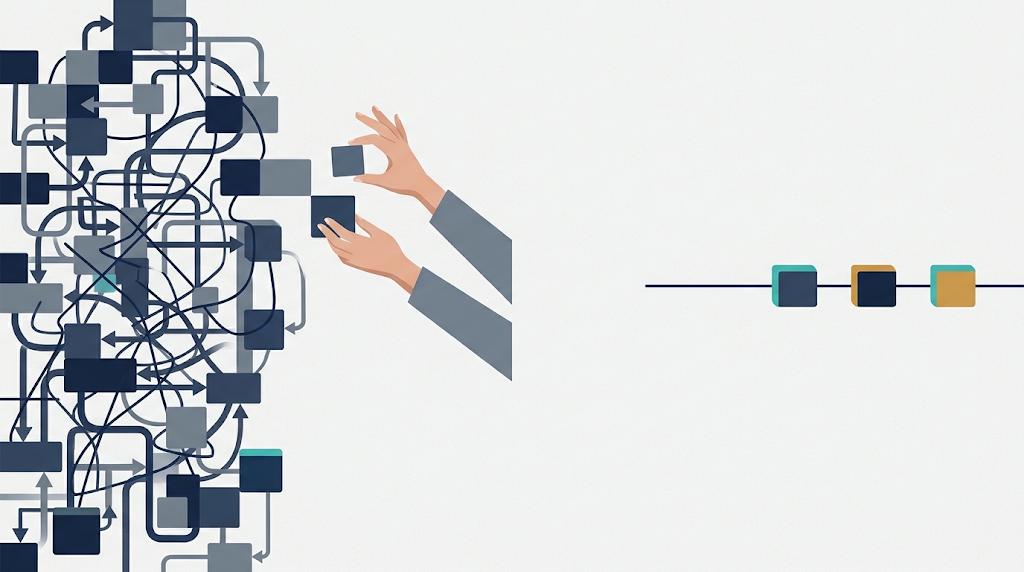
Three people told me the same thing in one week. Each one was working through a certification, and each one said their breakthrough came when they simplified.
The people on Stage 3 had been building agents that did too much. The people on Stage 4 had built workflows that were too big. Both groups were stuck, and both got unstuck by taking something away.
I recognized it immediately. That was my Stage 3 story. I was stuck on the PRD exercise, complicating the work, and what unlocked it was going back to the simplest thing: my Write Stories agent writing stories. Everything after that came from there.
Simplicity isn’t easy. That’s the wrong way to hear it. Simplicity is powerful, and powerful things are worth the effort of finding.
A 12-step workflow may be too big
I’ve been looking at a twelve-step workflow. The temptation is to build the whole thing and then run it.
I’d rather break it into parts. Three, maybe. Then ask which parts apply every time and which apply differently depending on context. Then start with the part that has the fewest dependencies, because that’s the part I can run today and learn from.
The rest of the workflow can wait until I know more. It usually changes anyway.
The workflows I’ve been sketching
Breaking things down made the shape of the work visible. Here’s what I see:
- Discovery. Stakeholder conversations, what we get from them, and how we find agreement when stakeholders disagree. Often the cheapest path to agreement is a low-fidelity prototype they can react to.
- Planning and execution. Turning what we learned into something we can build.
- Quality assurance. Testing the work, with automation where it actually helps people test well.
- UAT. The people who asked for the feature accept it and feed the results back to the business stakeholders who make the decisions.
I don’t need to define and automate all of it at once. Each of those blocks can be built, run, refined, and then assembled into the next one.
Progress over perfection
This is the same lesson from my harness work. I didn’t wait for the perfect workflow before using it. I picked a step, checked whether it moved me closer to the goal, and kept going.
The simplest thing that teaches me the next best question is the best next step. A workflow that’s too big to run isn’t teaching me anything. One small enough to run this week will.
I keep noticing that the people who get unstuck aren’t the ones who add more. They’re the ones who find the smallest part that still does something real.



Leave a Reply