The talk ended and almost nobody left. People stayed in small clusters, some of them around the speaker, some of them with someone they had just met. We had to start herding people out of the building so we could tidy up before the next workday. A meeting that ends with a room full of conversations is a good meeting.
That was my first time hosting the Design Thinking and Innovation Group. I committed to it for a year, and if every session looks like that one, the year will be easy to keep.
The sewing machine
My good friend Daniel Scheufler gave the talk, and one example from it is one I’ll add to my toolbox.
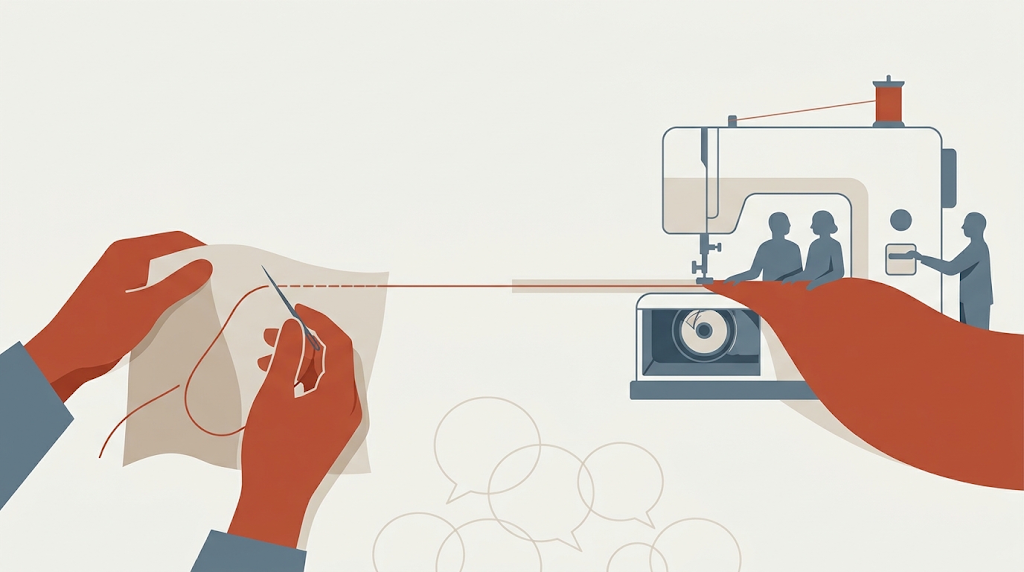
Sewing by hand and sewing with a machine are not the same activity. A person with a needle and thread works one stitch at a time. A sewing machine uses a different mechanism: an upper thread and a lower thread lock together in the middle of the fabric, and that lock is what holds the seam. A sewing machine is not a fast pair of hands. It does not sew the way a person sews.
The work still had to get done. Clothes still had to be made and mended. What changed was the skill in demand, from moving a needle through cloth to running, maintaining, and designing for a machine. People who only knew the first version of the work had to learn a different one, and the trades built around machines became their own profession.
What that has to do with us
That is the shape of the change AI is bringing to jobs people have held for a long time. We usually hear it as a question of replacement: will the machine take this job. The sewing example asks something more useful. Which parts of this work survive in a different form, and what do I have to learn to stay in the part that does?
I spent thirty years stitching code. Typing it, mostly, one statement after another, the way you move a needle. I can still sit down and write code, but I would be rusty at it, and I know it.
What I do now is decide what the software should do, talk to the people who will use it, and check what came back against what they actually needed. That part takes more of my time than it used to, not less. My hands are off the thread. The judgement is still mine.
That version helps the people I talk to, because most of them can picture someone at a sewing machine. They can see the person still there, doing the work differently.
Why communities matter
Talks carry information. Communities carry the thing information cannot, which is other people working on the same problems.
The talk is what gets people in the room. The reason to come back is the person sitting next to you who tried the same thing and has a story about it. That is what the room is for once the talk ends, and it is where I have had some of my most useful conversations, standing around while everyone else is slowly packing up. I still talk to people I met at user groups years ago.
A community is also where you find out that your problem is not unique, and where you find out that your solution already has a name. You might get that from a recording, but the conversation, the collaboration, the interaction; that’s what helps retain the knowledge.
The invitation
The Design Thinking and Innovation Group meets every month on the second Wednesday. It is not a software group. It is a community for people who want to use human-centered design, service design, user experience, and lean to create positive social impact, in Houston and beyond. The mission includes fieldwork in the community, not just talks in a room.
If you work in product, process, or service design, you will find your people there. If you are curious about Design Thinking and have not practiced it yet, that works too. The group welcomes people with a passion for learning and personal growth, and the events are built around sharing knowledge rather than watching a presentation and leaving.
If you have something to say, the group takes speakers. Details and the schedule live on the group’s LinkedIn page.

Leave a Reply