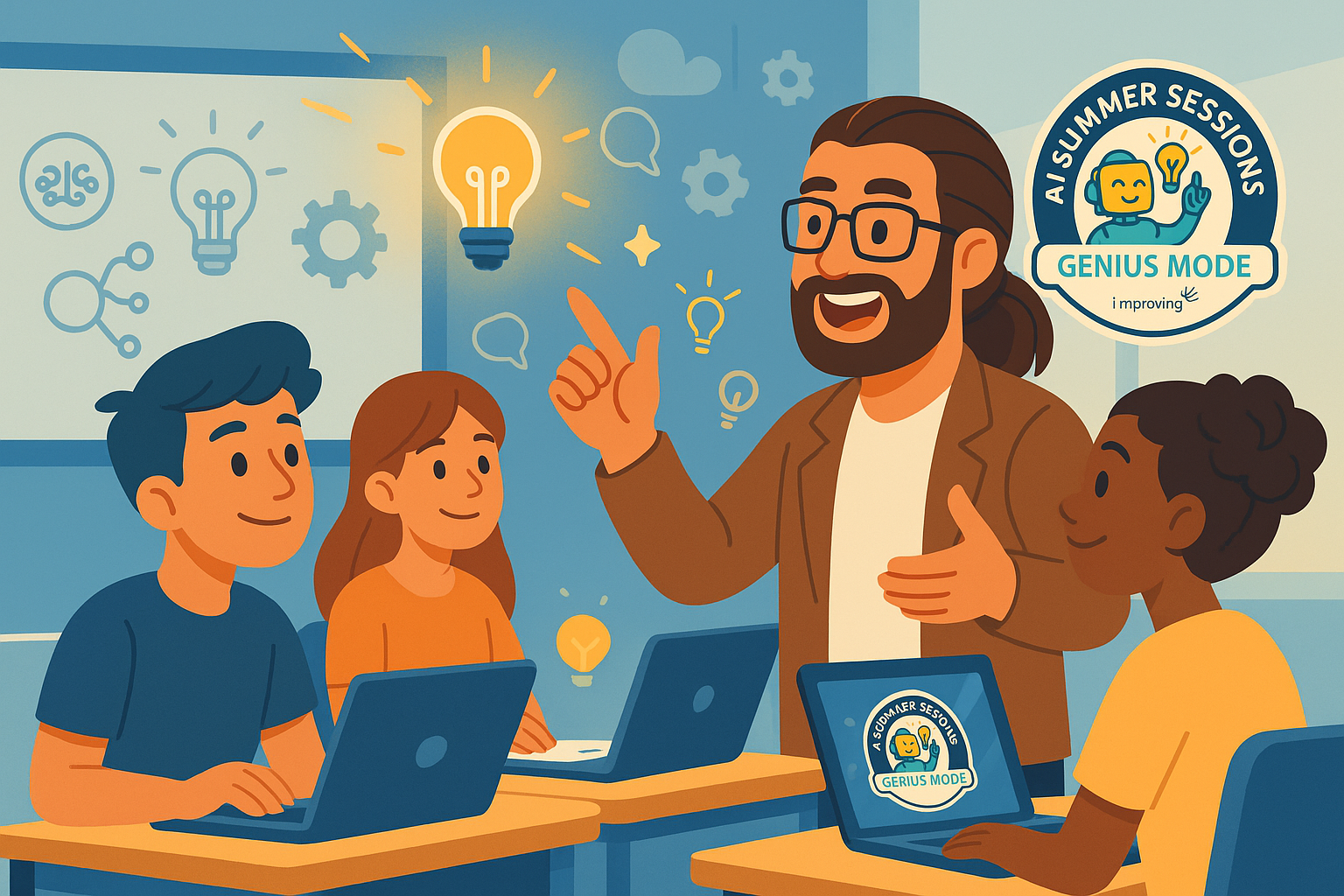
When an Improver first mentioned her son had gotten caught using ChatGPT for a school assignment, I didn’t think it would spark a whole summer camp. But it did. And a few months later, I was standing in front of a group of high schoolers teaching the final session — Genius Mode — where we explored how to learn faster, study smarter, and build confidence with AI.
This post is about how that class came together, what I shared with the students, and what I learned along the way.
🧭 Starting with the Bigger Picture
We built the camp around three sessions:
- Wake-Up Mode: What AI is (and isn’t)
- Power-Up Mode: How to use it responsibly and creatively
- Genius Mode: How to think better, learn better, and grow with AI
Each session built on the last. Daniel and Jessie led the first two — and I took tons of notes. Jessie showed students how to check sources and write with their own voice. Daniel talked with parents about cheating, motivation, and how tools change but human nature doesn’t. I wanted my class to tie it all together — skills, mindset, and confidence.
If you want the behind-the-scenes story of how the whole camp came together, I wrote about that over on the Improving blog: Improving the Future: Reflections on Our AI Summer Camp.
💡 Designing “Genius Mode”
My theme was simple: “You’re more capable than you think — AI just gives you leverage.”
I kicked things off with a quick demo — switching between English, Portuguese, Italian, and Spanish mid-sentence in a spoken conversation with ChatGPT. It was chaotic, fun, and the perfect example of AI as a learning companion.
Then I asked the students:
“What if you had to learn something you know nothing about?”
To make it concrete, I used American Football — a subject I barely understand — and showed how you could use AI Studio to build a little app that teaches it through something familiar and fun.
👋 Sharing My Own Path
I told them a bit about myself — oldest instructor in the room, born and raised in Brazil, started working at 14, never went to college, and still ended up building software for a living. I said that not to brag, but to make a point: there’s no single right way to learn. Different backgrounds mean different superpowers.
💬 What Does “Genius” Even Mean?
I asked who thought they were a genius. No hands went up. Then I asked who they thought was a genius. That got a few Einsteins, Teslas, and Musks.
I reframed it:
“A genius isn’t someone who knows everything. It’s someone who uses what they know to make an impact.”
We talked about cheating — why people do it, and how AI can tempt us into shortcuts. But when you understand how you learn, you start wanting to use AI for leverage, not replacement.
🧠 Learning How You Learn
We broke down six learning styles — visual, auditory, read/write, kinesthetic, social, and solitary — and I asked students to notice which ones fit them best. Then I showed how AI tools can adapt to those preferences. One example: NotebookLM, which turns your notes into summaries, diagrams, or even a mini podcast.
“Experiment. Observe what works for you. Then use AI to amplify that.”
🔍 Using the ROCC Framework
Daniel had introduced the ROCC framework (Role, Objective, Context, Constraints) in his class. I brought it back, showing how to fill in the blanks:
“If you don’t know the Role, ask AI for one. If you only know part of the Context, let it help you fill it in.”
It’s about thinking clearly over perfect prompting.
💻 Real AI Use Cases
To make it real, I shared a few ways I actually use AI in my life and work:
- Planning a track-day checklist for motorcycle racing
- Creating a video hub for client demos
- Using voice journaling to turn reflections into insights
- Analyzing my blog and talks to learn from past content
- Automating newsletter creation to save time
Each example showed how AI helps me think and create faster — without taking over the work.
🔑 What I Wanted Them to Take Away
“Doing the right thing, at the right time, in the right place.”
That’s the essence of mastery. Tools will change. AI will evolve. But the way we approach learning, creativity, and impact — that’s what defines a real genius.
🎉 Final Message
I wrapped up with this:
“Go be a genius. Be curious, courageous, and creative. Do not skip learning; use AI to amplify your thinking.”
The smiles and questions at the end told me they got it. Genius Mode went beyond just using AI, sharing with the studends some thoughts about learning how to learn, think, and communicate — and realizing that’s a lifelong superpower.


Leave a Reply