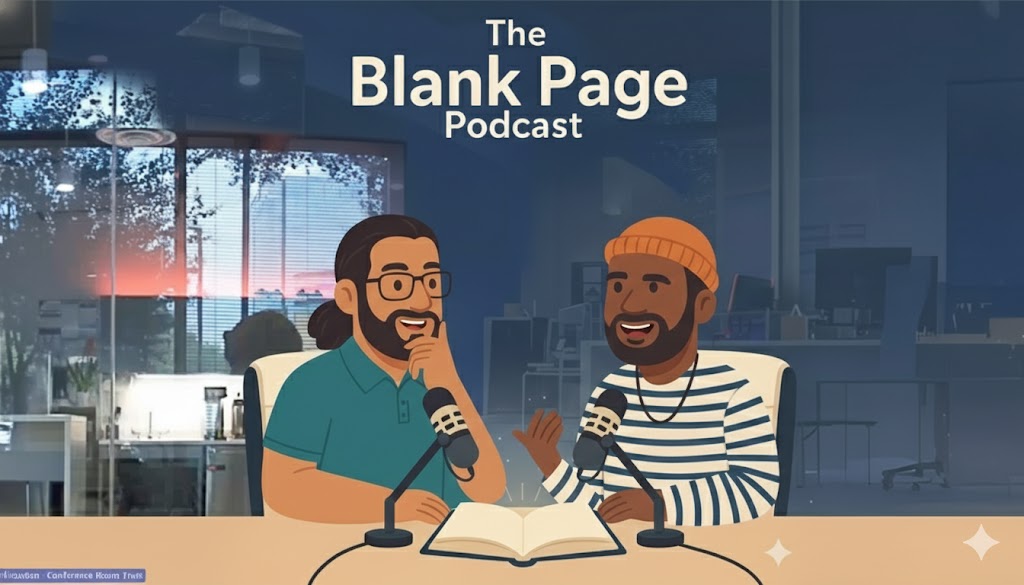
In Episode 3 of The Blank Page Podcast, Matthew and I explored how AI can help us rediscover the human side of software—where empathy, curiosity, and collaboration matter as much as code. Through live experiments with tools like NotebookLM and MacWhisper, we showed how technology can amplify reflection, understanding, and creativity rather than replace them.
Key Takeaways:
- AI can amplify the human side of software.
- Record conversations and reflect on them intentionally.
- Use AI to analyze patterns and sentiment to uncover blind spots.
- Trust grows when insights are grounded in real context.
- The blank page was never truly blank—it’s full of human experience waiting to be seen.
🎥 Watch the full episode:
We began by loading transcripts from our previous meetings into NotebookLM and asking it to surface our top three “aha moments.” What came back was a perfect mirror of our philosophy:
- Escaping the blank page – realizing that creation doesn’t have to start from nothing.
- Capturing conversations to drive iteration – turning dialogue into a living source of insight.
- Using natural language to create solutions – bridging human intent and working software through plain English.
That last point led to a fascinating discussion about how far we’ve come—from early tools that promised no-code development to today’s reality of natural language interfaces that actually deliver. After thirty years in software, seeing a system translate a simple user story into working software feels less like automation and more like empathy—technology finally speaking our language.
From there, we explored how these same tools can deepen team communication. I shared that my team, on one project, records and transcribes our daily scrums, then uses AI to surface patterns, emotions, and blind spots. Matthew introduced ConvoMind, his prototype that pairs transcription with sentiment and entity analysis to reveal not only what was said, but also what was missed. Together, we called this blind spot detection—a way for AI to help teams listen to themselves more fully.
One of the most powerful moments came when we explored NotebookLM’s citation and mind-map features, which ground every AI-generated insight in a verifiable context. When the source of truth is visible, trust follows. Instead of fearing hallucination, we gain a clearer reflection of our own words and patterns.
We wrapped up by returning to a core idea: the blank page isn’t empty—it’s waiting to be rediscovered through the traces we already leave behind. Our voices, our meetings, our notes—all of it is raw material for growth. With the right tools, we can see the human side of our work more clearly than ever. It’s up to us to look for it.





Leave a Reply