
Early on the call, a colleague who had seen me speak and follows my blog raised the question, almost like it had been waiting for an opening. They wanted to know: does the daily writing make me a better speaker, or does the speaking make the writing easier? Which comes first, the chicken or the egg?
I did not have to think about it. The answer is yes, both, and they feed each other so closely that I stopped trying to separate them years ago. The two are not competing hobbies that happen to share my calendar. They are the same practice in two directions, and each one keeps the other going.
How a talk can grow out of writing
In the early days, preparing a talk was exhausting. I would start with a blank canvas for a one-hour talk, and it was genuinely hard to know where to begin. I would spend forty hours getting ready for sixty minutes on stage. Around the same time I was also writing articles for magazines back in Brazil, and eventually I noticed something. Those articles, taken together, looked a lot like the outline of a talk.
That realization changed how I work. I can build a talk out of several blog posts. Before AI, writing a single post might take me two or three hours of getting my thoughts onto the page. I would publish one, then another, then another. By the end of a month or a quarter, I would look at the stack and see that it already was a talk. I had done the hard work of thinking it through. All that remained was to shape it into something presentable and rehearse the flow.
So most of my talks over the years did not start as talks. They started as a running series of posts on one topic, and the posts quietly assembled themselves into a presentation. The writing prepared for me. When I wrote about preparing by speaking my ideas out loud and thinking in public, that was the same instinct at work in Preparing a Talk by Thinking Out Loud. The difference is only where the thinking lands: on a page or on a stage.
How a talk can feed the writing
The loop goes the other way just as often. I give a talk, and something shifts. On stage, I end up explaining the idea a different way because the words that worked in writing do not always work when I am looking at people. I get questions I did not expect, and those questions are gold. They reveal a part of the topic people care about, a part I might have buried.
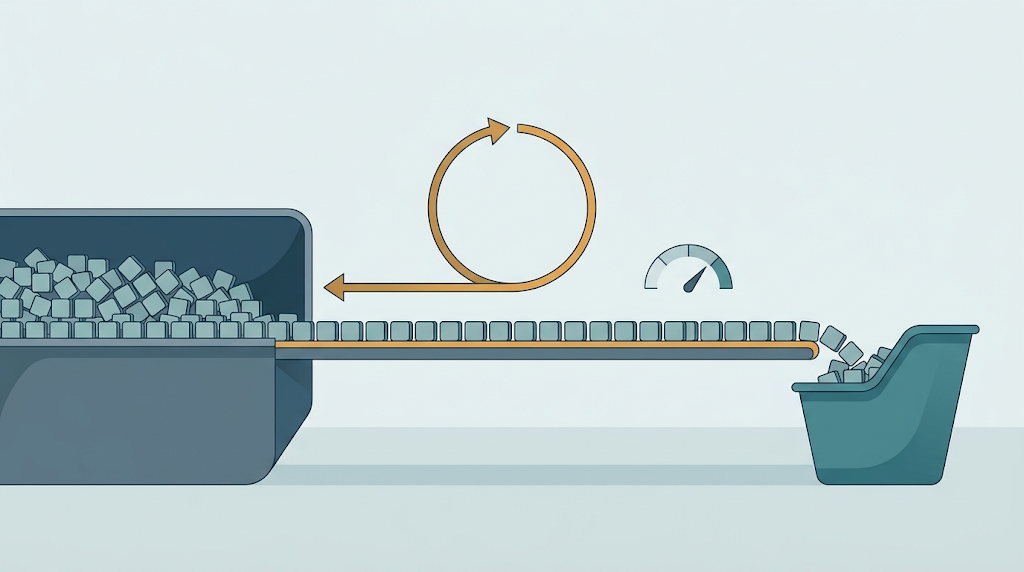
So I come home from a talk with more content than I started with. The new way of explaining a concept becomes a post. The question I had not prepared for becomes a post. Each talk seeds the next few articles, and those articles seed the next talk. It keeps going in a circle, and the circle never really closes.
There is a history here that goes back long before the daily blogging. Early on, my writing opened doors for me. Speaking at conferences and user groups became possible in part because people had read what I wrote, and they wanted to meet the person behind the words. That connection, where the writing brings the audience and the audience feeds the writing, is something I traced back in A Busy Summer in 2007: Conferences, Code, and Curiosity. The two were tangled together from the beginning, not separate lanes.
One useful habit came out of seeing the loop clearly: I started keeping the raw material of every talk. I record most of my talks anyway, mostly because it helps me later. A single hour of speaking, with the questions and the tangents, is usually enough for several posts. I do not have to scrape for topics after a conference. I come home with a folder full of them. The talk does the generating, and the writing does the shaping, and neither task feels like it is starting from zero.
Writing makes us think slower
The part that matters most is not the logistics. It is what writing does to my head before I ever step on stage. Writing forces me to slow down. When I speak in the moment, thoughts come fast and some of them are half-formed. Writing will not let me get away with that. To put an idea on a page, I have to actually settle what I mean, order it, and find the words for it. That process internalizes the thinking.
By the time I stand up to speak, I have already thought the thing through slowly and written it down. The fluency on stage does not come from natural talent. It comes from having done the slow version of the thinking in advance. I can speak with confidence because I have already worked through the idea on the page, not because I am improvising well.
This is the same muscle behind the longest-running thread on my blog about speaking. If you want to see where the loop first formed, Nine Questions About Speaking walks through how my first real talk grew out of documentation and writing, and how that experience made the whole practice my own. The pattern was there from the start: write the thing, then say it, then write what you learned from saying it.
The same practice in two directions
I used to think of blogging and speaking as two separate skills I happened to be good at, and that the effort was split. It is not. They are the same practice of getting an idea out of my head and into someone else’s, done twice. Writing is thinking in slow motion. Speaking is thinking out loud. Feed either one and the other grows, because they share the same source material: my curiosity, my lessons, my struggles.
That is why the daily posts did not steal time from speaking. They fed it. Every post is a small rehearsal, a chance to get clearer, and every talk is a batch of new material waiting to be written up. I have stopped counting them as separate investments in my time and started seeing them as one.
When a colleague asks whether the blog made me a better speaker or the speaking made me a better writer, the honest answer is that I cannot separate them anymore. Each one supplies the other, and together they turn my work into an asset that keeps paying off. A talk I gave last year is a post I publish this month, and a post I write today is a talk I might give next quarter. The loop does not ask me to choose. It asks me to keep feeding it, and the more I feed it, the easier both sides get.




Leave a Reply