Every year around this time, there’s a familiar energy in the air.
Clean slates. Fresh starts. Big goals. Bold declarations.
I feel it too.
But over the years, I’ve learned to be a little suspicious of that feeling.
Not because goals are bad. Not because ambition is wrong. But because starting with what’s next often skips something more important:
Understanding where you actually are.
That’s what this recent episode of Reflective Practice Radio became about—not by design, but by honesty. Instead of asking “What are we going to do this year?” we found ourselves asking a quieter question:
What changed?
Looking backward to understand direction
For a long time, large stretches of my life blur together when I look back.
I don’t remember years as distinct chapters. I remember fragments—projects, people, moments—floating without a clear sense of sequence. That realization hit me hard more than a decade ago, and it’s what pushed me to start doing an annual review.
Not a performance review.
Not a highlight reel.
A pause.
A chance to sit with the year long enough to understand its shape.
Before you can decide where you’re going, you need to understand your trajectory. Direction only makes sense when you know where you’ve been and how you got here.
That’s something Matthew and I kept circling back to in the episode: orientation matters more than speed.
Busyness is not the same as progress
One of the recurring themes in our conversation was busyness.
“I’m busy” is an easy thing to say. It sounds responsible. Productive. Necessary.
But busy by choice and busy by default are very different experiences.
When you’re busy by choice, there’s a sense of ownership. You know why you’re doing the thing. You can explain the tradeoffs.
When you’re busy by default, time fills itself. Requests pile up. Tools multiply. Motion replaces intention.
That’s where reflection becomes uncomfortable—and necessary.
Because reflection forces the question:
Did I choose this?
Reflection as a practice, not an event
One thing I’ve learned over time is that reflection doesn’t work well as a once-a-year ritual.
Annual reviews matter—but they work best when they’re supported by smaller feedback loops.
Weekly check-ins.
Quarterly pauses.
Moments to notice patterns rather than reconstruct them later.
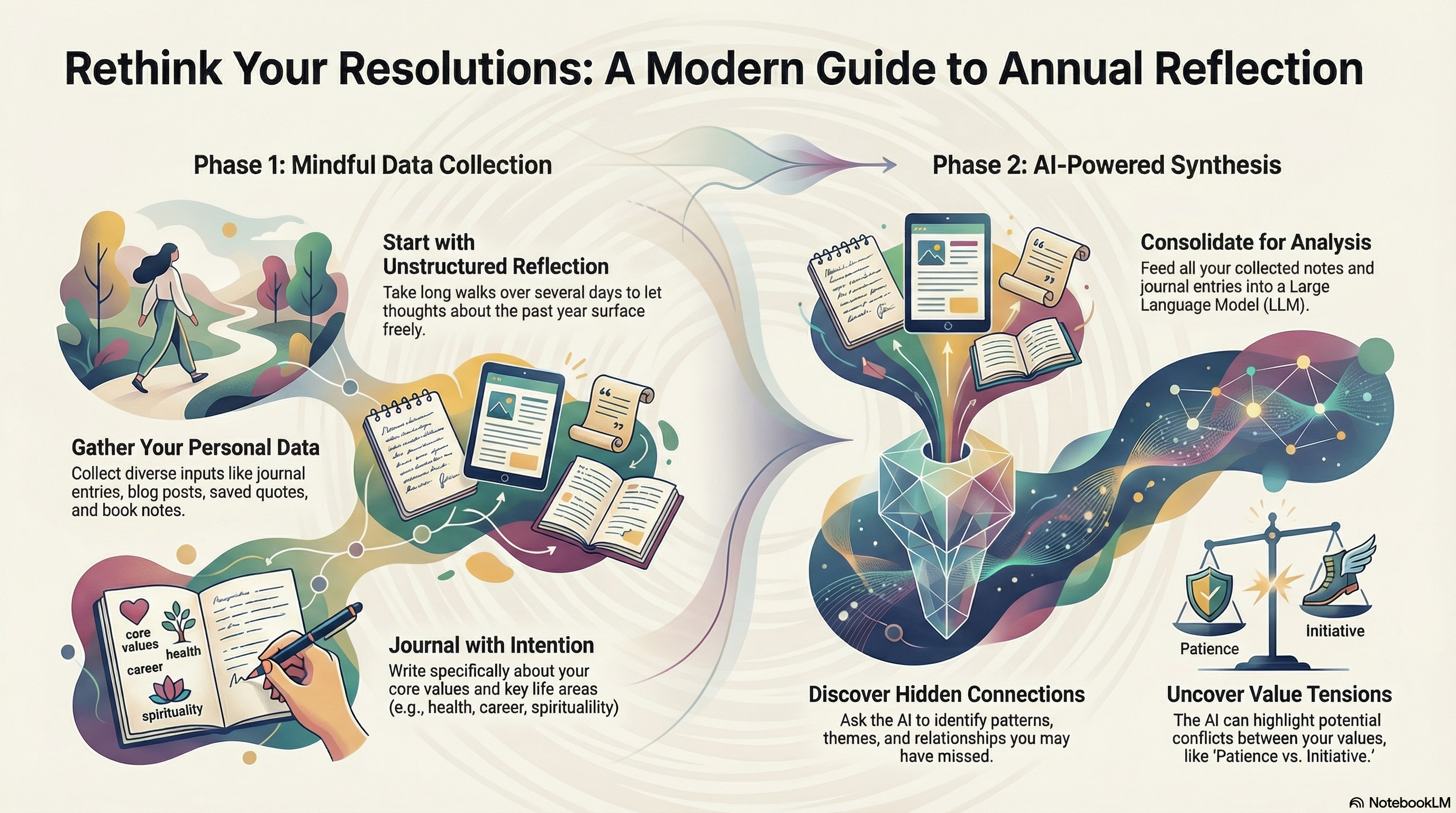
For me, that’s evolved into walking, journaling, capturing quotes that stop me mid-page, and lately, voice journaling. Not to optimize output—but to externalize thought.
What surprised me this year wasn’t just what I remembered.
It was what I noticed.
Connections I hadn’t consciously made.
Tensions between the values I hold at the same time.
Patterns of patience and initiative showing up together—not as opposites, but as a rhythm.
That kind of clarity doesn’t come from trying harder.
It comes from slowing down long enough to see.
Why this episode matters
This episode isn’t about tools.
It’s not about productivity hacks.
It’s not even really about AI.
It’s about being human in the midst of fast-moving work.
About resisting the urge to fill every quiet moment with action.
About learning from experience instead of racing past it.
We talk about craftsmanship, intuition, perceptual learning, and why some things can’t be fully explained—only practiced. We talk about building too much too early, mistaking motion for momentum, and how easily capability turns into distraction.
Most of all, we talk about paying attention.
A pause before moving forward
If you’re feeling the pull to reinvent everything right now, maybe pause.
Not to stop.
Not to retreat.
Just to notice.
What carried you here?
What quietly changed last year?
What no longer fits—but you’ve been holding onto anyway?
You don’t need a clean slate.
You already have momentum.
The work is noticing where it’s taking you.
If that question resonates, this episode is for you.
And if nothing else, let this be a moment to breathe before the year accelerates again.



Leave a Reply