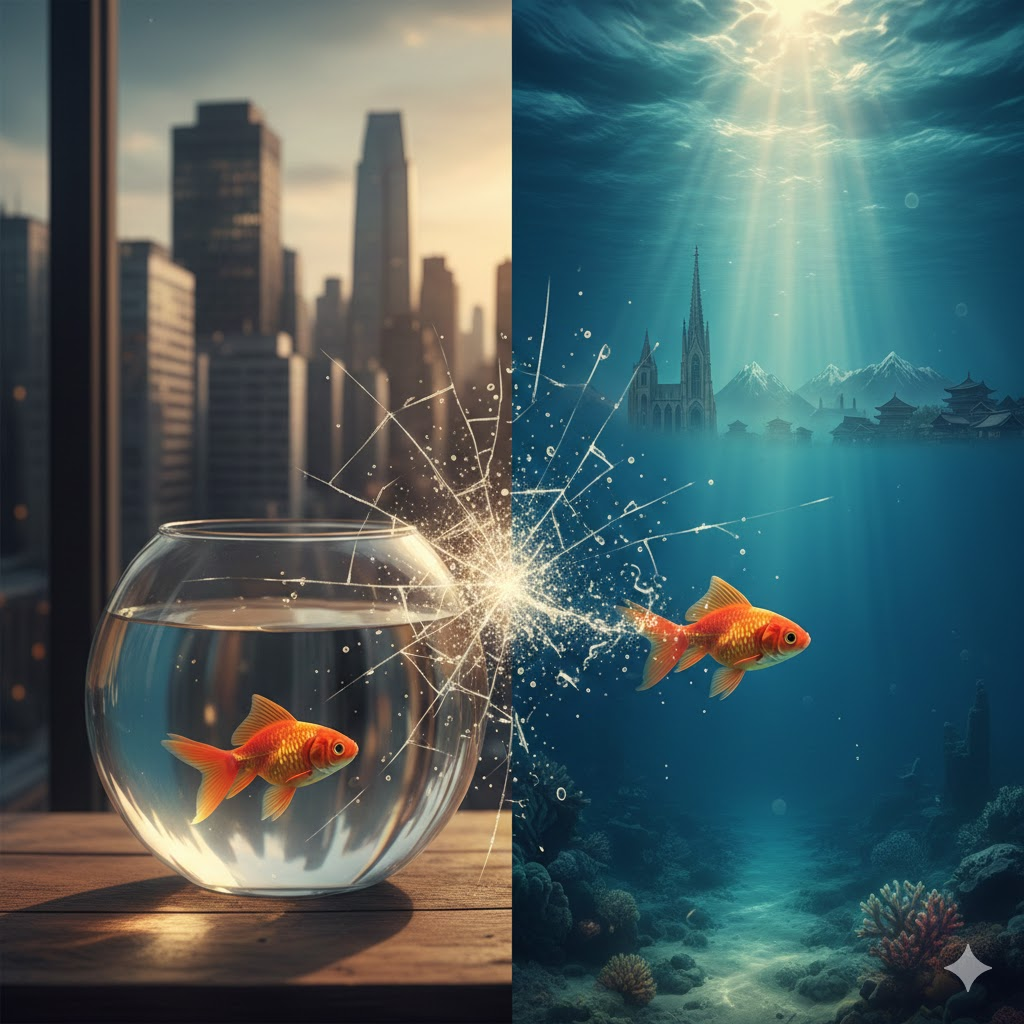
There’s a story David Foster Wallace told about two young fish swimming along who meet an older fish. The older fish nods and says, “Morning, boys. How’s the water?” The two young fish swim on, and eventually one looks at the other and asks, “What the hell is water?”
I think about this story often. The most profound realities are the hardest to see because we’re submerged in them. We become blind to our own culture, our biases, our very identities—not because we’re ignorant, but because we lack the distance to view them objectively.
I was born and raised in São Paulo, Brazil. Twenty million people. A concrete jungle. By any measure, it’s a world unto itself. And yet, for the first 24 years of my life, my entire existence fit within a three-to-four-hour driving radius. I thought I knew the world because the city was massive. But I was just staring at the glass walls of my own tank.
It wasn’t until I left—first to the United States, then to Germany and Austria, then to small villages and unfamiliar cities—that I started to see the water I’d been swimming in all along.
The Deception of the Familiar
Before I ever boarded an airplane, I assumed my experience was expansive simply because São Paulo was large. I had my routes, my neighborhoods, my version of normal. The fish tank felt complete.
This is the trick familiarity plays on us. We confuse the size of our environment with the depth of our experience. We think we’re seeing the world when we’re really just seeing the same patterns on repeat.
The younger fish don’t know what water is because they haven’t experienced enough to understand the context they’re living in. I didn’t know what my “São Paulo-ness” was until I left it behind.
Truth is Regional
I used to believe history was a collection of objective facts. Then I moved to the United States and discovered that “truth” is often a matter of geography.
In Brazil, it’s an undisputed fact that Santos Dumont invented manned flight. In the U.S., that honor belongs to the Wright Brothers. I carried my Brazilian truth with me, assuming everyone else was just wrong.
Then I visited the Deutsche Museum in Munich. There, the Wright Brothers, Santos Dumont, and French balloonists all share the stage. No single hero. Just a more complete story.
Later, I found an American author who had researched the Brazilian perspective to write a fuller history of Santos Dumont. Even a historian from the “Wright Brothers’ aquarium” had to leave their borders to find the whole picture.
This pattern showed up everywhere. Christmas imagery in Brazil? Beach barbecues, not snow. The “universal” holiday aesthetic I saw in American movies was just one region’s version of the story.
Travel taught me that intellectual growth requires challenging the truths we were raised to accept. Not because they’re lies, but because they’re incomplete.
Home is a Feeling, Not a Place
I used to think “home” was a physical address. A mailing coordinate. But travel forced me to redefine it.
I felt at home in Porto Alegre with an Italian-Brazilian family who opened their doors to a stranger. I felt it again in a small village near Salzburg, staying with musicians in a house filled with soul.
The moment that crystallized this was when my host, let’s call him Mr. F, heard a vinyl record his sister put on. He stopped mid-sentence, his face transforming as he realized he was hearing himself playing from 40 years ago—an album he thought was lost to time.
Watching the goosebumps rise on his arms, I felt a profound connection that transcended our broken English and Austrian-German. Home wasn’t the house. It was the connection at a level that doesn’t require a shared language.
If the house disappears, the home remains in the heart.
You Have to Leave to See What Was Always There
From age 14 to 19, I worked in downtown São Paulo. Every single day for five years, I walked past a magnificent cathedral. I never once stepped inside. It was too familiar. I lacked curiosity for my own backyard.
At age 48, after traveling the world and developing a traveler’s eye for architecture, I finally returned to that cathedral with my wife. I marveled at its beauty.
When I told my mother about the visit, she said, “That’s where you were baptized.”
I had spent decades observing history and beauty across the globe, only to realize I’d been blind to a foundational piece of my own origin. I had to travel the world to develop the eyes necessary to truly see where I started.
What I’m Noticing Now
Self-discovery isn’t about finding a new version of yourself. It’s about gaining the perspective to finally see the version that was there all along.
The fish don’t know they’re in water until they leave it. We don’t know our own culture, our biases, our identities until we step outside them.
This is why I keep traveling, even when it’s uncomfortable. Why I keep seeking out unfamiliar contexts and foreign tongues. Not because I’m running from home, but because leaving is the only way to truly understand it.
The shock of the unfamiliar cracks the walls of our personal aquarium. And in those cracks, we finally see the water we’ve been swimming in all along.
What aquarium are you currently swimming in without realizing it?





Leave a Reply