I was reviewing my journaling practice recently and realized something: most people overcomplicate it.
They get stuck on tools. They worry about doing it “right.” They wait for the perfect system before they start.
But journaling as a professional practice isn’t about any of that.
What It’s Actually About
Journaling is about capturing what you learn so you can build on it instead of rediscovering the same things over and over.
It’s about making connections between different experiences. It’s about being able to answer the question “what have you been working on?” without drawing a blank.
And here’s the part most people miss: it’s about creating assets from your daily work. One journal entry can become a blog post, a talk, documentation for your team, or an update to your resume.
The Question Everyone Skips
Something I got from The Pomodoro Technique a long time ago is the question that most people ignore: What did I learn?
That’s it. That’s the core of professional journaling.
Not “what did I do?” (though that matters too). Not “how many hours did I work?” But what did you actually learn?
Start With Two Minutes
After your next focused work session, set a timer for two minutes. Answer one question: “What did I learn in the last hour?”
Don’t edit. Don’t organize. Just get it out of your head and into a text file.
That’s journaling.
Everything else is optimization.
The Real Resistance
When I talk to people about this, the resistance usually sounds like:
“I’ve never been good at journaling.”
But there’s no “good” or “bad” in journaling. There’s only doing it or not doing it. Are you capturing your learning? Then you’re doing it right.
“I don’t know which tool to use.”
You’re stuck on tooling as a way to procrastinate. Use what you have right now. A text file. Voice memos on your phone. The Notes app. Pen and paper. The tool doesn’t matter until you have a practice.
“I need to organize everything perfectly first.”
You can’t organize what doesn’t exist yet. Start capturing. Patterns will emerge. Then you can organize based on actual needs, not imagined ones.
Why This Actually Matters
I’ve been journaling for years now, and I’ve seen the compound effect.
I fed 20 years of blog posts and journal entries into AI when I was looking at a career opportunity. It analyzed my experience against the job requirements and showed me exactly where I was strong (95% match in some areas) and where I had gaps. It removed the anxiety and gave me an actionable plan.
I’ve turned single journal entries into multiple blog posts, talks, and documentation. The effort was 10 minutes of reflection. The multiplier was 5+ different uses.
I’ve used my journal notes to give AI comprehensive context on a problem, which lets it run autonomously for hours rather than needing constant guidance. And I realized: this is exactly how it works with people, too. Better context up front means longer autonomous work.
The Knowledge Cycle
Here’s what most people don’t understand about knowledge work:
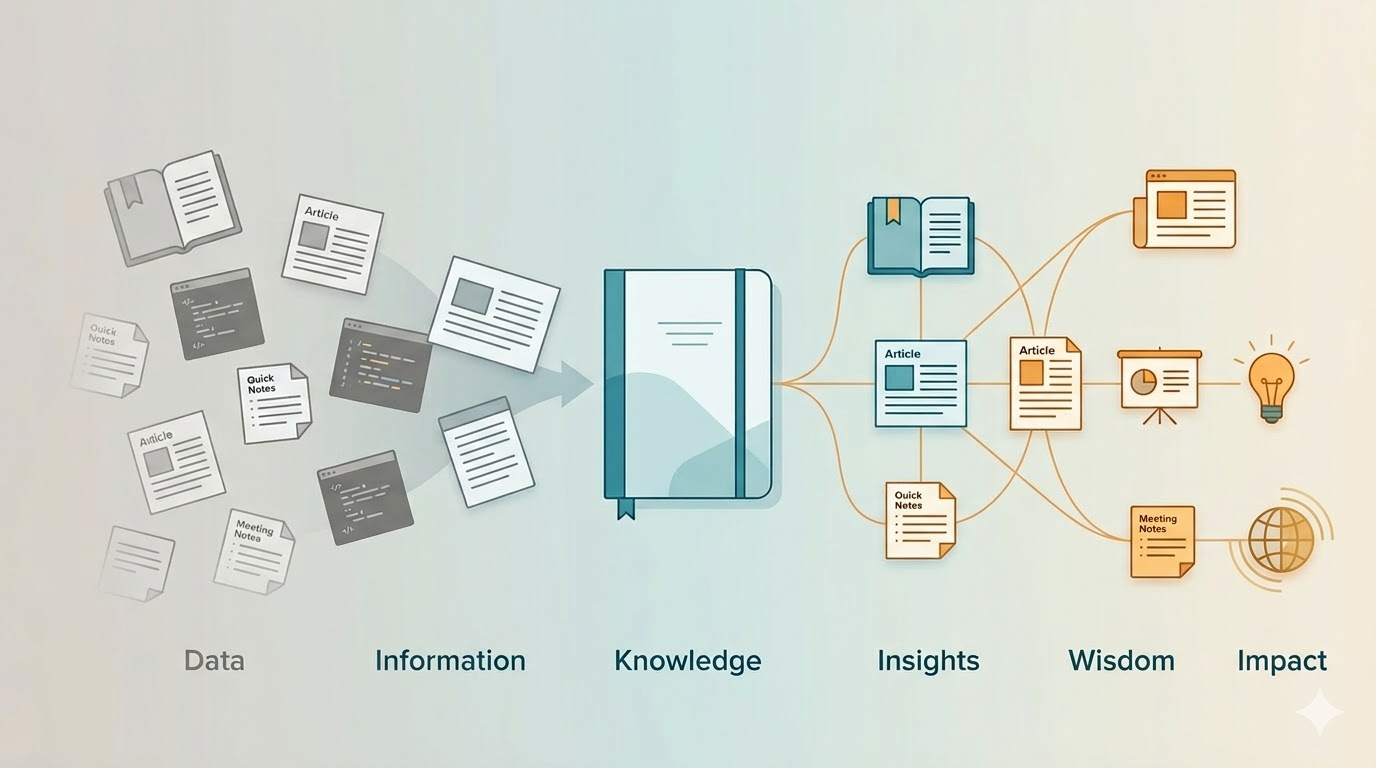
Data → Information → Knowledge → Insights → Wisdom → Impact
Most people collect data. They highlight books. They save articles. They bookmark things.
But if you never process it into insights and wisdom, you’re just a dragon sitting on a pile of gold. Impressive, but useless.
Journaling is how you move through that cycle. You capture the data. You reflect on it to create information. You connect it to other things to build knowledge. You extract insights. You develop wisdom. You create impact.
And then the cycle continues because you now have new data on that impact.
Start Today
Create a folder called “journal” somewhere on your computer. Or pick up a pen and paper.
Record or write about one thing you worked on today. Five minutes.
Answer the question: What did I learn?
That’s it. You’re journaling now.
You can optimize later.



Leave a Reply