Matthew starts this episode with a confession. He has been journaling a great deal lately. Not the sit-at-the-desk kind. After a late-night Peloton ride, he reclines in a zero-gravity chair, phone in hand, eyes closed, and talks into a voice journal until the app shuts him down. By that point he is too tired to hide anything from himself, and the entries come out differently.
I do something similar on my walking pad under the standing desk. Some evenings I am watching a queued video, editing a post, or just moving. When I notice I have missed two minutes of the video because my mind is somewhere else, I hit pause. The video is not going anywhere, but the thought will be gone if I do not catch it.
That small act, pausing to capture what is actually going on in my head, is the theme that runs through the whole conversation. Matthew and I are both streamlining our systems, leaning on AI, and wondering out loud where speed helps and where it starts to erase the parts that matter.
Streamlining the Process, Keeping the Ritual
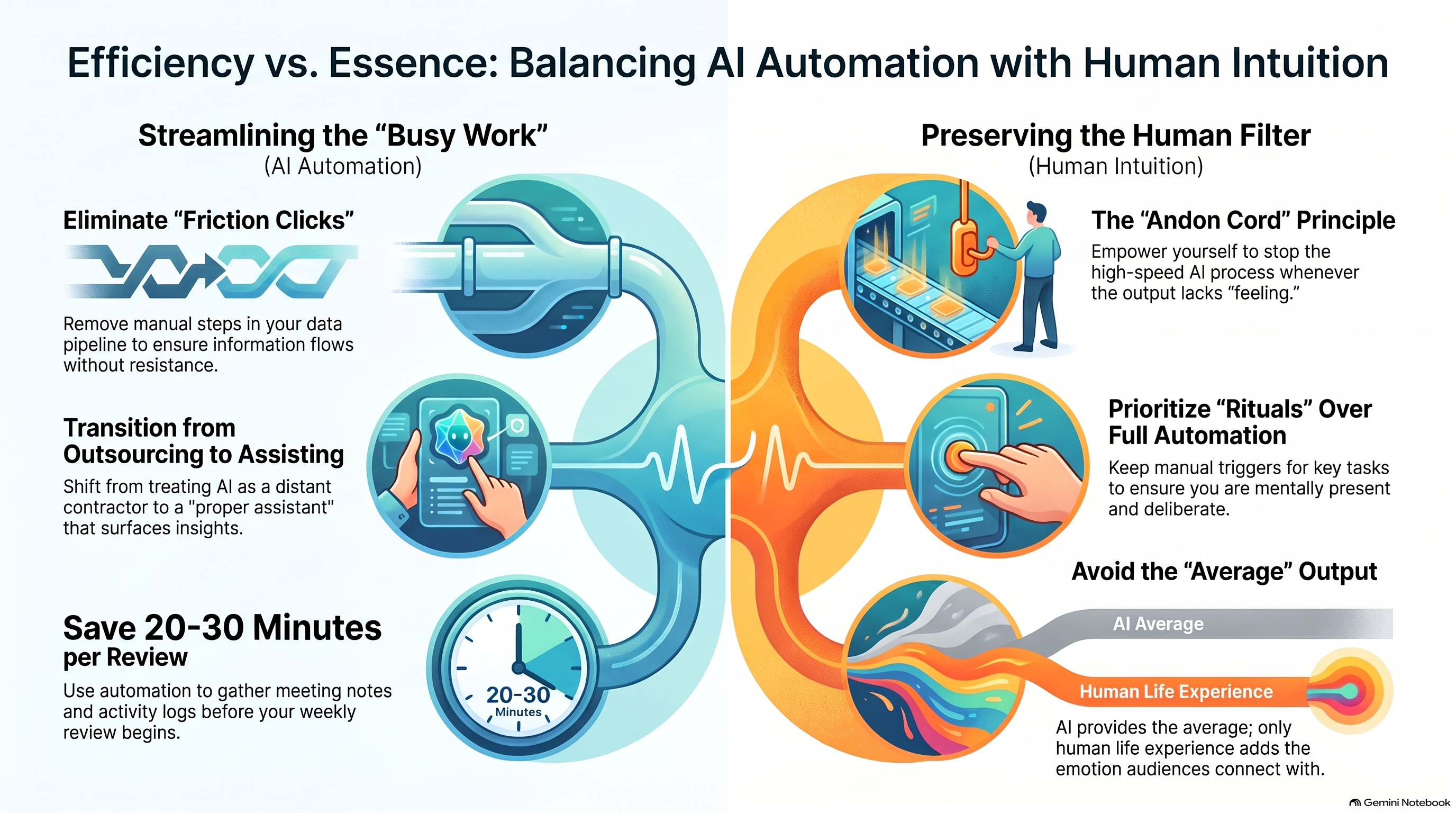
Matthew’s journaling has improved because he removed friction. He gets the thought out, showers, goes to bed. I have been doing the same with my journal-to-computer pipeline. I stripped out extra clicks so the files just land where I need them, and I have one deliberate trigger that starts my weekly review.
Last week I wrote some automation that reaches into my Obsidian daily notes and everything linked to them. It summarizes what I did on each project and bubbles that up to my weekly note. That saves me 20 or 30 minutes of gathering. But I still want to be the one who decides when to look at it. I do not want a notification that says “your summary is ready.” I want the ritual of sitting down and saying, now I process my journals.
That distinction keeps coming up. Automation is good for busy work. It is dangerous when it removes the moment where a human decides what matters.
AI as an Assistant, Not an Outsourcer
We have been using AI long enough that it is starting to feel less like outsourcing a task and more like an assistant that is actually present. Matthew puts it well. An outsourcer finishes the job and hands it back. An assistant notices things because it spends time with you.
My blogging workflow is moving in that direction. I can create a single-post project or a multi-part series, drop in a source file or a transcript, and the system prepares the project, links the references, and drafts the structure. For a long talk I gave last year, I started a multi-part project. The tool surfaced eight possible installments and pointed out connective tissue I had not seen. I did not ask it to draft everything at once. I asked for the outline first, then worked through it with me.
That is the shift. The AI is not replacing my judgment. It is making my judgment easier to apply.
The Tyranny of the Average
For almost two months, I have been using SWE 1.6 or 1.7 almost exclusively for a lot of my work. The free model is mind-blowing, and I have been refining what I feed it and how I plan the work. People ask if I used SpecKit or the BMAD or some other tool. I tell them no, just SWE, a clear problem, and rounds of iteration during planning.
The catch is that raw AI output is trained on the average of what is out there. When Matthew and I talk about Suno generating music, we both notice the same thing. The production quality is impressive, but the result sounds generic. It sounds like every other highly produced track because that is exactly what it is.
The same thing happens with software. Feed a list of requirements into a model, and you get the average of every CRUD app it has ever seen. That is fine for a car that just needs to get from A to B. It is not fine for the software equivalent of a Ferrari, where the dial, the steering feel, and the sound are part of the experience.
Recipes, Contracts, and the Missing Pinch of Salt
One of my favorite examples from Jeff Patton’s User Story Mapping: map out everything you do from the moment you wake up to the moment you leave the house. At first people say “I get up, shower, eat, leave.” Then you ask them to be specific. Do you take your clothes off before you get in the shower? What if the water is still cold? What if the first thing fails?
That exercise surfaces the hidden steps. Matthew compares it to a grandmother’s lemon pie recipe. She writes down everything she thinks she adds, but the kids can never reproduce it. The salt on her hands transfers to the dough. She rolls it a certain way. The recipe is not wrong. It is incomplete.
This is why I am careful about requirements and contracts. A contract tells two people to build the same thing, but what comes out is never identical. Sometimes that is fine. If you are machining metal to tight tolerances, the contract has to be exact. If you are making a pie, or a song, or a piece of software that people actually feel, the contract is only the starting point.
The Human Story in Music
Music is where the idea becomes easiest to see. A young virtuoso can play every note perfectly and still sound mechanical. A less experienced player with real emotion can move an audience more because they are drawing from something the virtuoso has not lived yet.
Matthew and I agree: the people who go to concerts are not there to hear the record reproduced. They are there for the moment the singer holds the mic toward the crowd, and everyone sings. They are there for the guitar solo that changes every night, or the opening act that wins them over with energy instead of polish.
A few years ago I followed a band called The Warning through three Texas dates. The opening act did not grab me on record, but live they connected with the crowd so completely that I got goosebumps from the back of the room. Rush played Brazil in 2002 to a stadium of people singing one of their instrumental songs, start to finish. The band looked confused. That kind of moment cannot be planned, and it is exactly why people go.
AI-Assisted Music and Authenticity
Matthew is not anti-AI in music. He is anti-lazy. He draws a hard line between using AI to build on something you created and using AI to generate a song you then perform as your own. If you have a melody you have been noodling for years and you want to hear it with an orchestra behind it, go for it. That is augmentation.
But prompting a tool and passing the output off as original is karaoke. Worse, it is concealing the karaoke. As these models get better, the output will sound indistinguishable from a human act. The question will not be whether it sounds good. The question will be whether there is a human story behind it.
Pulling the Andon Cord
The software factory is where this lands. We can generate code faster than ever, but speed without a checkpoint is dangerous. I bring up the Andon cord from the Toyota production system. Anyone on the line can pull it and stop production the moment something looks wrong.
That is what we need with AI. The agents are fast. They can do a million things at once. Somebody has to look at the output and say, stop. This does not feel right. We need to walk it again before it ships.
Matthew frames it as walking the track slowly before you speed up. You learn the turns, the braking points, the apex. With AI, we are getting really good at going fast. We are not yet good at walking the result slowly on the other side, as the humans who have to live with it.
Building for the Experience
At Improving, the kind of problems we solve are not commodity CRUD. Anyone can store data and retrieve it. The interesting work is in the experience. I care whether it feels right to the person using it, whether it reacts the way they expect, and whether it respects their intent.
I want to put something in front of people and watch their body language change. That is the signal I trust more than any spec. If it does not feel right, I do not care that it met the requirements. Requirements are the recipe. The feeling is the pinch of salt.
The episode ends with us laughing about the certainty that we will be back “next time, next time.” Under the joke, the point is serious. AI is not going anywhere, and neither is the work of deciding where it belongs. The tools can accelerate the average. Only humans can decide when the average is not enough.
If you want to hear the full conversation, including Matthew’s post-Peloton journaling routine, my walking-pad voice memos, and more music examples than I can fit here, watch the full episode.


Leave a Reply