I was asked to give a talk at Improving on time management.
Instead, I talked about managing three things. Time is one of them.
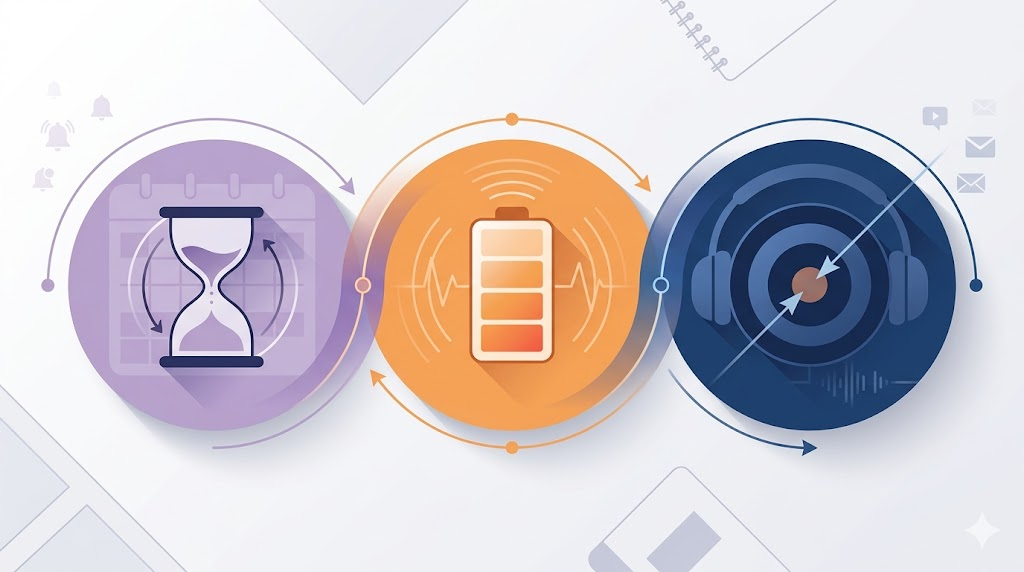
Time, Energy, and Focus
We all have the same 24 hours. That’s the one constant nobody can change. You can make more money, lose money, gain skills, but you cannot manufacture time. It keeps moving whether you use it well or not.
So when people talk about “time management,” they’re only seeing one piece of the puzzle.
Here’s what I’ve learned: you need three things aligned to do meaningful work.
Time: The hours you have available.
Energy: The physical and mental capacity to do the work.
Focus: The ability to direct your attention without distraction.
You can have all the time in the world, but if you’re exhausted, you won’t produce anything worthwhile. You can be energized and have time blocked off, but if you’re in a noisy environment with notifications pinging every two minutes, you won’t get into deep work.
I’ve sat down on Saturday mornings with a full day ahead of me, excited to work on a new talk. I had the time. I had the focus because the house was quiet. But I was wiped out for the week. I stared at my screen for an hour and accomplished nothing.
That’s when I started tracking all three.

The Blank Canvas Problem
There’s another dimension to this that people don’t talk about enough: having something to work on.
You can have time, energy, and focus, but if you’re staring at a blank page, you’re stuck. I used to face this all the time when creating talks or blog posts. The blankness would drain whatever energy I had.
So I stopped starting from zero.
I collect ideas constantly. When I read a book, I take notes. When I notice a pattern in my work, I write it down. When something frustrates me or excites me, I journal about it.
Now, when I sit down to create, I’m not facing emptiness. I have a pool of thoughts, observations, and half-formed ideas to draw from. I’m assembling and connecting, not conjuring from nothing.
That shift made creation feel less daunting and more like assembly.
Productivity by Design
I used to think productivity was about tools. Keyboard shortcuts, multiple monitors, and the latest app that promises to organize your life.
Tools don’t make you productive. They can help, but only if you first understand what you’re trying to accomplish.
I work with four monitors at home, three at the office. But here’s the rule: every pixel I can see must relate to the task at hand. If I’m writing, I don’t have email open on one screen and Teams on another. That’s not productivity, that’s distraction with extra real estate.
When I’m in deep work, I close everything (or put it out of sight) that doesn’t serve the current context. My phone stays on Do Not Disturb 24/7. Only a few selected people can get through. Everyone else can wait.
This isn’t about being unavailable. It’s about being deliberate.
Internal vs. External Interruptions
A few years ago, I learned about the Pomodoro Technique. The mechanics are simple: work in focused blocks, take breaks. But a great lesson was learning to manage interruptions.
There are two kinds: internal and external.
External interruptions come from outside. Someone walks into your office. An urgent text arrives. The building’s fire alarm goes off. You can’t always control these.
Internal interruptions are self-inflicted. You’re writing an outline and think, “I should research this point.” You open your browser. You see a notification. You click. Now you’re reading about something completely unrelated, and 20 minutes have vanished.
I started logging my interruptions. Every time I got pulled away from my work, I wrote it down. Internal or external. What caused it? How long did it take?
At the end of the day, I reviewed the log and looked for patterns.
Then I changed my approach. If I’m creating an outline and realize I need to research something, I don’t do it right then. I write a note: “Research X.” Then I keep going with what I have. When I take a break, I review my notes and decide whether to do that research now or save it for the next session.
For external interruptions, I set boundaries. When I worked in an open office, I wore large headphones. I told my colleagues, “When I have these on, I’m in deep focus. If it’s urgent, interrupt me. Otherwise, leave a note, and I’ll get back to you.”
People respected it because I explained it.
The Recovery Protocol
Interruptions will happen. The question is: how quickly can you get back up to speed?
Before I handle an interruption, I write down two things:
-
What I just did
-
What I’m about to do next
Sometimes I drop a quick voice note instead. Whatever’s faster.
When I come back, I will read that note. It takes me 30 seconds to remember where I was and what comes next. Without it, I’d spend five minutes (or more) trying to reconstruct my train of thought.
Small habit. Massive difference.
The Consumption-Creation Ratio
I read a lot. Books, articles, documentation. I listen to podcasts and audiobooks. I watch instructional videos.
But if all I do is consume, I’m not building anything.
You can read a million books about swimming. Until you get in the water, you don’t know how to swim.
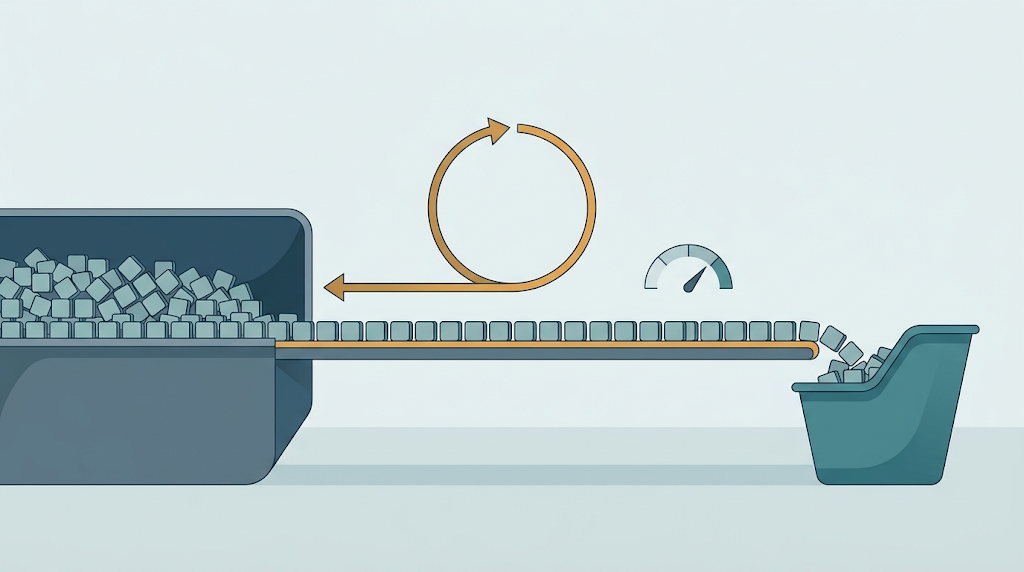
So I track my ratio: for every hour I spend consuming information, I spend at least two hours creating something from it. A blog post. A talk. An experiment. A conversation where I share what I learned.
This isn’t a hard rule. It’s a guideline that keeps me honest.
Creation is how you make knowledge your own.

The Perfectionist Trap
When it comes to creating, it’s common to hit a wall: perfectionism.
We sit down to write a blog post and think, “This has to be perfect before I publish it.” So we revise and revise and never ship.
We outline a talk and think, “I need three more examples before this is ready.” So we keep researching and never give the talk.
Here’s one of my favorite gems from Derek Sivers: You can improve something bad. You can’t improve nothing.
If you create something and it’s rough, you have material to work with. You can refine it, get feedback, and make it better.
If you never create anything because it’s not perfect, you have nothing.
So I aim for “good enough to ship.” I create. I get it out. Then I improve it based on what I learn.
Perfection is a moving target anyway. What feels perfect today will feel incomplete two weeks from now. So I focus on perfecting, not perfection. It’s an ongoing process.

The Shipping Threshold
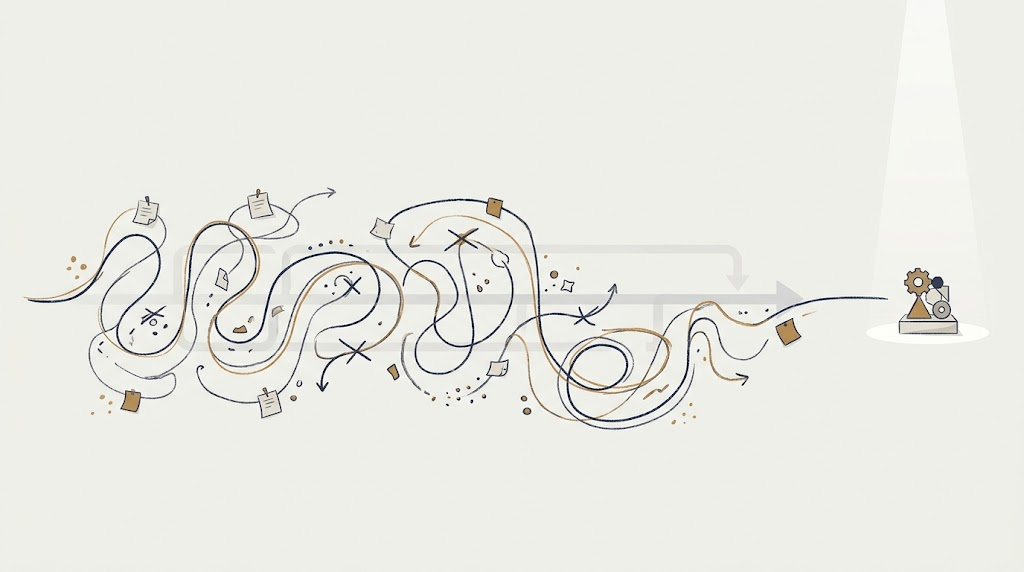
I used to collect ideas endlessly. Notebooks full of outlines. Folders full of drafts. None of it ever saw the light of day.
I was stuck in the creation phase, never crossing into shipping.
So I started putting deadlines on the calendar. If I wanted to give a talk, I’d find a venue and schedule it. Even if the talk wasn’t ready. Even if it was just three friends in a room.
The deadline forced me to make something shareable.
Then I’d get feedback. I’d refine the talk. I’d schedule it again for a bigger audience.
But the first step was always: put it on the calendar.
Constraints are useful. They push you to ship.
Slowing Down to Go Fast
Last year, I noticed something. AI tools made it easier than ever to create content. I could generate outlines, drafts, images, and entire presentations in minutes.
So I did. I created constantly. I was producing more than I ever had.
By Thursday, I was exhausted. Physically and mentally drained.
I realized: just because I can go faster doesn’t mean I should.
I’m not built to run at 150 miles an hour all week. Nobody is.
So I started paying attention to my energy levels. How did I feel on Monday versus Thursday? What happened when I pushed too hard?
I learned to slow down. To be smooth. To pace myself.
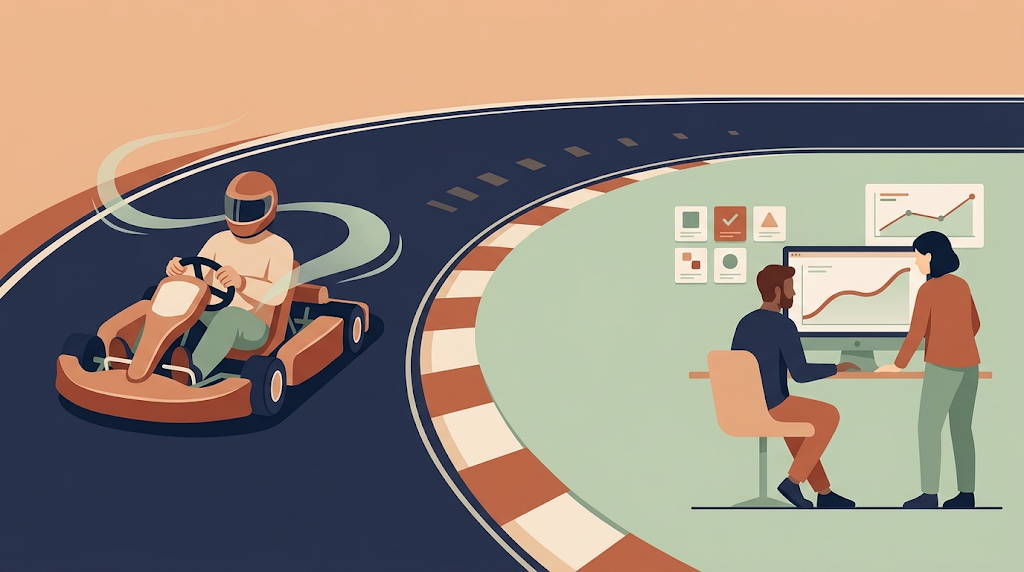
There’s a saying from motor racing: slow is smooth, smooth is fast.
It applies here, too. When you slow down your thinking, you see things more clearly. You organize your thoughts better. When you share those thoughts with others, the clarity comes through.
Rushing makes everything harder.
The Morning Routine
I’m not naturally a morning person. But I’ve learned that if I have an exciting project to work on before I go to the office, I’ll wake up early.
So I design my mornings around that.
If I’m working on a new talk, I’ll wake up earlier and do the work from 7 a.m. until 8. The house is quiet. I haven’t checked my email yet. I have time, focus, and energy.
But here’s the catch: if I stayed up late the night before, I won’t have the energy. I’ll drag myself out of bed, sit at my desk, and accomplish nothing.
So I plan backward. If I want to work on something important in the morning, I go to bed earlier. I shut off my mind before I sleep. I set myself up for a good night’s rest.
This is where journaling helps. At the end of the week, I review my entries. I see patterns. “Thursday morning, you wanted to work on that talk, but you had no energy. You stayed up late on Wednesday. What are you going to do differently next time?”
If I don’t write it down, I forget. Life moves fast. We don’t learn from what we don’t remember.
Work-Life Balance Is a Myth
I don’t like the term “work-life balance.” It implies work is separate from life.
Work is part of life. So is health. So are hobbies, relationships, and rest.
I think about it as one life with different areas. I adjust the dials based on what needs attention.
Some weeks, I turn up the work dial because I’m shipping something important. Other weeks, I turn up the health dial because I’ve been neglecting it. Some weeks, I focus on hobbies because I need creative space outside of work.
It’s all life. I’m just managing the mix.
I also blur the lines between personal and professional practices. At work, we use Scrum. We have backlogs, daily scrums, and retrospectives.
Why not use that in my personal life?
I have a personal backlog. When I want to create a new talk, I add it to the backlog. I break it into tasks: define the title, write the description, do research, create the outline, and build the slides.
I move those tasks across my board just like I would at work.
Tools are tools. If they’re useful, I use them. I don’t care whether they came from my professional or personal life.
Creating This Talk
I want to share how I created the talk this blog post is based on.
An Improver asked me to speak about time management. I’d given talks on the topic before, but I wanted fresh content.
So I went to my blog. I used AI to pull every post I’d written about focus, energy, and time management. I dropped them into NotebookLM.
I didn’t ask the AI to “create a talk about time management.” I gave it my content. My thoughts. My experiences.
Then I prompted it: “I need a one-hour presentation on this topic. Suggest titles.”
It gave me options. I picked “The Trinity of Productivity.”
I asked it to write a description. It did, with citations showing where it pulled from my posts.
I had it create a mind map. An infographic. A slide deck. Audio overviews where AI hosts discussed my ideas in podcast format.
I listened to those podcasts. Hearing my own thoughts reflected back in a different voice helped me see new angles.
Then I gave it one final prompt: “Turn these sources into a slide deck for a 60-minute presentation for the Women’s Speakers Program. Balance time, energy, and focus equally.”
It generated the slides I presented.
Were they perfect? No. But they were good enough to ship. I presented the talk. I got feedback. Now I can refine it.
The key: I didn’t start from a blank canvas. I started from years of writing, thinking, and journaling. The AI helped me organize and shape what I already knew.
That’s the power of collecting your thoughts over time.
What I’m Taking Forward
I’m still learning how to balance time, energy, and focus. Some weeks, I get it right. Other weeks I don’t.
But I’m paying attention. I’m journaling. I’m tracking what works and what doesn’t.
I’m designing my productivity instead of letting it happen by default.
And I’m shipping. Not perfectly, but consistently.
What about you? When you think about your most productive moments, which of the three was aligned: time, energy, or focus? And which one tends to be missing?


Leave a Reply