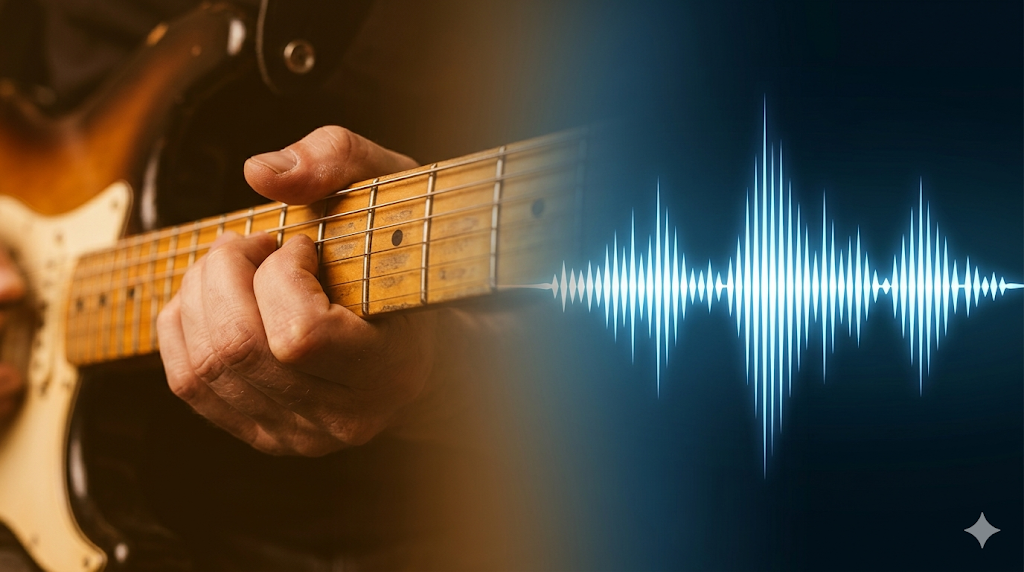
I’ve been making music for a long time. Not as a profession, but as an outlet, a way to get thoughts and feelings out, to sit with an instrument and figure out what’s possible. A few weeks ago, a friend sent me an AI-generated version of one of my songs, created using Suno. It was interesting enough that I decided to run an experiment: could I use AI tools to create the orchestrated versions I hear in my head but don’t have the skills to write myself?
The short answer is no. At least not yet for me. But the longer answer is more useful.
Here’s a video of my first experiment with AI music.
The Setup
I have a song called “Captive” that I recorded years ago with my old bud Robert on vocals. It’s a seven-string guitar tuned down a whole step, layered with drums I’m actually proud of writing, and vocal melodies I helped shape with Robert. When I uploaded it to Suno and asked it to create a classical orchestrated version, I was curious what it would do.
What it created was polished, clean, and completely generic. The production was better than my original mix. The sound was professional. But it wasn’t my song anymore. I couldn’t connect with it.
That’s the thing I noticed right away: the AI version sounded like a lot of other things. It lacked the specificity that comes from sitting with an idea, playing it over and over, making choices about why a riff lands the way it does, why a drum pattern works in that moment. The AI version had no reasons. It just had options.
Important note: this is a summary of my very first experiment using Suno, not really knowing how to use it.
The Second Experiment
I decided to try something different. I took a newer song I’d recorded called “Hindsight,” where I’m singing, and uploaded it to see what Suno would do with my vocals. I wanted to know: would I like the AI interpretation better than my own? Could I learn something from how it sang the lines?
Again, the output was polished. The drums were tighter than anything I can play. The arrangement was fuller. But the vocal delivery sounded generic in a way that bothered me. It sounded like a lot of metalcore singers from the last twenty years, all blending together. There were moments I liked—a few vocal deliveries I thought, yeah, I could learn to sing like that. But mostly it felt like the AI was filling in the gaps with the most statistically likely choice.
And that’s exactly what it was doing.
What I’m Learning
Here’s what’s becoming clear to me: the things I make music for are not the things AI is good at.
I make music because I want to sit behind a drum kit for an hour, try things, fail, try again, and find two minutes of something that feels true. I make music because I want to struggle with a riff until I understand why it works. I make music because I want to hear my mistakes clearly, without correction, so I can actually learn from them.
I don’t auto-tune my vocals. Not because I’m stubborn, though maybe I am a little. But because if something is fixing my mistakes, I might never realize I’m making them. I want to hear the pitch issues. I want to feel them. That’s how I get better.
The AI tools I’ve tried are optimized for a different goal: making something that sounds good fast, something polished and professional. That’s genuinely useful if you need background music for a game, or if you want to hear what a song could sound like in a different style. But it’s not useful for what I’m trying to do, which is to build skill and create something that carries the weight of my actual choices.
The Limits of Leverage
I went into this thinking maybe I could use AI as a collaborator, the way I might bounce ideas off a bandmate. I couldn’t get that experience with the tool yet.
There’s a version of this that could work for me: if I had a tool that let me say, “Here’s the drum section I wrote. Give me three different interpretations, and I’ll pick the one that resonates,” that would be useful. That would be like working with a drummer.
What Stays
I still want to create orchestrated versions of some of my songs. I still hear them in my head with strings and arrangements I can’t write.
The AI experiment was worth it, though. It clarified something important. The joy of making music for me isn’t in the polished output. It’s in the process of figuring things out, of making choices that are specifically mine, of hearing my mistakes and knowing I can do better next time.
That’s the thing I cannot outsource. And I don’t want to.
I have run a few more experiments and will share the results in other posts.
Coincidentally, when I was preparing this post, this TED talk showed up for me: A survival guide for musicians in the age of AI.


Leave a Reply