Some conversations start in one place and end somewhere completely different. Episode 23 of Reflective Practice Radio was one of those.
Matthew and I began by catching up since the last episode, which we recorded live at Improving with colleagues in the room. I mentioned I’d been finding my footing through some life changes. Matthew asked a simple question: How do you find opportunity in adversity? That question pulled us in several directions over the next hour.
The Two Questions Worth Asking
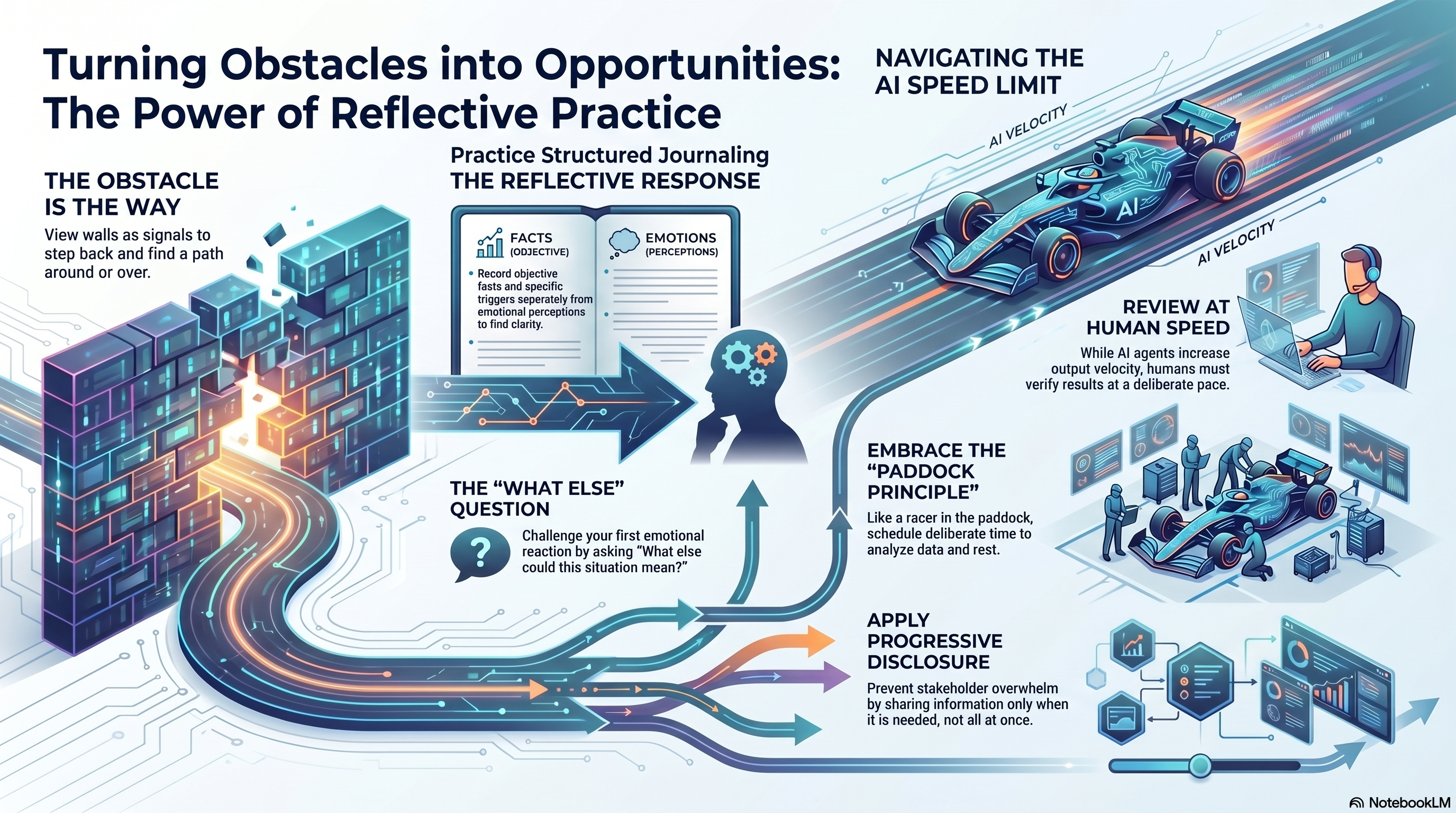
The conversation opened on a callback from the last episode’s improv discussion. When you run into a wall, you don’t stare at the wall. You take a step back and look at what else is there. That habit of reframing connects directly to how I think about adversity.
Two questions I’ve learned to ask myself: what can I do about this, and what will I do about it? They’re not the same question. The first maps the territory. The second requires a decision. Knowing you could do something doesn’t mean you should, or that you will.
There’s a performance journal template I first encountered through an Improving training. When something goes sideways, it walks you through writing down what happened, not how you feel about it, and then what you felt, and then what triggered it. Separating the facts from the emotion on paper is different from trying to do it in your head.
The trigger is often something old. It’s not the words someone said today. It’s something from years ago that those words activated.
What Else Could It Be?
Another useful question I learned to ask myself: What else could this be?
A first reaction is almost always emotional. It’s rarely accurate. When I’ve paused to ask what else the other person might have meant, that “what else” tends to be closer to the truth than my initial read.
The hard part is remembering to create that buffer before reacting.
I shared a story from Derek Sivers, from one of his books, about a car accident he was involved in as a teenager. He believed for 20 or 30 years that the woman in the other car had been permanently injured, that she could no longer walk, and that it was his fault. He carried that guilt for decades. When he finally found the courage to track her down and apologize, she opened the door, walked across the room to greet him, and told him the accident was her fault.
Two people. Decades of guilt. Both wrong about what actually happened.
One conversation cleared it.
Matthew’s point landed cleanly: better sooner than later, even when it means ripping off the band-aid. The longer things go unaddressed, the further the ripples travel, and some things can’t be reversed once enough time has passed.
Being the Person in the Middle
Sometimes you’re not the one in the conflict. You’re the one who can see both sides, which creates its own kind of pressure.
I’ve been in that position. I knew enough about both parties to understand the misunderstanding clearly, but the timing wasn’t right to say anything. Matthew pushed on this thoughtfully. If you’re uniquely positioned to help and you stay silent, that’s a choice with consequences too. The ripples keep spreading.
There’s no clean formula for when to intervene. What I keep asking myself: does this need to be said? By me? Now? All three questions matter.
Journaling as Time Travel
Matthew is raising a five-year-old, and summertime is its own puzzle: one car, gymnastics ending at 4:15, and a job that still requires showing up in person some days. He’s figuring it out.
What stayed with me was how he talked about journaling alongside all of it. His phone rotates through old photos of his daughter. He’ll pick it up and see her at two years old. What the journal gives him is context alongside those images. He can go back and see what he was thinking, working on, and talking about during that period. Not just the picture, but the texture of that time.
I told him what I tell a lot of people: it goes fast. Much faster than you expect. Be there as much as you can.
He also made the point that knowing yourself improves decision making. When you have principles rooted in self-knowledge, questions like “is this something I would do?” become easier to answer. The journal is part of how you build that record of who you are.
AI as a Music Partner
The conversation shifted when I started talking about AI and music.
The AI-generated music that gets millions of streams, built on fake personas with no human behind it, does nothing for me. I need to know a real person was feeling something when that music was made. Without that, there’s no connection.
What I’ve been experimenting with is different. I took one of my own guitar recordings, a piece I’d been doodling between Pomodoro sessions for years, and a set of lyrics I wrote after watching a Netflix show called From Scratch. I fed both into Suno and asked for something heavy, a gothic ballad feel with a specific approach to the vocals. What came back gave me goosebumps, because those were my melodies and my words. I was hearing my material through a different band.
Then I used the output as a practice tool. The vocal delivery the AI produced had nuances I don’t know how to do yet, moving between chest voice and head voice in ways I haven’t built. Because I’m invested in the material, I’ve been listening to it constantly and working to reproduce what I’m hearing. It’s been improving, slowly and in patches.
Matthew compared it to inputting a melody into Logic Pro and swapping out the instruments. Same melody, different timbre. You didn’t play it on strings, but you wrote it. That’s close to how this feels. The human fingerprint is what makes it matter.
The Paddock
The conversation moved into AI velocity and what it’s doing to the rhythm of work.
I mentioned a few months back that I’d been exhausted by Wednesday some weeks, not from the work the agents were doing, but from the cognitive load of planning what to give them and then reviewing what came back. By the third or fourth day of a sprint, I had double what I used to ship in two full weeks. And someone still has to review it at human speed.
Matthew made a sharp observation: the more you step out of the orchestration and let agents hand off to each other, the more you accumulate at the end that you’re still responsible for reviewing. Your name is on those pull requests. That accountability doesn’t delegate.
I’ve been working out how to handle sprint reviews in this environment. I take quick notes in Obsidian as I go, and I say the work out loud in our daily scrum so it’s in the transcript. The day before sprint review, I pull all of that together and design the story arc: what do stakeholders need to see, where do we stop and ask for feedback, what needs to be set up in the environment before the demo. I’m also experimenting with creating short graphic novel versions of stories to send as sprint review primers: two or three pages, a teaser before the meeting.
We also talked about progressive disclosure, a concept from UX that applies to onboarding. You don’t hand a new team member the entire documentation library at once. You open it progressively, so each layer builds on what came before. We imagine a future where an agent listening in a meeting could surface a diagram from the codebase in real time, as the question is being asked, instead of producing an artifact in post that someone has to go back and try to connect to the conversation they half-remember.
That’s the racing analogy I often use. Someone who shows up at a track day on their street bike, gets caught up in the excitement, pushes past what the bike was built for, and gets brake fade. They crash. And then they have no way to ride home, because the vehicle they brought for that speed wasn’t set up for it.
Sprint review is the paddock. It’s the session after the fast session, when you look at the data and ask whether you need to change anything before going out again. We have more features to show now. That’s not a problem in itself. But the question of whether we should slow down the next sprint or keep pushing needs to be asked.
Matthew put it plainly: we’re going to have to answer that question from reality instead of desire, and for a lot of people, the answer is only going to come after something goes wrong.
Moving at Natural Speed
We ended where we always seem to end: somewhere we didn’t expect to be.
Matthew said he likes the unscripted format of this podcast because it lets him move at a natural speed. Everything else is pushing toward faster. Here we just talk. I feel the same way.
Constant speed isn’t speed. You need to slow down to feel the acceleration. You need turns to make the straight lines mean something.
If any of these threads resonated, the full conversation is worth watching.


Leave a Reply