A few weeks ago, Dave Prior invited me on his Drunken PM Radio podcast to talk about AI and Scrum teams. It was a great conversation, and one question he asked has stayed with me: does AI fundamentally change what it means to be a developer?
My honest answer: it depends entirely on how you define yourself.
I don’t think of myself as a software developer. I think of myself as a solution developer. That distinction has mattered to me for 30 years, and it matters even more now.
You can listen to the full conversation on Drunken PM Radio.
I’ve Seen This Movie Before
When I started in IT, I was the kid showing up with spreadsheets and database tools, disrupting the folks running mainframes and punch cards. They weren’t wrong to feel the shift coming. They were just focused on the wrong thing.
Today, non-developers are using AI to prototype solutions the same way they once used Microsoft Access to build homegrown applications. Those early Access databases eventually hit their limits: scalability problems, architectural debt, brittle data models. Someone had to step in and fix things properly.
The amateur AI solutions being built today will hit the same walls. And when that happens, the people who understand both the technology and the business context will be exactly who gets called.
What Happens When the Team Shrinks
About 18 months ago, my team shrank. We lost our business analyst/Scrum Master, a QA, and full-stack developers/DevOps. The remaining team members sat down together and asked: What’s our process, and where might AI help fill these gaps?
The first thing we tackled was user stories.
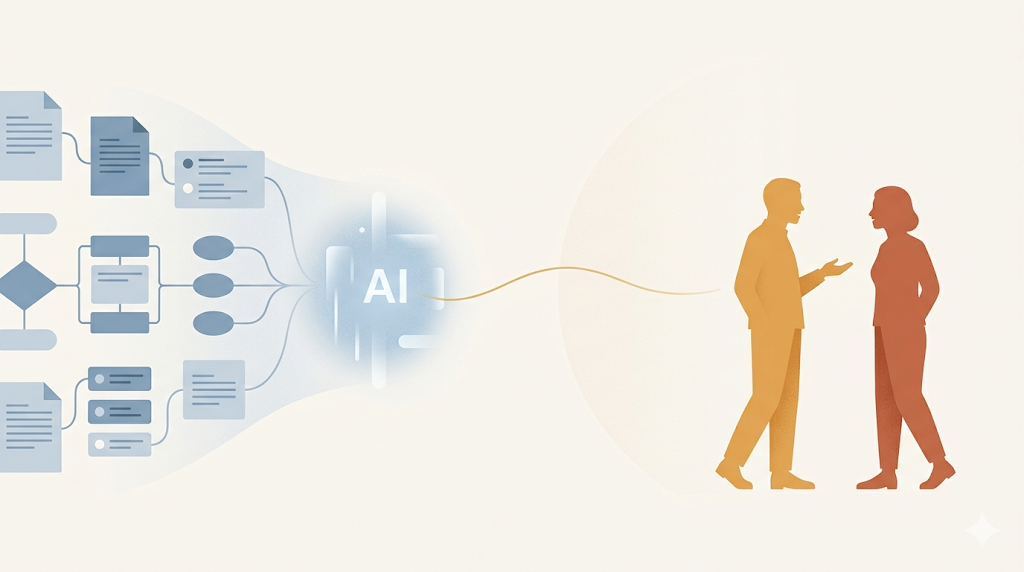
Before the downsizing, writing and refining stories was a multi-hour team process. We had structured conversations, poked holes in each other’s thinking, and applied a specific set of principles about human-centered versus system-centered storytelling. So we codified those principles and gave them to the AI, along with transcripts from stakeholder conversations, and asked it to cut stories from that.
The output wasn’t great at first. But I treated it exactly the way I’d treat a new BA: I reviewed the stories, explained what I liked and didn’t like, gave specific feedback, and had it revise its instructions. We iterated until I got to a point where I read the output and thought: yeah, that’s how I would have written it.
The Part That Surprised Me
After we refined the stories, I started asking the AI: what questions should I ask the stakeholders next? And the questions it gave back were genuinely good. Things I hadn’t considered. Gaps I hadn’t seen.
That’s when it clicked for me. The AI was making my thinking sharper.
Now I use that same approach for everything I don’t want to be the bottleneck on: writing tests, creating implementation plans, and decomposing stories into tasks. That frees me to focus on what I actually enjoy: high-quality conversations with stakeholders, real listening, and eye contact. That’s what I’m optimizing for.
The Identity Question
If your professional identity is tied to writing code, AI does feel like a threat. I understand that feeling.
But if you define yourself as someone who solves business problems using whatever tools make sense, then AI is just the latest in a long line of tools. And a very powerful one.
The developers who will thrive right now are the ones who take their principles, their taste, and their deep understanding of what good looks like and codify that into their AI workflows. You’re not being replaced. You’re being given the ability to scale yourself.
Leaders Versus Managers
Dave asked me what advice I have for leaders bringing AI into teams without alienating the people on those teams.
There’s a distinction: managers and leaders are not the same thing. A bad manager might look at AI and think, “I can replace this person with this.” A good leader asks: “Now that this task is handled, how do I best use this person’s knowledge and skills somewhere more valuable?”
Here’s an example. Customer support roles are getting automated quickly. But the person who was great at picking up the phone, building rapport, and genuinely understanding what a customer needed? That person doesn’t disappear. They might become a product owner. They might create better marketing collateral because they actually know the customers. AI opens doors. Leaders use those doors to bring people through.
How This Connects to My Daily Work
I also mentioned my daily blogging workflow during the conversation. I record my raw thoughts while driving, run them through an AI trained on my voice and style, then review and refine the draft myself. Dave picked up on something important: I’m not having AI write my blog. I’m pairing with it. My words, my ideas, my voice. It helps me get from raw to ready faster.
Human intent still has to come from somewhere. The curiosity, the relationships, the judgment. Those don’t transfer. What transfers is the mechanics.
What I’m learning is that the most important question about AI at work isn’t “will it take my job?” It’s “what does this free me to finally focus on?”



Leave a Reply