
There’s much conversation right now about what AI can do. The processing power, the parameters, the emergent capabilities nobody fully understands yet. The question I keep asking: what does it enable us, as humans, to do?
A Line at the Window
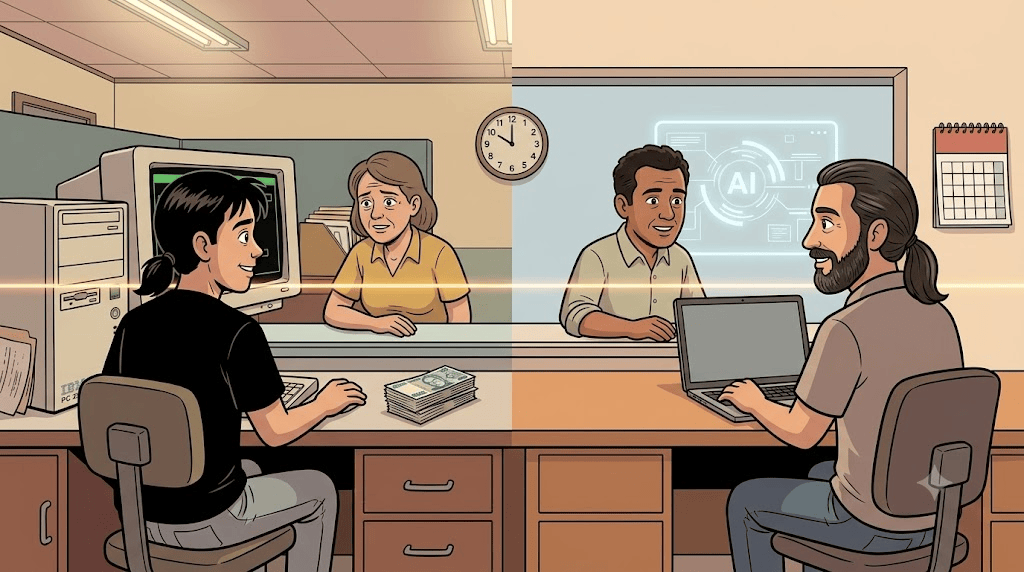
When I started in IT in the mid-90s as a teenager in Brazil, I worked as a financial clerk at a real estate company. My job was to process mortgage payments from clients who came in to pay in person, bringing their cash or their checks.
This happened on the 5th and the 20th of every month. Those were paydays. And because of hyperinflation at the time (look up Brazil in the 1990s if you want the full picture), people had to pay their bills on the exact day they got paid. The next day, their money was already worth less.
So on those two days, a line would form at my window. Clients had to come during their lunch break, wait in line, and get back to work. Some missed lunch entirely. Some were late returning. You could see the frustration on their faces.
But there was another emotion too: relief. And sometimes joy.
When someone had managed to save a little extra that month, they could pay toward their mortgage principal — making an early payment that removed compound interest and shaved time off their loan. That meant bringing a promissory note from 15 years in the future to the present, calculating the amortization, and processing it properly. To do all that, I needed a financial calculator (the HP-12C, specifically), the paper promissory notes from a walk-in safe, and a fair amount of time (I was 16 years old!).
Some clients would count out their bills on the counter. Literal cash, for people who didn’t even have a bank account. Counting what they’d managed to set aside that month to pay down their house. To own that house.
Thirty-four years later, I still get emotional thinking about it.

What Computers Changed
The system analyst and programmer at that company, who became my first professional mentor, figured out how to write the amortization formula into our software. That eliminated the HP-12C calculation step. What used to take several minutes of careful keystrokes on a calculator now happened in seconds on screen.

But the software couldn’t retrieve the promissory notes from the safe for us. That was still a physical, human step. So I worked out something simple: I asked clients to call me the morning of their visit, or the day before, if they knew they were planning to make an early payment. I’d go to the safe, pull the notes, keep them in a locked box on my desk, and have everything ready when they arrived.
When they came in, we’d say hello. I’d ask how things were going. We’d process the payment. And then, because we weren’t scrambling anymore, we’d actually talk. About life. About what was coming up. About how they were doing.
The computer gave us speed. What that speed actually bought was space to be human with each other.
The Same Question, 35 Years Later
I carry the same lens into conversations about AI now.
I don’t focus on parameter counts or benchmark scores. I’m genuinely grateful to work at Improving with people who understand that deeply, because I can ask them when I need to know. My focus is: what does this tool free us up to do?
The customer support person clicking through a dozen screens while a frustrated client waits on the other end of the call — can AI compress that lookup into seconds? So they can spend more time being present, getting past the immediate fix, and actually getting to know the person. What else is going on. What might be coming up.
That’s what gets me excited about AI: what it does for the people on both sides of the interaction.
What I’m learning is that this has always been my instinct. From a real estate office in Brazil to a consulting career built around software and people, the question hasn’t changed: how do we use the tools at hand to make more room for what actually matters?

Leave a Reply