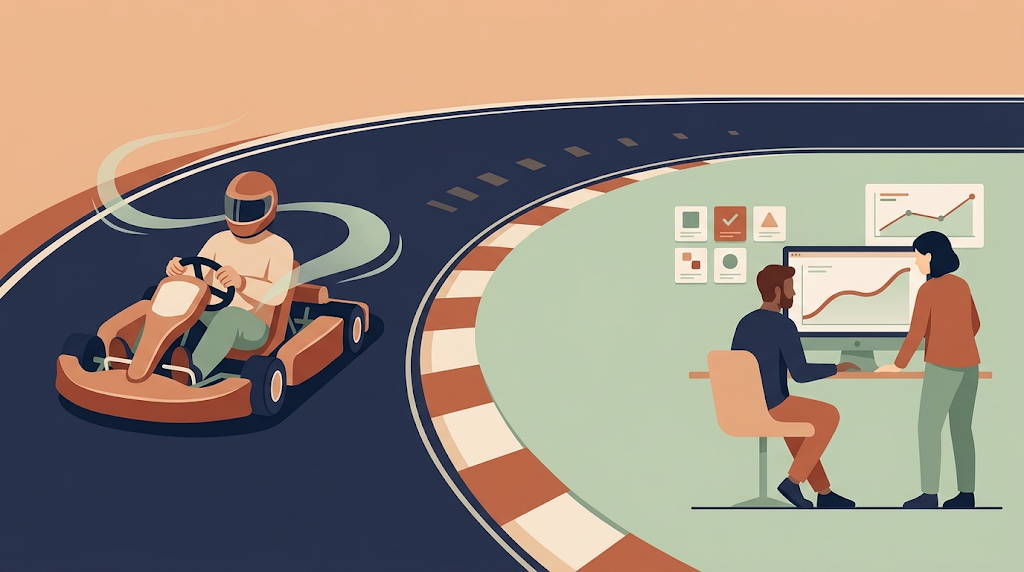
In the early 2000s, not long after I moved from Brazil to the US, some coworkers took me go-kart racing. I had never done it before. It was, and still is, expensive in Brazil, so the chance to try it here felt special.
When I asked how long a session lasted, they said seven minutes. Seven minutes? That sounded like nothing. I bought ten sessions, sure I could do that all day.
By the end of the second session, my arms hurt so much I could barely wave goodbye. I saved the rest for another time.
When I came back, I paid attention to how I was driving. I gripped the wheel tightly, kept my arms stretched out, and held my breath through parts of the track. I barely moved in the kart. No wonder I was exhausted.
I started noticing where I held my breath and letting it out. My arms and body relaxed. I also loosened my grip when I did not need to steer sharply. After a few visits, I could drive several sessions and still have energy left. I was enjoying the ride more, too
 Riding at Kart Granja Viana, in Sao Paulo, Brazil, years later; that’s where F1 drivers go have fun in their off-season.
Speed changes what comes at us
I had the same experience riding motorcycles on a racetrack. At higher speeds, things came at me faster, and I would tense up and hold my breath. I had to learn to look further ahead and start preparing to enter the braking zone with composure.
 Gratuitous “Check out when I was cool” pic.
My work with AI tools has started to feel similar. I get more output, and more decisions land in front of me at once. I get tired sooner.
When I use AI to plan work, I need to keep track of how much context the task requires and how closely I need to watch it. Sometimes, with the right process and checks, I can let the AI carry the work forward while I step away. I wrote about one example in Building a Development Harness I Can Trust. The harness gives each step a defined job, checks its output, and pauses for my review at key points. That structure helps me decide when I can let the work continue and when I need to take the wheel.
The sprint has a human-speed ending
If a team finishes fifty stories during a two-week sprint, the stakeholders still need time to understand what changed and give useful feedback. They cannot switch between features at the same speed the team built them.
Waiting until the final demo to explain a pile of work is like driving full speed and slamming on the brakes at the last turn. We can start slowing down earlier by consolidating what we built and giving the demo a clear thread.
Or we can shorten the track. A one-day or two-day sprint might work better when the team can build quickly and needs feedback more often. The point is to find a pace that gives people enough time to see the work and respond to it.
Faster building leaves time to validate
We find out whether a feature solves a problem by putting it in the hands of the people who will use it. Their experience matters, and so does what the data shows.
Say we changed a feature because a task took too long. Someone might tell us the task feels faster, but if they are doing other things at the same time, their sense of time may not be accurate. We can record when they start and finish the task, then ask how the experience felt. Those two signals tell us more than either one alone.
We can plan for that while designing the feature: decide what we want to improve, what information will help us measure it, and when to ask for feedback. For example, the app could ask a brief question when the person finishes the task.
Teams do not always have the time or the roles to build that whole experience. There may be time to deliver the feature, but not to add the measurement and feedback that would tell us whether it worked. AI-assisted development might give us some of that time back. We could spend it on validation instead of using every saved minute to build another feature.
Ease off before the turn
I am still learning when to relax my grip and when to pay closer attention. When the work starts coming at me faster, I want to look further ahead and ease off before I reach the turn. I have more to learn about getting that pace right, for myself and for the people who need to make sense of what we build.


Leave a Reply