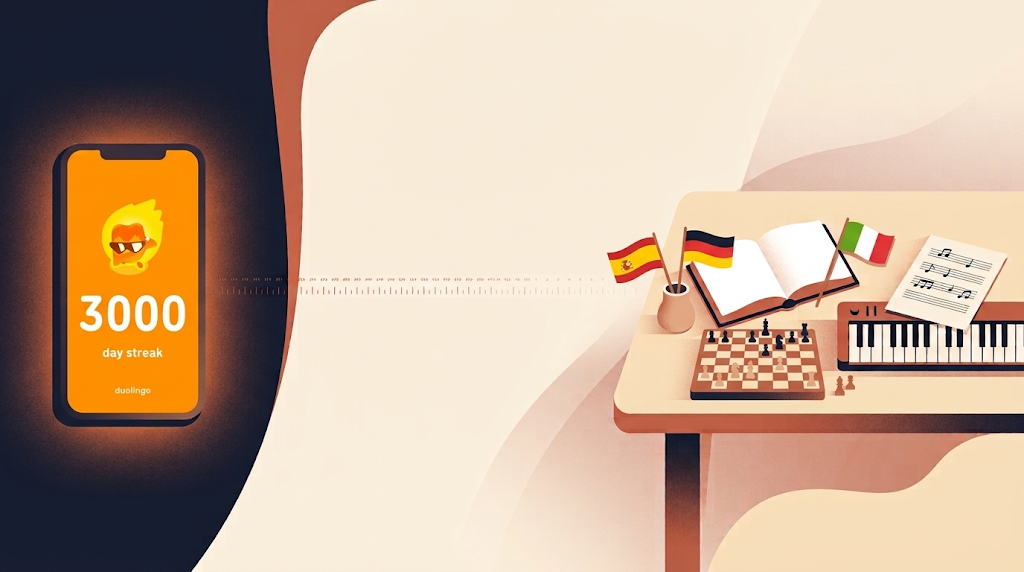
I hit a 3,000-day streak on Duolingo yesterday. This run began on July 27, 2018. I first joined the app in March 2014.
About three months ago, I decided I’d stop when I reached 3,000 days. I’m going to remove the app from my phone and leave my account open in case I want to return.

From Spanish to Italian and German
I first mentioned Duolingo in my 2017 annual review. I had used it for Spanish in 2015, taken a break, then returned in 2016 to redo the course. After that I moved on to Italian. My longest streak at the time was 144 days.
In January 2018, I wrote about earning Duolingo’s Golden Owl for Italian. It took about four months of focused study, and I finished the course after a 158-day streak. I could recognize more words and understand simple sentences, but I wasn’t fluent. That wasn’t the goal.
My 2018 annual review records what came next: I finished Italian, then German, and used both on a trip to Europe. The streak passed 300 days before I broke it by completing a lesson a few minutes after the counter reset. I started over, reached 175 days, and lowered my daily target from 50 XP to 20 when I was short on time.
By the time I wrote my 2019 annual review, the streak had reached 526 days. I was spending at least ten minutes a day on a language, had returned to Spanish, and was also watching videos for more exposure. The point was to learn enough to use the language, not to become fluent in everything.
The practice kept changing
In my 2023 annual review, I mentioned starting Duolingo’s Music course. I had written songs for years but couldn’t read music. In a post about learning sight-reading with Duolingo, I explained what I wanted from it: read and write parts of my own music to make recording easier, and learn a few simple songs on piano from sheet music. I wasn’t expecting to learn piano by tapping notes on a phone. My 2024 annual review says I was still practicing daily and making gradual progress. Later, the short bass clef lessons and songs (outside of my musical taste) in the app stopped holding my interest, so I quit.
Learning beyond the app
In April, Matthew and I talked about Duolingo in Walking the Track: Why Slowing Down Helps Us Go Faster. We discussed the option to pay to restore a broken streak and whether the app was helping people learn or mainly keeping them engaged. I had been using Duolingo for twelve years and was still maintaining my own streak. The question felt less abstract when I looked at how much attention the app asked for after each lesson: sometimes six, seven, or eight screens of badges and rewards. I do not like that level of gamification.
Then, in June, I traveled to Cancun and tried using Spanish in restaurants and at the hotel. I wrote about it in Learning Out Loud, Then Meeting the People Who Were Listening. I used the wrong word, saw the confusion, got corrected, and remembered the right one. Those exchanges showed me what the lessons had prepared me for, and what they couldn’t do on their own.
In August, I wrote several posts about the five-minute Spanish practice. In Pick the Right Goal-Setting Tool for the Season, I described using Kaizen: practice for five minutes, then check whether I was learning, enjoying it, and wanted to continue. Tiny Experiments Beat Big Plans framed Duolingo as a three-month experiment. In Track Less, Learn More, I wrote about logging the date and what I had done, even if all I had to report was five minutes. And in Use Curiosity, Not Certainty, to Start, I put the idea as a question: What happens if I do Duolingo for five minutes a day for three months?
Looking at those posts now, I can see that the useful part was the practice and the regular check-in: was I learning, and did I still want to continue? The streak counted days in the app. It couldn’t answer those questions for me.
Where I want that time to go
For the last six months, I’ve mostly focused on chess. A quick match can take five minutes, or it can turn into twenty. I often played because picking up my phone was easy, even when I could have been reading or making music.
I’ve deliberately spent less time reading while focusing on creating and other priorities. Now I want to make room for reading again and spend more time on my own music. Removing the app will make it less automatic to start another match.
I’m glad I kept the streak. Duolingo helped me practice languages, reach goals I cared about, and try a few other things. I don’t need another lesson or another badge to recognize what the habit gave me. I’m ready to leave the account open, take the app off my phone, and use that time differently.




Leave a Reply