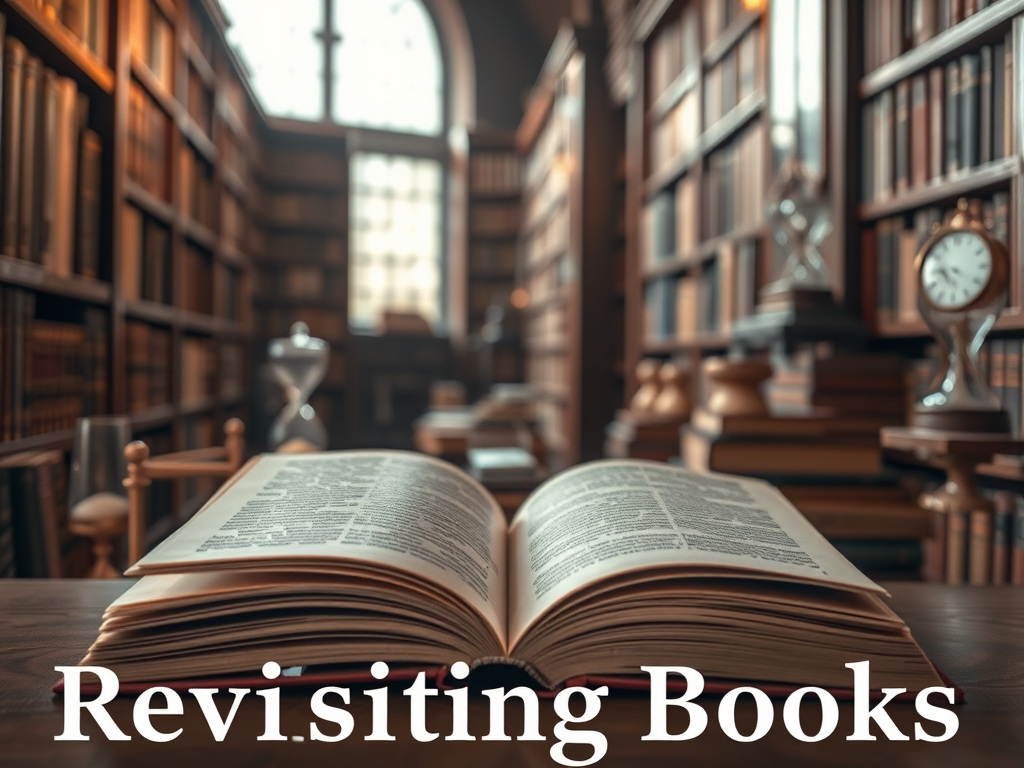
After calculating how many books we have left to read, what’s the case for rereading a book?
Remember: the quantity of books we read isn’t essential; the habit of always reading is.
In other posts and videos, I talked about how I approached learning in a spiral, understanding where I am, and trying to see how I got here through a refreshed perspective.
If you prefer listening to reading…
I’ve reread books I enjoyed the first time and enjoyed more the second time, as well as a few that I did not enjoy.
I haven’t re-read a book I didn’t enjoy the first time. But that could happen; the books we read don’t change. We change.
It’s like watching a movie that has a plot twist.
Sometimes, when I finish a movie, I want to go back and rewatch it (if I enjoyed it), paying attention to things that were right there under my nose but that I missed, as well as other details that I remember “looking at” but not “seeing.” The movie hasn’t changed; my understanding of it did.
It is also similar to me re-watching Friends, the sitcom, after so many years of living in the US. Now I can understand jokes that, decades ago, didn’t make a lot of sense to me, but now they do.
It is another example of learning in a spiral.
Considering the limited number of books we can read, how do we decide which books to reread?
Some books were very influential earlier in my career, and I have recommended them to people for years. However, there comes a time when I wonder, “Should I still recommend those books? Have they aged well?” So I re-read them. I have been doing so in book clubs at Improving; besides leveraging my own renewed perspective, it’s also interesting to see through the perspective of others who are reading the books for the first time, some at an early stage in their careers, others at a late stage. Here are some examples of such books and how many years had passed in between reads:
- Head First Design Patterns, 18 years
- Working Effectively with Legacy Code, 14 years
- The Pragmatic Programmer, 12 years
Another benefit of rereading those books is that they reminded me of where I learned some techniques and practices that I had forgotten the source.
The longest gap between two reads of a book is 34 years; I read “The Power of Your Subconscious Mind” when I was 11 or 12 years old. I remember reading it once or twice again before turning 15, and something in it resonated and stuck with me for decades. When I reread it thirty-four years later, I realized I’m glad I read it when I did; if I had picked up the book a little later in my teenage years, I might not have read it through the end.
Sometimes, I want more people to know the lessons in a book. For example, in 2020, I read “Badass: Making Users Awesome” and immediately put the lessons into practice. I was so happy with the results that I wanted to share that gem with more Improvers, so I ran a book club and reread the book the following year.
That book also belongs in an interesting group: the books I’ve reread in consecutive years.
Another one in that group is Trevor Noah’s Born a Crime; I enjoyed reading it a lot and decided to listen to the audiobook (brilliantly read by Trevor) the following year. Around that time, I was also reading Nelson Mandela’s autobiography, Long Walk to Freedom. Both books cover an overlapping period in South Africa’s apartheid, and I was interested in learning about that through their unique perspectives.
Another short group consists of books I’ve read more than twice. Three books have been read four times (Derek Sivers’ How to Live and Your Music and People, and Ryan Holiday’s The Daily Stoic), all in consecutive years. I find or ponder something different every year when I read these books.
Since taking the Read to Lead Challenge and making rereading a habit, about 20% of the books I’ve read between 2020 and 2024 have been rereads.


Leave a Reply