
Over the past few years, visual thinking has captured my attention in new ways. It’s a thread that has pulled me backward, revisiting old habits, and forward into new possibilities for learning and collaboration.
Drawing as a Bridge
Years ago, a colleague recommended The Back of the Napkin. At the time, I was frustrated: I often had a clear picture of an idea in my head but struggled to put it into words; sometimes because I couldn’t find the right words, sometimes because I couldn’t find the right English words. I could see in people’s faces when my explanations weren’t landing.
Drawing changed that. Even with crude sketches, I could put something concrete in front of people. It moved the conversation forward. That book provided me with tools to practice, and soon I was sketching ideas ahead of sprint planning, reviews, and backlog refinements. The results were clear: shared understanding came faster, and collaboration improved. People told me my drawings helped, so I kept going.

Books That Shaped My Journey
- The Back of the Napkin → a starting point for sketching ideas.
- See What I Mean → introduced comic strips and storyboards, a great companion for user stories.
- UZMO: Thinking With Your Pen → practical tools for capturing and creating content visually.
- Understanding Comics → deepened my appreciation of visual language.
- Graphic novels and comic-style nonfiction → proof that drawings can clarify complex ideas.
Here’s one of my experiments mixing techniques I learned in See What I Mean and UZMO: Given-When-Then: Past, Present, and Future.
A phrase I discussed with a coworker stuck with me: “We think in images, but we communicate in words.” Except that not all of us think in images.
Visual vs. Verbal Thinkers
Around 2019, I read Jordan Peterson’s 12 Rules for Life. My impression: dense, wordy. Later, I learned why. Peterson is a verbal thinker. He thinks in words. His wife, however, is a visual thinker. That contrast clicked for me.
Then came Temple Grandin. Her book Visual Thinking showed me that there are three main types of thinkers:
- Verbal Thinkers
- Object Visualizers (concrete images; this is me)
- Spatial Abstract Visualizers (patterns and relationships; this is my friend Daniel)
Daniel once presented design patterns “visually,” but what appeared were abstract diagrams rather than the concrete pictures I imagined. Grandin’s framework explained the difference.

Experimenting With Assessments
Grandin’s book includes an 18-question questionnaire to assess thinker types. Curious, I built a prototype tool in Google AI Studio:
- Users answer the 18 questions.
- Results are processed through Gemini.
- A chart shows where they fall on the spectrum.
The key word is spectrum. I may lean toward object visualization, but I also score in spatial and verbal thinking.
This made me reflect on my strengths. Grandin herself has said she struggles with algebra and programming. Musicians, she notes, often score high in spatial thinking. That gave me perspective on where I fit.

My Strengths in Practice
A colleague once told me my superpower is handling abstract thinking—being comfortable with “cloudy” areas while still seeing the big picture.
That plays out in coding:
- I spot code patterns visually (anti-patterns like “arrowhead” leap off the page).
- My instinct isn’t “this doesn’t read right.” It’s “this doesn’t look right.”
The same applies to music. When I write songs, I don’t go linearly. I build the structure, leave gaps, and circle back. I organize from above, like a map.
At the same time, I have verbal strengths. Years of writing blogs and articles have honed my ability to explain things clearly. That combination—visual, verbal, abstract—has become a toolkit I lean on daily.
Learning, Thinking, Communicating
During our AI Summer Camp (Genius Mode), I spoke about learning styles:
- Some learn by reading.
- Some by listening.
- Some by doing.
We all use a mix. Thinking works the same way: visual, verbal, abstract. And for collaboration, communication is the bridge:
- With visual thinkers, show images.
- With verbal thinkers, use words.
- When unsure, prepare for all types.
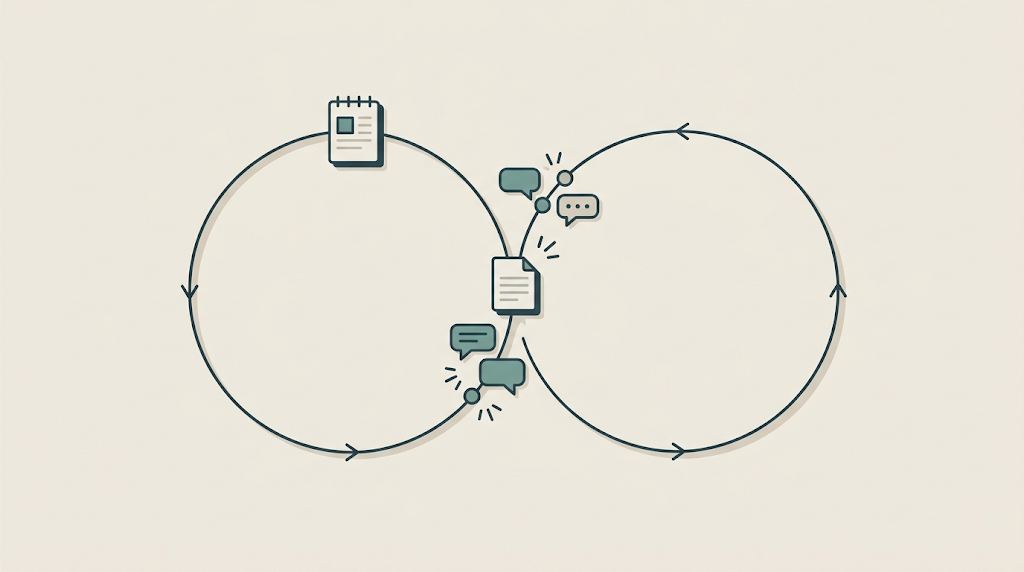
It’s a full loop: learning, thinking, communicating.
Looking Back, Looking Ahead
When I first studied Lean and Extreme Programming 20 years ago, I valued communication and collaboration, but I didn’t know about thinker types. With this awareness, I have better foresight.
Temple Grandin learned about thinker types in her mid-30s. I learned in my mid-40s. A colleague in his 20s already knows. The earlier we learn, the more we can leverage.
And yes, the HBO movie Temple Grandin is on my watchlist.
Future Possibilities
I’ve been imagining an app:
- Input information.
- Output different perspectives:
- Verbal: as words.
- Spatial: as abstract patterns.
- Object: as concrete images.
- Layer in cultural context—because a visual thinker from São Paulo may picture something different from one in Houston.
Maybe even extend this to VR experiences—immersing ourselves in how others perceive the world.
Food for thought.




Leave a Reply