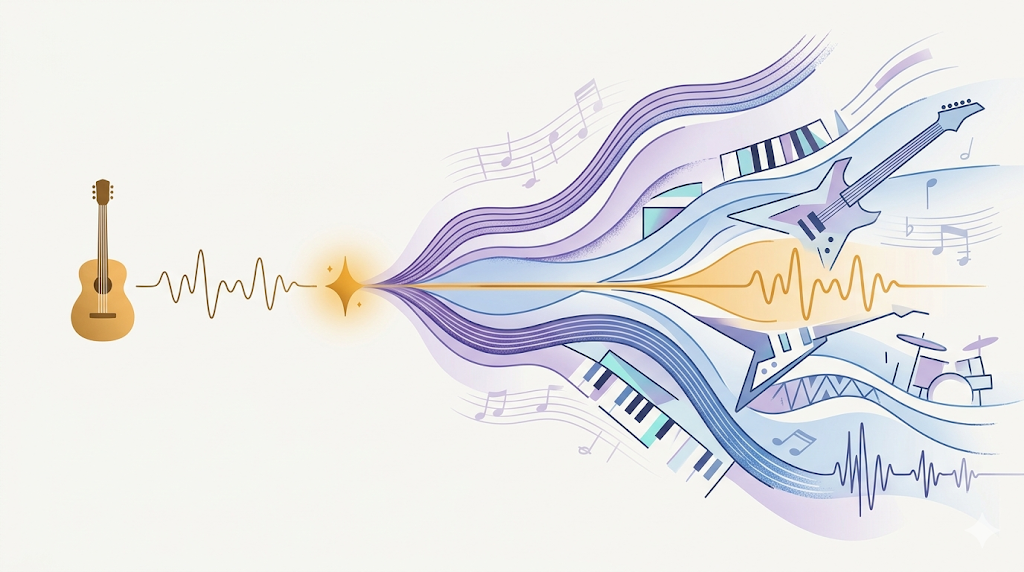
I’ve been experimenting with Suno AI, the generative music tool. After trying the free version, I upgraded to the $8/month plan to run more tests. What I wanted to explore was whether I could take one of my song ideas (something with structure but no lyrics, no full arrangement) and have the AI give me a fresh perspective on it.
Here’s a recording of the full experiment:
The Source Material
I have a piece called “Six Elements.” It’s eight minutes long, structured around six distinct parts in my mind. The only recording I have is two acoustic guitars layered on top of each other. I recorded them back in 2013, then relearned the piece just before this experiment. I barely remember how I played it all those years ago, but I could get close enough to record it again.
The interesting part is what happened when I fed this to Suno. The AI picked up on about a minute and thirteen seconds into the recording and ran with that. It ignored the rest entirely.
What It Heard
The first version that came back was a two-minute piece. Suno analyzed it as folk rock and acoustic pop: electric guitar, bass, drums. I never told it any of that. I’m still learning how to prompt the tool effectively, so I’m not even sure what I asked for.
The AI took the melody I’d played on an acoustic guitar and translated it to a distorted electric guitar. The drumming pattern caught my ear immediately. All these years listening to my own recording, focused on the acoustic guitars, I’d never really thought about what drums would sound like underneath. When I heard what Suno created, something clicked. The drums had this syncopated, offbeat feel that was hard to pin down. I don’t even know how to count it. My music theory falls short there.
What I liked most was that the instrumental and the melody motif stayed true to what I’d written. The AI didn’t invent something completely new. It orchestrated what was already there.
Exploring Variations
I kept running experiments. Some versions leaned into that slightly distorted guitar sound with overdrive and slides. That’s the kind of thing I might actually play if I picked up an electric guitar. Others shifted the drum pattern in surprising ways. One version put the melody on the upbeat instead of where I’d originally placed it. Different, but interesting. If I ever expand this song, that could become a variation worth exploring.
Then I tried something different. I wanted no drums. I wanted something more symphonic: emotional, with crescendos and melancholic strings. I didn’t save the prompt, but what came back was closer to what I’d been hearing in my head. Piano, soft strings, the kind of orchestration I’ve wanted to do with my music, but don’t have the skills or instruments to pull off.
That’s the thing I mentioned in my first Suno video: I can hear these arrangements in my head. I don’t have the technical ability to create them myself. But with this tool, I can describe what I’m imagining and get something back that’s close. That’s powerful.
Adding Vocals
The final experiment I wanted to try was adding vocals. I went to Gemini and asked it to describe the style of one of my favorite singers. Then I took that description (the style, the delivery) and prompted it into Suno along with some lyrics.
What came back was striking. The breathing of the AI singer coming in at the start. I wasn’t expecting that level of detail. The quality was impressive. I’d thrown together a few lyric ideas from different fragments, and the AI wove them into something coherent.
I tried to edit that version and ended up breaking it. The second half went somewhere completely different from what I’d created. But that failure led me to try again, and the second attempt was something I’ve been listening to quite a bit.
The Interesting Problem
Here’s where it gets complicated. That second version has elements I really like: the distorted guitar, the vocal delivery. But the second half goes into territory that’s not mine. It reminds me of Dimash, the opera-style vocals. It reminds me of Therion, the symphonic metal band. It reminds me of Disturbed.
But none of that came from me. It came from the AI’s interpretation of what it thought should happen next. And while it’s well-produced and interesting to listen to, it’s not something I would write. The lyrics and the vocal interpretation sound dark and heavy in the first half, which clashes with the second half, where the orchestration feels too happy for what came before.
That’s the tension I’m sitting with. The AI gave me something I didn’t ask for, something that sounds good on its own, but it’s not mine.
What’s Next
I still need to figure out how to take the entire eight-minute piece and have Suno work with all of it, not just a fragment. That might require the Premiere version, which gives access to studio tools to break things into individual tracks. I’m not ready to spend that kind of money yet.
The tool is genuinely useful for getting a different perspective on my own music. It’s showing me possibilities I hadn’t considered, some of which I’ll use, and some of which I’ll listen to and set aside.
The real skill I need to develop is knowing which suggestions to take and which to leave behind.



Leave a Reply