Most people, myself included at some point, learned that the elevator pitch is “a short, persuasive speech to sell something to somebody, delivered in the time it takes to ride an elevator.” In other words, memorize some words, hit play, and talk fast.
Even ChatGPT will tell you that. Ask it, “What is an elevator pitch?” and it will respond with a definition that sounds a lot like tell, tell, tell.
But here’s the thing: that’s not the origin of the term.
The Real Elevator Pitch
Back in the 1850s, Elisha Otis, the man behind the Otis Elevator Company, had a problem. People were terrified of elevators. Step into a wooden box hanging by a rope? If that rope snapped, you were dead. No speech would overcome that fear.
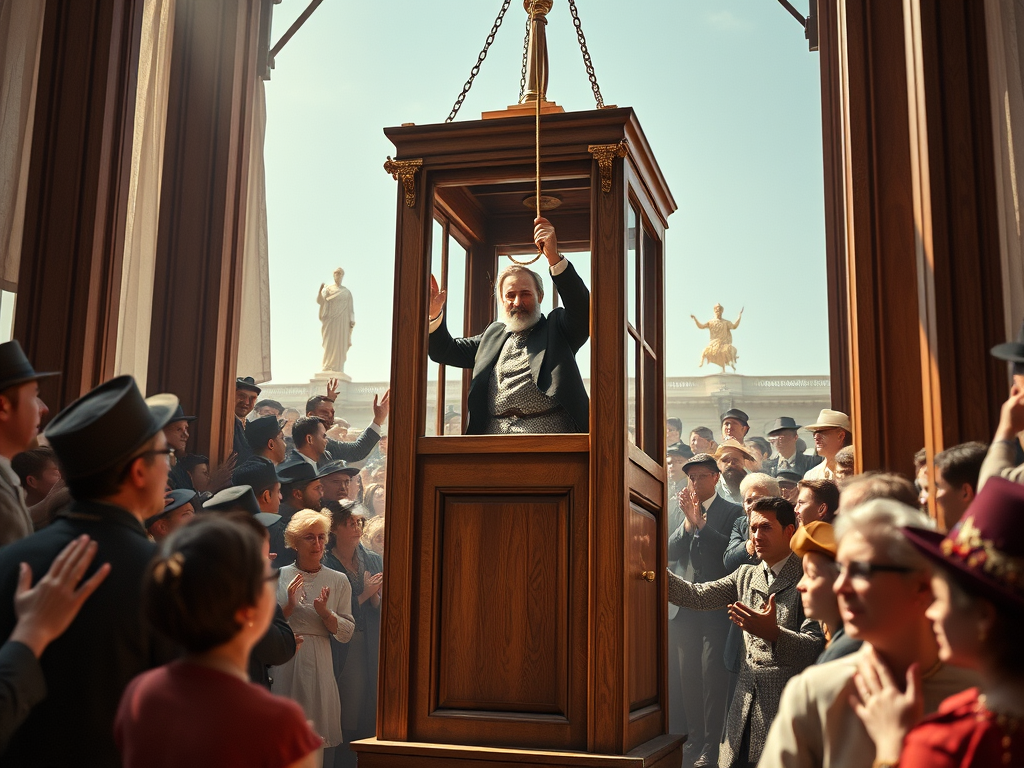
So Otis did something radical. At the Crystal Palace Exposition in New York, he rode one of his elevators. At the top, he ordered the rope to be cut. The platform dropped, and then his safety mechanism kicked in, catching the elevator before disaster. The crowd gasped, then applauded.
That was the first elevator pitch. He didn’t just tell them. He showed them.

Copie de gravure ancienne, Public domain, via Wikimedia Commons
Show, Don’t Tell
Since learning this story (thanks to Daniel Pink’s To Sell Is Human), I’ve never thought of an elevator pitch the same way. It isn’t about memorizing clever words. It’s about showing the value of what you do.
The quickest way to put a vision in people’s minds is to let them experience it. Otis didn’t explain the mechanism in abstract terms; he showed it in action.
I have met with clients and seen trust grow not because I recite jargon, but because they watch me solve real problems. They see me apply purpose, processes, systems, and technologies in that order. That speaks louder than any pitch.
It’s the same spirit behind a concept I borrowed from Temple Grandin: the 30-second wow. If you can show someone something meaningful in half a minute, you’ve got their attention and permission to say more.
Years ago, I went to a trade show and stopped by a booth, curious to see what their software looked like. The representatives eagerly told me what it did, how it worked, and how “friendly” the interface was. But no screens were showing their product. No banners, no pamphlets. I asked, “Can I see it?” They told me they didn’t do demos at trade shows, but I could scan a QR code to watch videos online. I did, and the videos barely showed the software, maybe for a second in the background. I walked away asking myself, “Is this a trade show or a trade tell?”
Selling Ideas in Tech
Want to persuade your team to embrace TDD, BDD, Clean Code, or UX?
- Show why, then show how. Don’t just tell.
Want to persuade the business to invest in AI/ML?
- Show why, then show how. Don’t just tell.
We’ve been doing just that at Improving: experimenting, demonstrating, and inviting people to see for themselves how AI/ML can enhance their work. (Here’s a glimpse).
The Real Lesson
The true elevator pitch isn’t a speech. It’s a moment of proof.
Otis didn’t sell with words. He sold with a show that people never forgot.
So the next time you think about your elevator pitch, ask yourself: what can you show in 30 seconds that will stick with someone long after the ride ends?



Leave a Reply