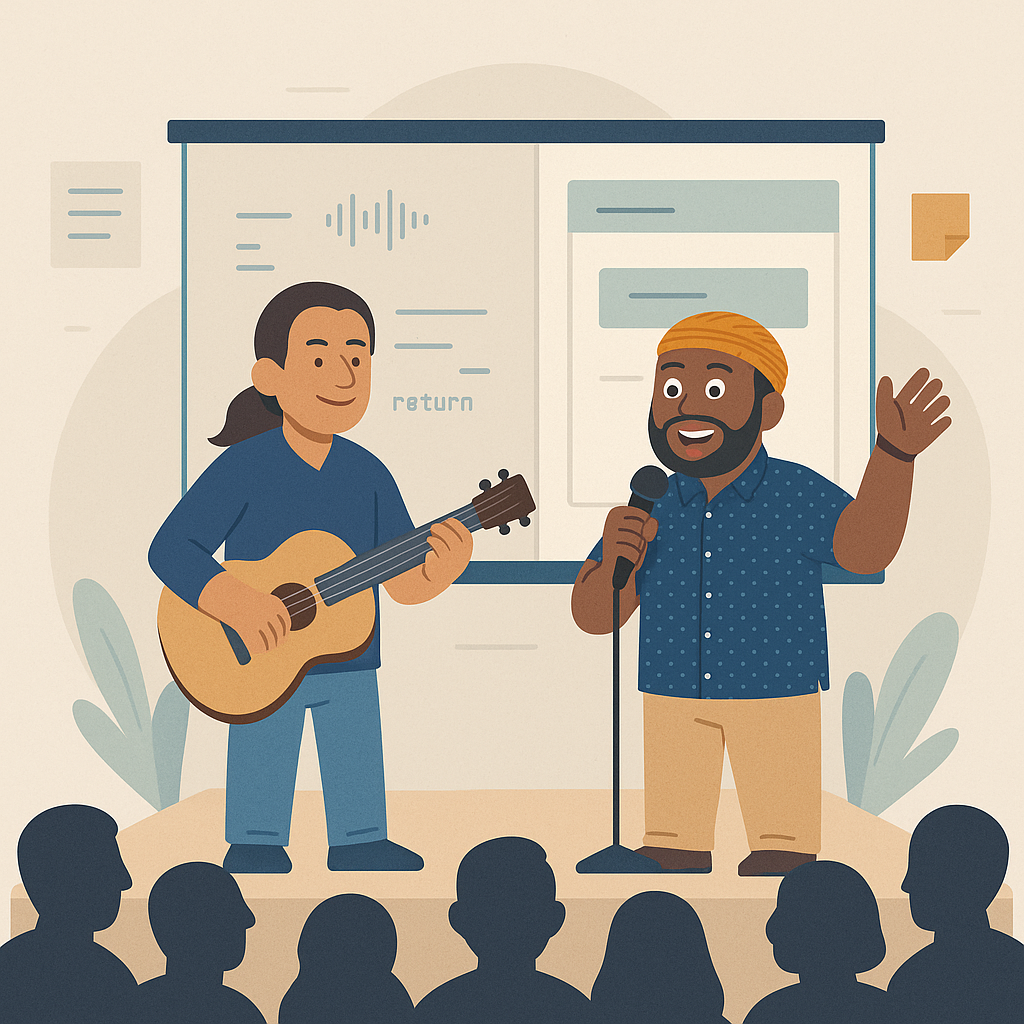
Over the past few months, Matthew and I embarked on a project that was more than just preparing a talk. It was about helping him conquer the familiar fear of public speaking, while also continuing to explore how we, as consultants and developers at Improving, can use AI tools in thoughtful, human-centered ways.
The Project: More Than a Talk
Our initial goal was simple: co-create a talk. But as we met week after week, it became clear that this was also a journey of coaching, reflection, and growth. We wanted attendees to leave with three things:
- Know: How AI can be used in practical, collaborative ways.
- Feel: Inspired rather than intimidated by these tools.
- Do: Experiment with AI as a teammate, not just a search engine.
The Process: Weekly Conversations and Iteration
We committed to meeting every Thursday. Each session, we recorded, transcribed, and then ran through an LLM to extract insights, action items, and even homework. I also extracted many blog post ideas, some already published (links at the bottom of this post).
This rhythm gave us continuity and a rich archive to draw from. As Matthew observed, I rarely face a blank page because past notes, drafts, and voice journals become raw material for new creations. That practice became contagious: he began building his own vault of ideas and reflections.
Along the way, several themes emerged:
- Resistance: skepticism, silent reluctance, or curiosity in disguise.
- Blank pages: how documentation and voice capture dissolve creative paralysis.
- Output vs Outcome: Clean code doesn’t matter if it doesn’t solve a problem.
- Collaboration: treating AI less like Google, more like a junior partner.
We also made deliberate choices to keep the talk conversational. Instead of reciting slides, we would bring up stories, analogies, and live demos as if the audience were eavesdropping on our Thursday sessions.
Building the Talk: Demos, Stories, and Even a Song
Our structure grew in three “legs”:
- Exploration & Resistance — including the “T-App” story (an app blamed for AI misuse when the real problem was security practices).
- Deliberate Experimentation & Collaboration — showing live how vague prompts lead to weak results, but iteration and context unlock better outcomes.
- From Output to Outcome — reframing AI use around solved problems and human value, not just generated code.
To make it memorable, we added surprises. A live demo where AI Studio built an app in minutes. A moment of audience choice: “Do you want to see the code or the app first?” And even a short song (Matthew singing, me on guitar) about trusting your ability and playing with the tools. We had to skip performing the song live, as we didn’t expect as much audience participation (which was a very welcome surprise).
The Talk: Tech Friday, September 19th
For nine years, we’ve had a bi-weekly meeting at Improving in Houston called Tech Friday, meant for seasoned Improvers to try out new talks, as well as for newcomers wanting to break into public speaking.
When the day came, the room stayed engaged past our allotted time; always a good sign. Attendees leaned forward during the live demos and chimed in with sharp questions on ethics, IP, and guardrails. Some nodded as we emphasized that stakeholders don’t care about pretty syntax; they care about working solutions. Others shared how they, too, struggle with resistance, whether fear of obsolescence or distrust of the tools.
My Public Speaking Journey
Coaching Matthew through his first full-length talk also reminded me of my own beginnings. My earliest experience with public speaking came in high school, when I prepared group presentations in a technical class taught by Professor Sergio. He wasn’t just an academic: he worked in IT by day and brought real-world challenges into the classroom. We had to code in Clipper, but also explain and sell our projects to our peers. I loved that process of collaboration and presentation.
Later, when I was invited to speak in 2001 at the Visual FoxPro 7 launch event at Microsoft in Brazil, I went all in. Instead of a one-hour talk, I delivered a full-day session from 9am to 5pm. It was overwhelming at first; what did I know? But it turned out great. People were engaged, asked when the next one would be, and I discovered a passion that never left me. From that day, my talks were never about proving expertise; they were about sharing what I was learning in real time, paying forward what others had given me.
Over the years, I’ve continued to invite others to co-present, encouraging new speakers to share their own lessons, struggles, and breakthroughs. One of my goals this year was to mentor more Improvers in giving talks. Seeing Matthew go from hesitation to confidence was a continuation of that journey.
Afterthoughts: What We Learned
Reflecting afterward, we realized:
- The process of preparing (recording, transcribing, iterating) was as transformative as the talk itself.
- For Matthew, the experience built confidence in both public speaking and finding and using his voice.
- For me, it reinforced the value of coaching through collaboration: side by side, not top down.
- For both of us, it demonstrated that AI is best utilized not as a shortcut to answers but as a catalyst for more engaging conversations, compelling stories, and improved outcomes.
Closing
This project wasn’t about a single presentation. It was about learning to create together, facing resistance with curiosity, and turning blank pages into shared insights. And maybe that’s the real lesson: with the proper practices, AI can help us amplify our humanity. And in the same way, public speaking isn’t just about delivering slides; it’s about creating space for others to find their voices, too.
Check out Matthew’s excellent post-talk blog post, and get to learn his side of this story.
And see below some of the blog posts I’ve published, inspired by our conversations in this preparation (I have a backlog of other ideas that’ll likely get published in the future):
- Overcoming Resistance – Reflections on Embracing AI as a Developer
- Why I never face a blank page
- Helping Stakeholders Get It With a 30-Second Wow
- Two Instincts in a Developer’s First Impression
- The Hidden Gap Between What’s Said and What’s Understood



Leave a Reply