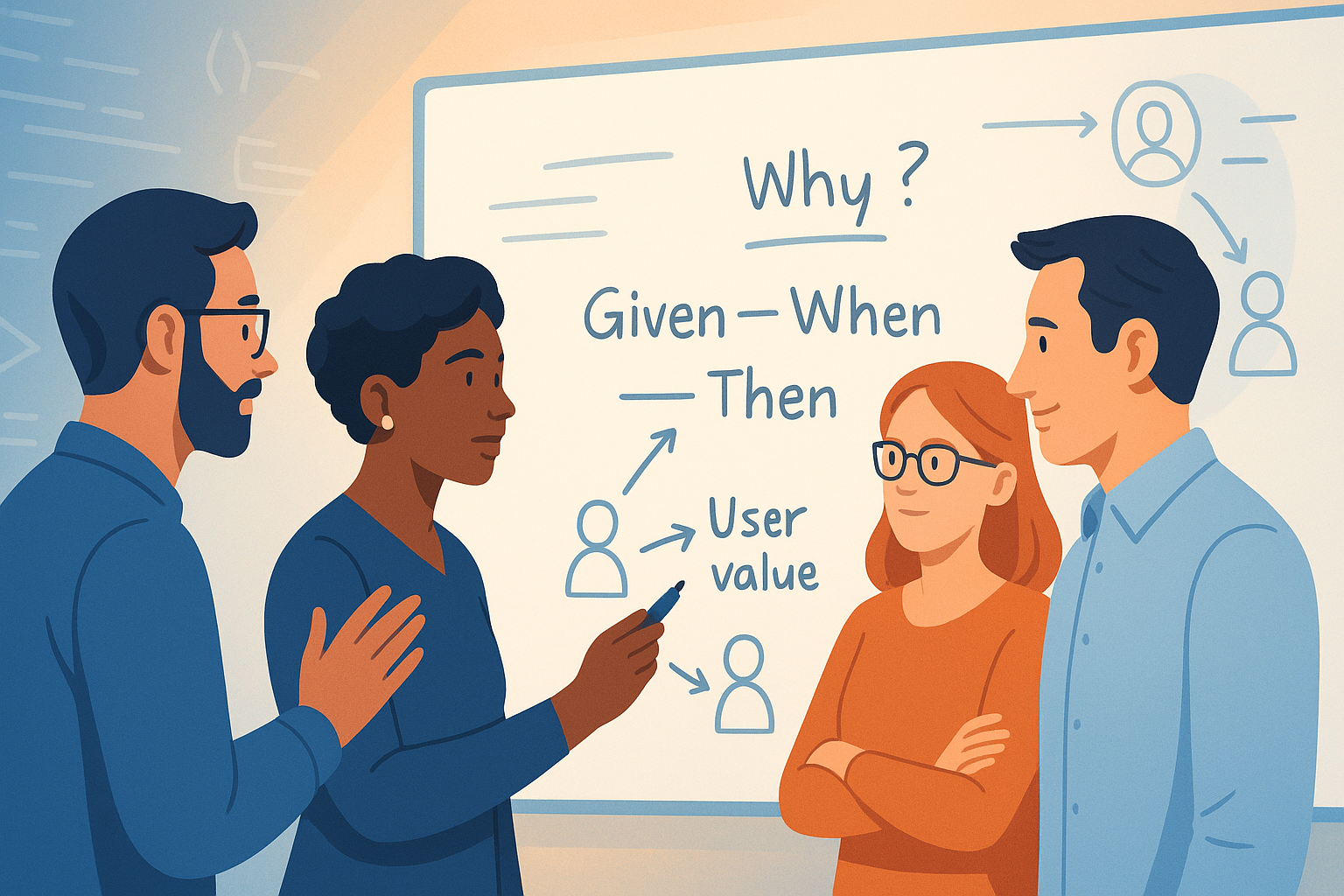
When people hear Behavior-Driven Development (BDD), they often jump straight to tools, pipelines, or test syntax. Is it a QA process? A coding practice? Something you plug into CI/CD? Depending on where you are in your journey, you might give a different answer. For me, BDD has shifted over the years from being about system behavior to being about something far more important: people.
Beyond the Tools
Early on, I thought BDD was just TDD with a different name. I replaced Arrange-Act-Assert with Given-When-Then, and that seemed to be it. But as I gained experience, I realized the real power of BDD had little to do with tools or pipelines. I’ve written scenarios on napkins with a pen. The point isn’t automation—it’s alignment. It’s about creating a shared language that developers, testers, and business stakeholders can use together.
Start With Why
Simon Sinek’s Start With Why describes the Golden Circle: why at the center, then how, then what. Many teams approach BDD in the opposite direction. They focus on what the system should do, and maybe on how, but they struggle when asked why. In my experience, the “why” of BDD is collaboration and communication. It’s about ensuring we’re not just building things right, but building the right things.
Behavior, But Whose?
Too often, BDD is described as a way to capture system behavior. That framing can be misleading. We should be concerned with human behavior—the needs, frustrations, and goals of the people we serve. Writing user stories that start with “As a system…” misses the point. Systems don’t have behaviors worth caring about unless they matter to people. Focusing on users’ behaviors reframes acceptance criteria from technical checklists to human outcomes.
Lessons from Other Disciplines
As I explored this theme, I started connecting dots across disciplines:
- Atomic Habits (James Clear) shows how identity, process, and outcomes shape behavior. That maps directly into how we think about BDD, from the outcomes we document to the identity we form as practitioners.
- Badass: Making Users Awesome (Kathy Sierra) focuses on how people learn, change, and grow. That lens helps us write stories that nudge, encourage, or prevent certain behaviors.
- The Speed of Trust (Stephen M. R. Covey) connects behavior to credibility and collaboration. At its best, BDD builds trust within teams and with the people who use what we build.
These aren’t “technical” books, yet they enriched my BDD practice more than any tool tutorial.
Empathy, Mindfulness, and Inclusivity
BDD becomes transformative when we approach it with empathy, mindfulness, and inclusivity:
- Empathy: We must step away from our multi-monitor setups to understand the noisy, stressful environments in which the people we serve live.
- Mindfulness: being aware of people’s fundamental tasks and constraints, not just the happy-path scenario.
- Inclusivity: respecting cultural, cognitive, and contextual differences, and designing for them instead of around them.
When we incorporate these qualities into BDD conversations, the resulting software isn’t just functional—it’s humane.
Wrapping Up
BDD is more than syntax. It’s more than tools. It’s more than pipelines. At its heart, BDD is a practice of shared understanding, rooted in empathy and trust. The conversations matter more than the code. Human behavior matters more than system behavior. And the “why” matters most of all.
If you’d like to explore this theme further, I also wrote about it here: BDD: What If We Do Not Focus on System Behavior?



Leave a Reply