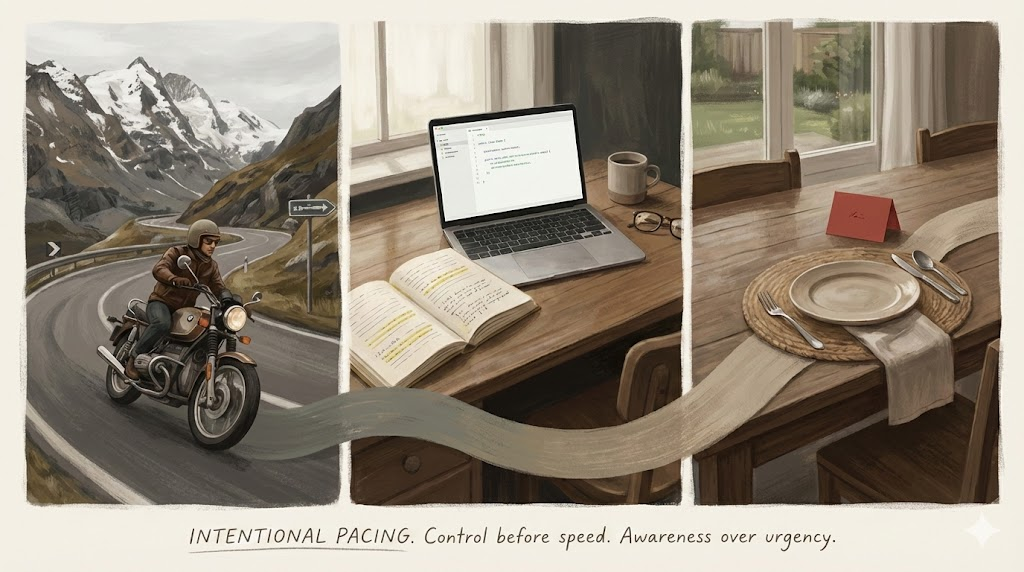
We’re all nudged – no, we’re all pushed -, into doing everything faster. We need to be more efficient. All the time. Go, go, go. More, more, more.
But sometimes we need to slow down to go fast.
Going fast, but out of control, can turn into a crash. Recovering from that crash often means delaying the achievement of a goal.
Slowing down to either establish or regain control often enables us to set a consistently fast pace and achieve a goal faster.
“What the heck are you talking about?”
I’m likely mixing metaphors based on experiences that resonate with me.
Riding
Riding a motorcycle fast is a thrill. But what’s the goal?
If I’m riding curvy roads, such as those in the Italian Alps, my goal is to enjoy the scenery on a motorcycle. Paraphrasing a passage of [[Zen and the Art of Motorcycle Maintenance]], “driving a car, we’re watching the scenery, while riding a motorcycle we’re a part of the scenery”.
If I’m going so fast that 100% of my focus is on staying on the road and not falling off a cliff or running into incoming traffic, then I’m disallowing myself from witnessing the amazing views around me.
When my goal is to get the thrill from riding a motorcycle as fast as I’m able to, I go to a race track.
But getting on the track and twisting the right wrist only makes me go as fast as I’m going. To learn to go as fast as I can possibly go, I need to slow down first. I need to know where the track goes. I need to know its camber, bumps, cracks, runoff areas, and references.
So first I’ll go on a track walk. That’s right, walk the track. See it up close.
Then get on a bike and go on a sighting lap. Then speed up just a little.
Stop and internalize what I’ve seen and how I’ve felt. Go out again, with the intention of working on specific aspects of my riding. Speed will come.
When winter comes, and the temperatures drop, it’s impossible to go as fast. Do I stop riding? No. Go out and ride my best, given what I have. As I do so, any sloppiness becomes immediately known: jerky body movements and sloppy throttle/brake control come to the surface. The braking approach into corners doesn’t work and requires adjusting. The mandatory slower pace brings extra awareness to things I was overlooking when I could just go fast.
Reading
Should I fast read or slow read?
What’s my goal?
Why have I picked up this book?
Say the goal is to learn as much as possible about the subject within a given timeframe. I’ll probably fast-read it. Flipping through the pages quickly, noticing the main sections, sub-sections, and images. Then go back to page one, and go through all the pages, slower this time, but still at a fast pace.
When my brain detects through my eyes something it deems important (I told my brain why I picked the book and what my goal is), it tells me to slow down. So I do. I highlight the passage. I write notes. I ponder. Then I speed up again.
Now I pick up another book. This is a work of fiction by an author whose writing I appreciate. I read the words at a much slower pace; I crawl through the words, savoring them, marveling at the craft.
Coding
I can write code pretty fast. I can use code snippets to speed up the process. I can use code generators. Or I can simply type fast. And lately, AI tools do that much, much faster.
But what’s the point of coding fast?
Typing as fast as I think doesn’t help if my thoughts are racing.
I’ve learned I should slow down when I’m not even sure what it is that I’m trying to accomplish. Slow down my racing thoughts. Once the goal and the best next steps are clear, then I use all the tricks I can to speed up coding.
I’ve also learned to deliberately slow things down, even when I know there’s a faster way to do it. For example, I may choose to use the mouse instead of a keyboard shortcut. Or type a long command on the terminal instead of any other faster way.
Food
Brazilian statehouses, such as Fogo de Chao, are an all-you-can-eat meat extravaganza. They have a little card or similar token on the table for each patron; one side is green, which means “Bring me meat”, and the other is red, which means “Stop bringing it”.
It’s common for the novice to sit at the table, turn the card green, get busy eating every cut the waiters bring, and then feel stuffed and done within 15 minutes.
Not me.
I keep flipping that card, green-red-green-red, controlling the pace, appreciating each cut. Figuring out which ones taste the best that day. After doing that for a while, someone always comes to the table and asks, “Sir, are you waiting on any cut in specific?” I tell them what I want, and take a few rounds of that. I get my money’s worth, enjoy a great meal, and head out very content.
Pace Yourself
- Do I need one fast lap?
- Or do I need as many consistent laps as possible?
- Do I need to slow down to smooth things out? To rebalance? To regain control?


Leave a Reply