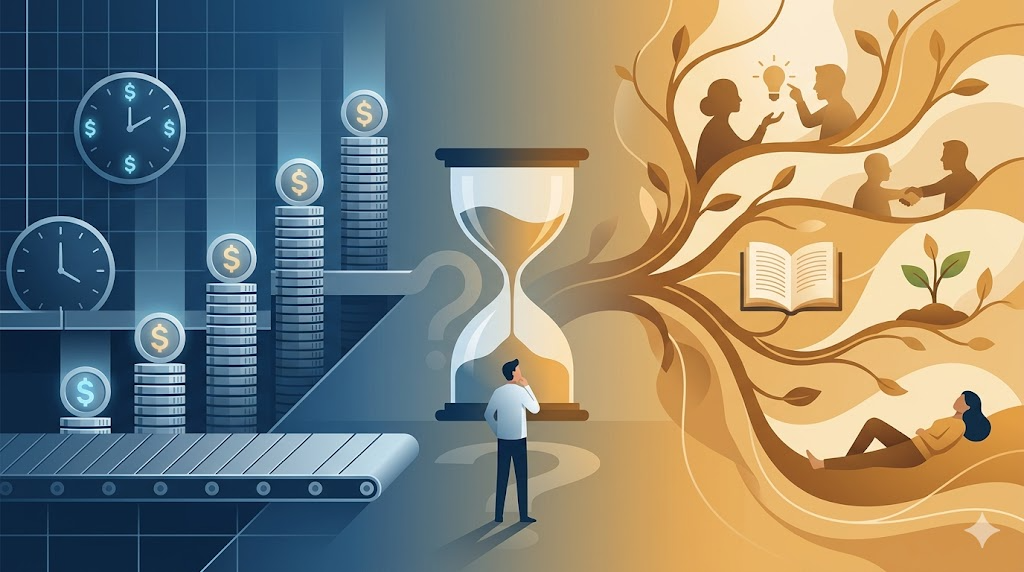
“Time is money.”
I cringe every time I hear it. Usually, it comes out when someone feels their time is being wasted: “Come on, hurry up, time is money.”
But is it?
The False Equivalence
Money and time are both resources, but they work fundamentally differently. Money can be saved, invested, and accumulated. You can have more of it tomorrow than you have today. Time doesn’t work that way. You can’t save it. You can only spend it.
When we say “time is money,” we’re treating time as something transactional, something that should always be exchanged for something else. But what if you have time and you don’t want to exchange it for anything? What if you just want to take your time, enjoy doing nothing, or go for a walk in nature?
Does money enter that picture?
Someone might say, “Well, you have to eat, don’t you? You need food.” Fair point. But if I use that time to walk in nature and decide to grow my own food, do I still need as much money? Or just the time it takes to grow my food?
The question becomes: how much of our time do we want to exchange for growing our own food so we can eat? Maybe that’s the exchange we want to have. Maybe we want plenty of time because that’s what we enjoy doing. Or maybe we don’t have time to grow our own food, or we don’t like it. So we prefer to earn money and exchange it for food.
Both are valid choices. The problem is when we lose sight of the fact that we’re making a choice at all.
The Autonomy Paradox
I’ve seen people with a lot of money who are unhappy because they don’t have enough time to do things they enjoy. They spend all their time earning money, then have no time to enjoy what they can afford with it.
I’ve also seen people with a lot of time but unhappy because they don’t have money to do the things they enjoy with the time they have.
But here’s what’s interesting: I’ve known people with almost no money who are still happy. They have time, and they’ve chosen how to spend it in ways that bring them satisfaction. They’re not wealthy by conventional measures, but they have autonomy over their time.
That’s the keyword: autonomy.
Choosing Your Exchange
Autonomy isn’t about having unlimited time or unlimited money. It’s about consciously choosing how you exchange what you have.
When someone says “time is money,” they’re usually implying there’s only one right way to spend time: in pursuit of money. But that’s not true. Time can be exchanged for:
-
Learning something new
-
Growing your own food
-
Building relationships
-
Creating something
-
Resting
-
Experiencing nature
-
Nothing at all
Each of these exchanges has value, even if that value can’t be measured in dollars.
The phrase “time is money” collapses all these possibilities into one. It suggests that if you’re not earning money with your time, you’re wasting it. That’s the part that makes me cringe.
What Are You Optimizing For?
I think the real question isn’t “Is time money?” but rather “What do I want to exchange my time for?”
If you want to exchange it for money to buy things or experiences you value, that’s a legitimate choice. If you want to exchange it for the satisfaction of growing your own food, that’s equally legitimate. If you want to spend it doing nothing in particular because rest and presence matter to you, that’s legitimate too.
The problem comes when we stop making conscious choices and start operating on autopilot, driven by phrases like “time is money” that we’ve internalized without questioning.
The Real Resource
Time and money are both resources, but they’re not equivalent. Money is a tool for exchange. Time is the medium in which we live our lives.
When we treat time as money, we reduce life to a series of transactions. We lose the ability to simply be, to experience, to exist without justification.
Maybe the better phrase would be: “Time is life.” And life isn’t something you save up for later. It’s something you spend now, one moment at a time.
The question is: what are you spending it on, and is that what you actually want?


Leave a Reply