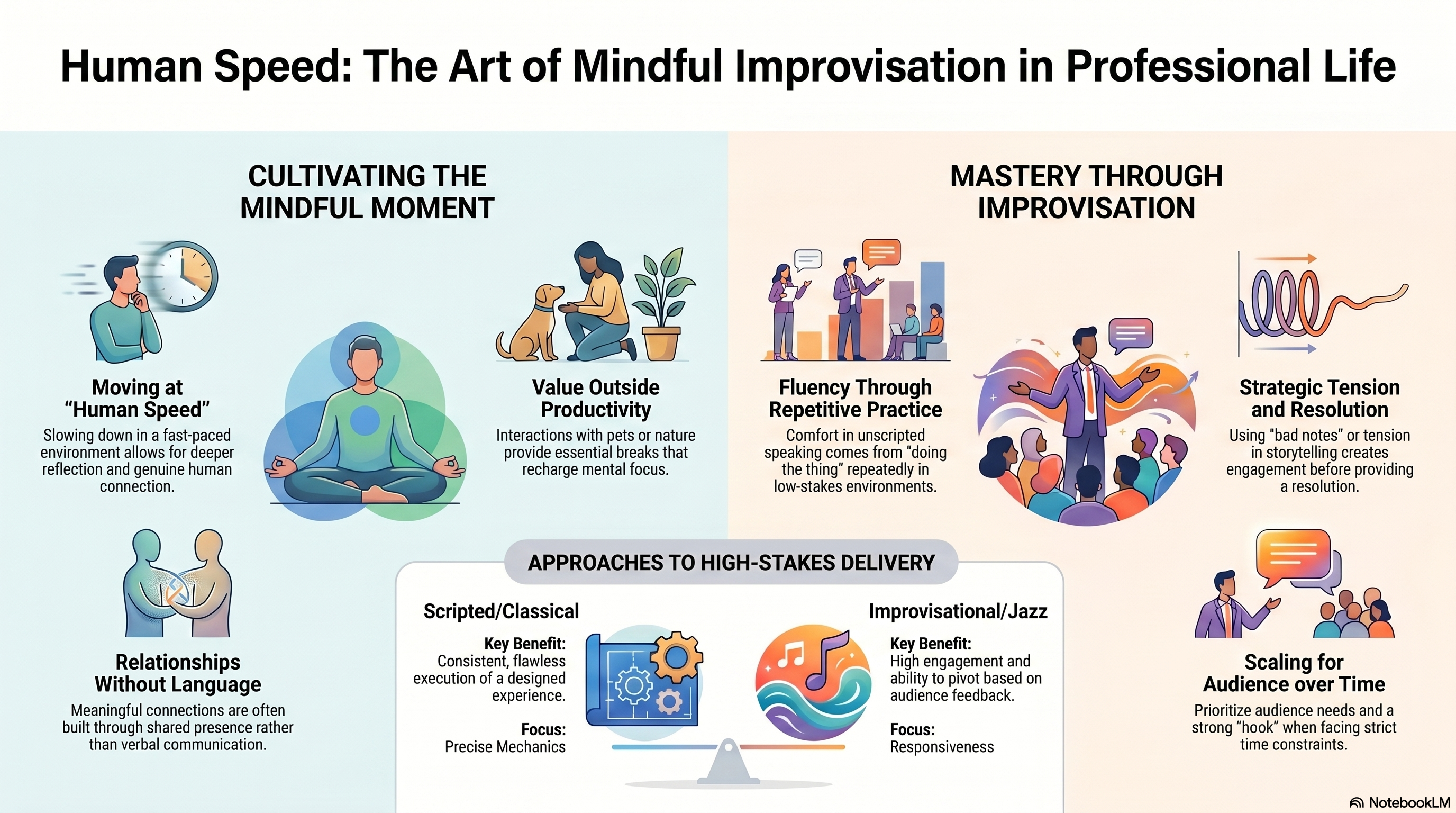
We didn’t plan this episode. That’s kind of the point.
Matthew and I started, as we often do, with something small. He’d been cutting grass. A bird had followed him from the backyard to the front yard, pecking at the grub he was uncovering. No shared language. No negotiation. Just a relationship that formed in the moment between a person doing work and a creature finding opportunity.
That story led us somewhere bigger: improvisation. What it means to show up without a script, to play without knowing exactly where things are going, and why that kind of practice is worth doing in public.
We were also joined this episode by some of our Improving colleagues, and the conversation opened up in directions neither Matthew nor I anticipated.
Why We Do This Without a Script
Matthew is, by his own description, a quiet and contemplative person. He doesn’t naturally love talking at length about a given topic on demand. So Reflective Practice Radio is exercise for him. Deliberate practice in a low-stakes environment.
Being intentional about having no plan lets him improvise. He pulls from what he’s been thinking about during the week, who he’s talked to, what ideas have been floating around. He can do that with more fluency now than he could at episode one.
I’ve noticed the same thing. Going into episode one already felt natural because we’d been having conversations off-camera for months while preparing for a talk we gave together. By the time we turned on the camera, we’d already built the reps.
And that’s the point. The camera is almost incidental. We’re in a small room at the office, there’s a whiteboard, and we talk. It just happens that the camera is rolling.
The Music Analogy
Matthew loves music, and he sees a connection between improvisation in music and improvisation in conversation. That connection sparked a long thread about how musicians think.
I shared that I’m a hobbyist musician, but I’m not a natural improviser. My process is to play alone, doodle around for hours, record what I find, and then piece it together. If someone says “pick up the guitar and jam,” I’m going to play some really bad notes while I figure out what key we’re in.
But put me behind a drum kit, and it’s different. Growing up Brazilian, rhythm is almost instinctive. I can find my way into a groove without needing the theory.
That distinction matters. I don’t want to perform music. I want to write it. There’s a process of composing, refining, and then playing what I’ve built. That’s very different from the mindset of someone who thrives on jamming.
There’s No Such Thing as a Wrong Note
One of our colleagues brought up Victor Wooten, and Matthew picked up the thread. Wooten doesn’t believe in wrong notes. In the referenced video, he’s playing with a guitarist and demonstrates how to take an “off” note and make it sound right. He does it through context, expression, and how long he holds it.
Marty Friedman, the former Megadeth lead guitarist, makes the same point. He will deliberately start a solo by bending into a note that sounds wrong because it creates tension. And then he resolves it. The release is the payoff. Without the tension, there’s no release.
We’ve all felt this in music without knowing the theory. You know when something needs to resolve. You know where the home key is, even if you can’t name it.
Matthew connected this to Disney. They’re masters at teaching us what sadness sounds like, what joy sounds like, by pairing sound with image. But someone asked the more interesting question: how much of that is trained? How much is innate? The answer led us into scales, semitones, and whether a minor chord sounds sad if you’ve never been taught that it should.
Context Changes Everything
One of the more interesting moments came when we talked about context in music. A note can sound wrong or right depending entirely on what surrounds it.
Play an A minor chord in isolation and it doesn’t necessarily sound sad. Play it after a C major in a C major progression and suddenly it feels like something is off. The note hasn’t changed. The context has.
The same principle applies to presentations, conversations, and probably a lot of other things. The note isn’t wrong. The context determines whether it resolves or creates dissonance.
Preparation vs. Presence
The conversation turned to public speaking, which is where Reflective Practice Radio started in the first place. Matthew and I originally had these conversations as preparation for a talk we gave together.
I gave a presentation to a group of kids the day before we recorded this episode. I spent zero time preparing for it. But I’ve given versions of that talk many times over the past 20 years, so the material is deep in me.
For a one-hour talk I’m giving for the first time, I used to spend 40 hours preparing. Not because I couldn’t wing it, but because I needed to see all my ideas in front of me, decide what to cut, and know the shape of the thing. The benefit was that when I showed up, I was overprepared. I had twice as much material as I needed, so audience questions rarely caught me off guard.
The improv classes I took some years ago reframed all of this. I thought improv was about thinking faster. It turns out it’s about asking “what else is there?” You’re presented with a can. Don’t stare at the can. Look around. What’s on the table? Who else is in the room? What else is true right now? Then you play from there.
Knowing Your Audience vs. Knowing Your Time
We closed the episode debating which matters more when adapting a talk: the audience or the time constraint.
My answer was the audience. If I’m running out of time, I start strong, I end strong, and I cut from the middle. The audience never knows what I’ve cut. But if I don’t know who’s in the room, I don’t know what the talk is for.
Eric pushed back a little: time is a hard limit, and respecting it is fundamental. If you go over, you’re already losing. The discipline of time-boxing a talk forces you to choose depth over breadth. It makes the talk more focused.
Both matter. But they shape different things.
The Practice of Showing Up
Matthew closed by saying something I’ve been sitting with. He talked about the discomfort of working a room. Wondering about confidence, mastery of the material, whether the slides are right, whether each person is getting enough attention. A lot of intangibles.
His approach is to practice. Accept what you can’t control. Be there to deliver. Let the rest be what it is.
The last talk I saw him give, at the Side Project Society, he sat down, opened his laptop, and started telling a story. Eventually he stood up, took a few steps, and kept telling the story. The audience wasn’t looking at his slides. They were looking at him. Because he was telling something that was uniquely his.
No one can Google that. No one can ask an AI for it. It’s his story.
That’s what we’re practicing here, episode by episode. Not scripted. Not polished. Just showing up and finding out what’s there.
Watch the full conversation to hear where the music theory rabbit hole took us, and how the group worked through the tension between improvisation and preparation.



Leave a Reply