
A friend once asked me: “How do you define ‘success’ for you? And have you seen that definition evolve over the years?”
The timing was perfect. I had just been reading Tim Ferriss’ Tools of Titans, in which he asks his guests, “When you think of success, who comes to mind?” It’s a good question because it forces you to look outward first, to see what patterns emerge before turning the lens inward.
Who Comes to Mind
A few people immediately came to mind:
Arnold Schwarzenegger succeeded in three distinct areas where people thought he’d fail: bodybuilding (when it wasn’t popular), acting (despite his accent, body type, and hard-to-pronounce last name), and politics (with no prior experience). He kept redefining what success meant for him.
Bill Gates pursued his passion for solving problems. He wanted a personal computer on every desk, worked toward that, achieved it, then stepped away to impact people’s lives in different ways. Same problem-solving drive, different application.
Derek Sivers built CD Baby, sold it, donated most of the proceeds to a trust, and found financial freedom to keep pursuing the life he chooses to live. He made the most of what he enjoyed doing and impacted others along the way.
Michael Jordan dominated basketball, then tried baseball and was nowhere near as successful. Was that a failure? Or was it a success that basketball gave him the freedom to pursue a different interest? I’d be curious to know how he sees it now.
Success as a Transient Thing
Thinking about these people got me reflecting on my own relationship with success. I don’t remember ever aiming to be successful as much as trying to achieve success in specific moments. That distinction matters.
Perfection, if it’s attainable at all, is a point-in-time thing. You do something right now that feels like a 10 out of 10. A few months or years later, you do it better, or someone else does. What you did before was perfect at that time, but not forever. It was a success at that time. It doesn’t mean you are perfect or successful. It means you achieved perfection or success in that moment.
I can think of situations where I’ve achieved success. But they’re moments, not a permanent state.
What Success Feels Like Now
After I learned to identify my core values and started reflecting on what I’ve learned, when, and from whom, I noticed something: I feel successful when someone tells me, “You made me better today. You helped me learn something.”
That resonates with my core motivation. Success, for me, is tied to my personal values. If I achieve something directly related to those values, I perceive it as success. If I successfully introduce humor into a talk, that’s a bit of success. If I help someone see a problem differently, that’s success.
On the other hand, if I complete a task that’s just busywork, do I consider that a success? Probably not. I got something done, I checked off an item, but it doesn’t register the same way.
There was a day a few years ago when I wasn’t feeling great. For a moment, I didn’t even want to go to work. But I worked through it and stayed productive. I stayed motivated and finished editing and publishing a video I’d been working on. That felt like a bit of success, not because I checked items off a list, but because I worked through my own thoughts and feelings and still made progress on something meaningful.
Overcoming and Pivoting
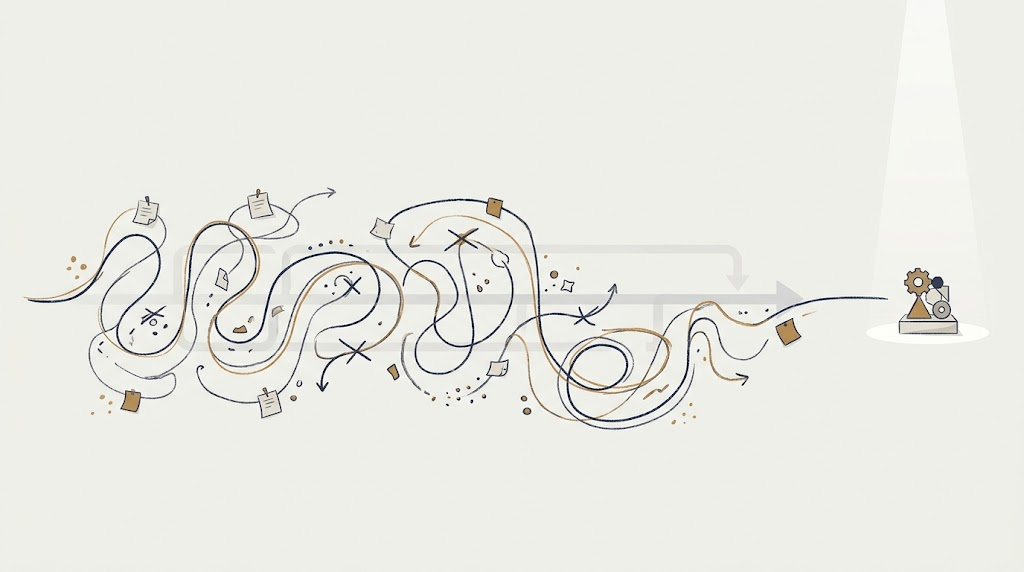
Overcoming a challenge is a form of success for me. Making progress toward anything directly related to my personal values is a form of success. So I define success as a transient thing: something we achieve at a point in time.
I think about Rodney Mullen, the skateboarder, who talked about winning 30+ contests and how he eventually let go of those trophies. They represented who he was, not who he is. A success is a point. If I see success as a point in time, it’s something I achieved based on who I was then.
Should I think of being successful as achieving success continuously? Or someone who works toward achieving success continuously, despite failures?
You decide to work on something, try to achieve it, and despite failures, you eventually find success—or you move on to something else. If you try different things, fail, and then learn that what you were pursuing wasn’t worth pursuing, you’ve learned there are better ways to spend your time and effort. Making that decision to drop something in favor of something more meaningful? I think that’s a success too.
Where I Am Now
Success isn’t a permanent title. It’s not something you achieve once and carry forever. It’s a series of moments where you align your actions with your values, overcome challenges, or learn something worth learning.
It evolves as you better understand your values. It shifts as you grow. And it’s okay if what felt like success five years ago doesn’t feel the same way now.
What matters is knowing what success means to you right now, and being willing to let that definition change.




Leave a Reply