A colleague asked me about using AI to tag everything in her Obsidian vault. My answer surprised her: “No, I don’t want it to do that.”
Not because AI can’t tag things. It absolutely can. But because AI will tag based on what was important to the average dataset it was trained on, not what’s important to me.
Tags Should Reflect Your Thinking
Here’s what I mean. Let’s say I’m taking notes during a meeting and someone mentions Bill Gates and Microsoft. Later, when I review my notes, I have choices to make.
Bill Gates: That’s a person. Should I create a link to track this person? I may have heard the name before and want to connect future mentions to it.
Microsoft: Is that a concept I want to explore? Or is it more like a status, a data point? If I’m thinking “prospect client,” that screams tag to me.
The difference matters because you can add notes to links, but not to tags.
This isn’t about AI being wrong. It’s about AI not knowing how I think about these concepts right now, in this moment, given everything I’ve learned up to this point.
The Cognitive Style → Metacognition Evolution
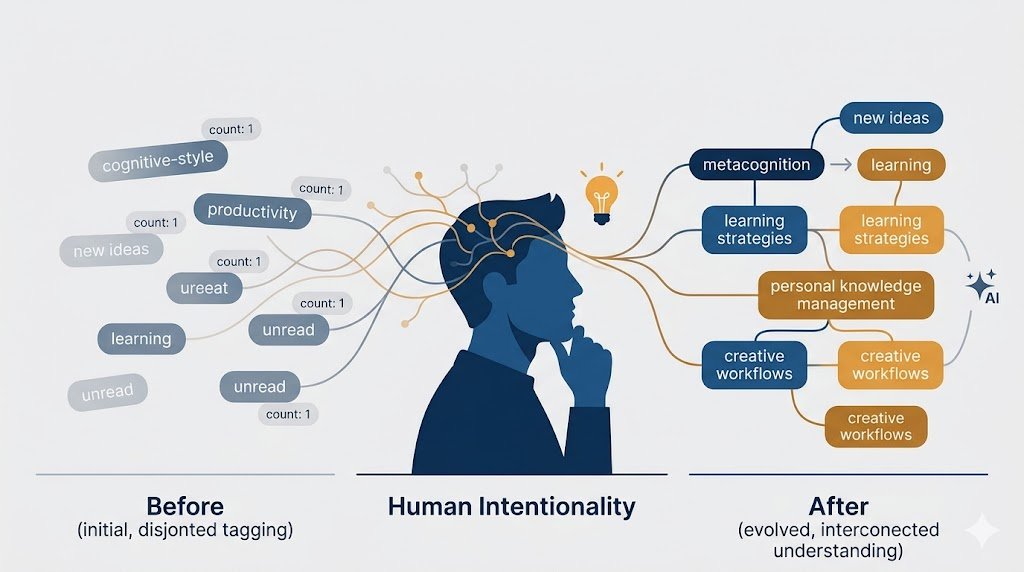
I showed my colleague my tag list in Obsidian. All those tags with a count of 1 (orphan tags) tell a story.
At some point, I created a tag called cognitive-style. It made sense then. Time went by. I learned more. Now, when I look at that concept, I don’t think “cognitive style” anymore. I think “metacognition.”
Maybe I even have a metacognition tag somewhere else in my vault.
That evolution, from how I used to think about something to how I think about it now, is my mental model changing. AI doesn’t know that unless I capture it.
The Folder-Specific Workflow
Here’s where AI becomes powerful: after I’ve done that thinking.
I bring a ProjectX Obsidian folder into Windsurf. Now I can tell the AI: “I used to think about this concept as X. I’ve started thinking about it as Y. Here’s my current understanding. Help me create a taxonomy, then go through this folder and retag everything based on how I think now.”
That works because I’ve given it my revised way of thinking. It’s not tagging based on statistical patterns. It’s applying my evolved understanding at scale.
The Process I Follow
When I work with AI on my Obsidian vault, it’s localized and intentional:
-
I review my orphan tags (count=1) and ask: why did I create this? Does it still fit how I think?
-
I capture my evolved understanding: “I used to tag X, now I think of it as Y because…”
-
I scope the work to a specific folder (like ProjectX notes)
-
I give AI my principles and let it apply them
The key is that I’m not asking AI to organize my thinking. I’m asking it to help me apply my thinking consistently across a large body of work.
Why This Matters
Someone once told me they wouldn’t use Obsidian until they figured out the perfect folder structure and tagging system. I told them: start creating content. The tool will show you what patterns are emerging.
You can always reorganize later. In fact, you should reorganize later, because your understanding will evolve.
With AI, you can even ask: “Look through these 100 notes I dumped in the root folder. What do you find? Suggest ways to organize it.” Then you evaluate those suggestions against how you think.
The most important thing isn’t how AI thinks. It’s how you think.
Links vs. Tags Revisited
This keeps coming back to a simple principle: you can add notes to links, not to tags.
If something is a concept I want to explore, build on, and connect to other ideas, that’s a link. I can click it later, create a note, and start refining my understanding.
If it’s a simple data point, a status, a way to filter or group things, that’s a tag.
AI can help me apply this distinction consistently. But only after I’ve made the distinction myself.
The Bigger Picture
This isn’t just about Obsidian or tags (I followed this approach for several years in Evernote before). It’s about preserving human intentionality while leveraging AI capabilities.
I don’t want AI to think for me. I want it to help me think better, capture my thinking more fully, and apply it more consistently.
That’s sophisticated knowledge management. Not because the system is complex, but because it respects that my understanding is always evolving, and the system should evolve with it.


Leave a Reply