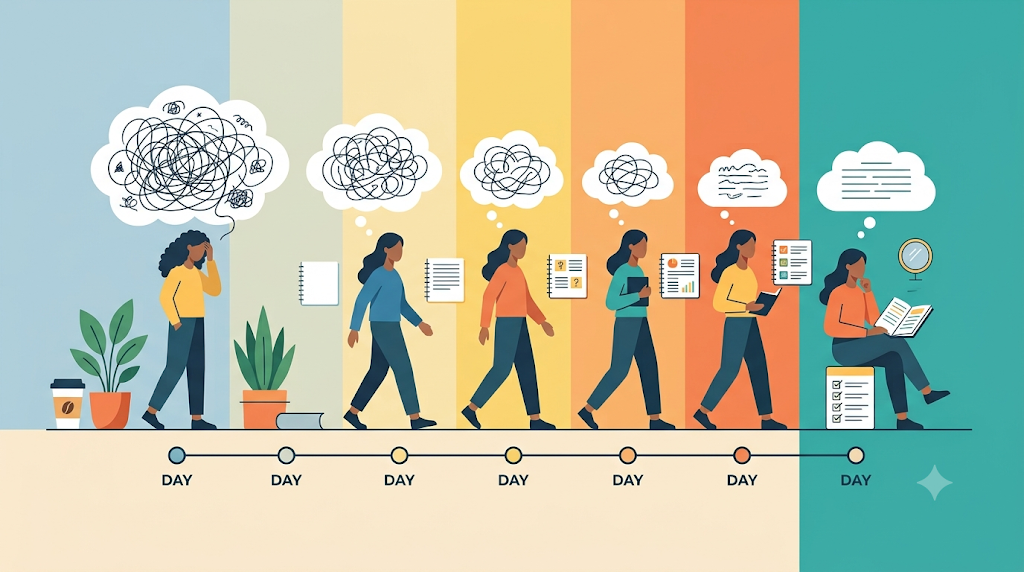
The hardest part of a new habit is the first few days. If you make the work too complicated, you will quit before the benefit shows up. This plan is designed to start small and end with a routine you can keep.
Each day has a single goal. By the end of the week, you will have captured real material and seen why the practice is useful.
Day 1: The Career Chronological Pass
Goal: Create a baseline of your experience.
Find a quiet place. Record yourself talking through your career chronologically. For each job or project, mention:
-
What you worked on
-
Technologies or methods you used
-
Challenges you faced
-
What you learned
-
What you accomplished
Do not worry about order or completeness. Just get it out. Transcribe it when you are done.
Time: 30 to 60 minutes.
Value: You now have raw material for resumes, profiles, gap analysis, and future reflections. Many people are surprised by how much they have actually done once they see it laid out.
Days 2–3: Single Question Focus
Goal: Build the habit without overwhelm.
After each focused work session, answer one question:
What did I learn?
Spend two minutes. Write or record it. Save it. Do not edit. Do this three or four times per day.
Time: 2 minutes per session.
Why this works: It is so small it is hard to skip. It also trains you to notice learning in real time.
Days 4–5: Add Context
Goal: Make your notes more useful.
Continue the single question. This time, add one line of context:
While working on [X], I learned…
Still two to three minutes. Still no editing. The context helps future you understand why the learning mattered.
Days 6–7: Try the Full Framework
Goal: Experience the complete reflection.
Pick one significant thing you worked on during the week. Answer all six questions:
-
What did I do?
-
What problem was I trying to solve?
-
What tool, approach, or technique did I use?
-
What value did I perceive?
-
What resistance or challenges did I face?
-
What did I learn, how does it connect, and what could I create from it?
Use voice recording if typing feels slow. Aim for completion, not perfection.
Time: 10 to 15 minutes.
End of Week: Review
Set aside 15 minutes and look back at your entries. Ask:
-
What patterns do I notice?
-
What surprised me?
-
What would I do differently next week?
-
Is there anything I want to share with someone?
This review is where the cycle starts to pay off. You are not just collecting notes. You are turning them into knowledge. Once the review habit is in place, you can use insight-extraction prompts to surface patterns across weeks or months.
If You Miss a Day
Do not make it a streak game. If you miss a day, start the next day. The value comes from consistency over time, not from a perfect week.
What You Should Have at the End
By the end of the week, you should have:
-
One career chronological transcript
-
Several quick captures answering “What did I learn?”
-
A few entries with context
-
One full-framework reflection
-
A short review with patterns you noticed
That is a rich foundation. From there, you can build whatever system you need.
Related posts




Leave a Reply