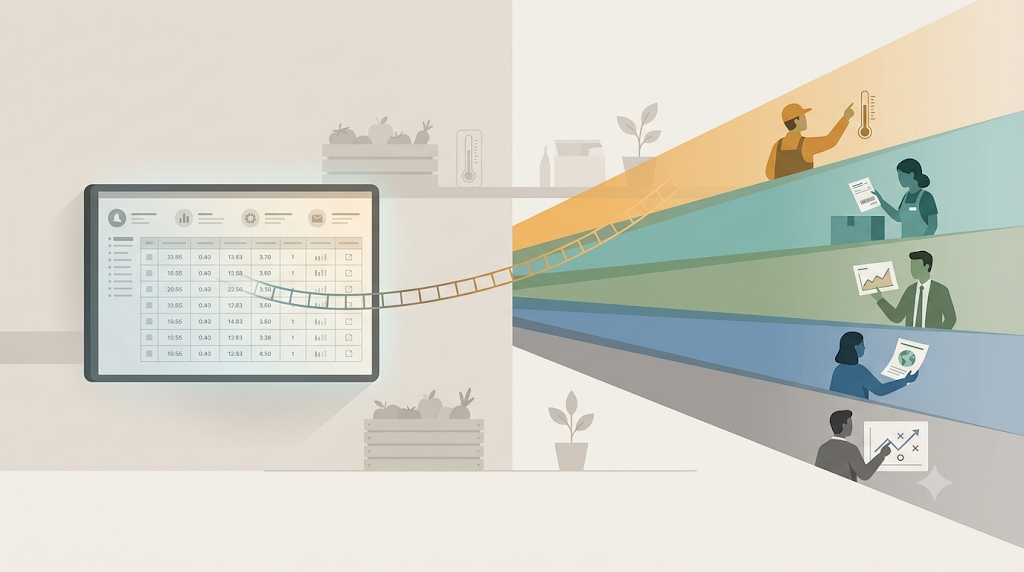
A story like this shows up in almost every backlog. It is a perfect example of how many “user” stories are written:
As a Warehouse Clerk,
I want a system screen where I can enter the receipt date, SKU number, and the temperature zone for incoming shipments of bananas,
So that the information is saved in the database and can be displayed on a dashboard.
It has the right template. It names a role and a concrete action. But it is not about the warehouse manager trying to stop spoilage, the technician adjusting a freezer, or the customer getting fresher bananas. It is about a screen.
This is exactly the kind of request I wrote about in [[Data to Impact – What Produce Businesses Really Need]]: people ask for data when they really need insight.
Who is the value for?
User stories are often described as a way to document the value a product brings. But whose value? Business value? Business value might be personal. Customer value? User value?
The warehouse story fails because it is written as a rigid requirement pretending to be a user story. It captures the data-to-impact ladder in the wrong way.
It stores raw data and displays information, but it stops there. A manager staring at 500 rows of banana SKUs and elapsed days has to do the rest. They have to move from information to insight themselves. That is the moment someone asks for the one feature people request in every piece of software: export to Excel.
The story also skips the outcome. It prescribes a screen, a database, and a dashboard instead of a change in behavior. An outcome is a change in human behavior that drives business results. If the team builds exactly what the story says, the business still loses money on spoiled produce. It just loses it with a digital record.
A better way to split the same story
The framework in Lean UX gives me a different lens: user value, customer value, business value, societal value, and aligned value. A robust and ethical framework for aligning value has to take into account the needs of a broad range of stakeholders, both those who directly interact with the system and those who are indirectly impacted.
The same produce scenario can be split into five stories, each pointing at a different kind of value.
User Value
In order to shift from constantly reacting to crises and instead prevent inventory loss before it happens
As a Cold Storage Technician working in Zone 3
I want to receive immediate guidance on the exact temperature adjustment needed and which pallet requires relocation

Customer Value
In order to guarantee our grocery partners receive only the freshest, highest-quality produce, strengthening our relationships and preventing returns
As a Receiving Clerk documenting incoming shipments
I want to see confirmation that the temperature log for each delivery stayed within cold-chain standards throughout transit

Business Value
In order to protect our bottom line by catching produce at risk before it becomes a costly loss
As a Warehouse Operations Manager accountable for minimizing shrinkage
I want to know twelve hours in advance when any batch of produce is about to spoil

Societal Value
In order to honor our commitment to environmental stewardship by reducing food waste across our operations
As a Director of Sustainability monitoring our resource consumption
I want to review a weekly report showing the volume and financial value of all spoilage we successfully prevented

Aligned Value
In order to make informed strategic decisions about where to invest capital for managing perishable goods across all distribution centers
As an Executive Strategist analyzing quarterly performance
I want to understand how proactive preventative measures compare financially against emergency clearance sales

What I am looking for now
The point is not to write five stories where there was one. The point is to know who the one story serves. If I start with the screen, I get a screen. If I start with the user, customer, business, societal, and aligned values, I get a system that prevents waste, protects partnerships, and guides better decisions.
The value is always there. The question is whether I am willing to look for it.
A user story without a value story is just a task in a friendly sentence. If I cannot name the human behavior that changes, I have not finished the story.


Leave a Reply