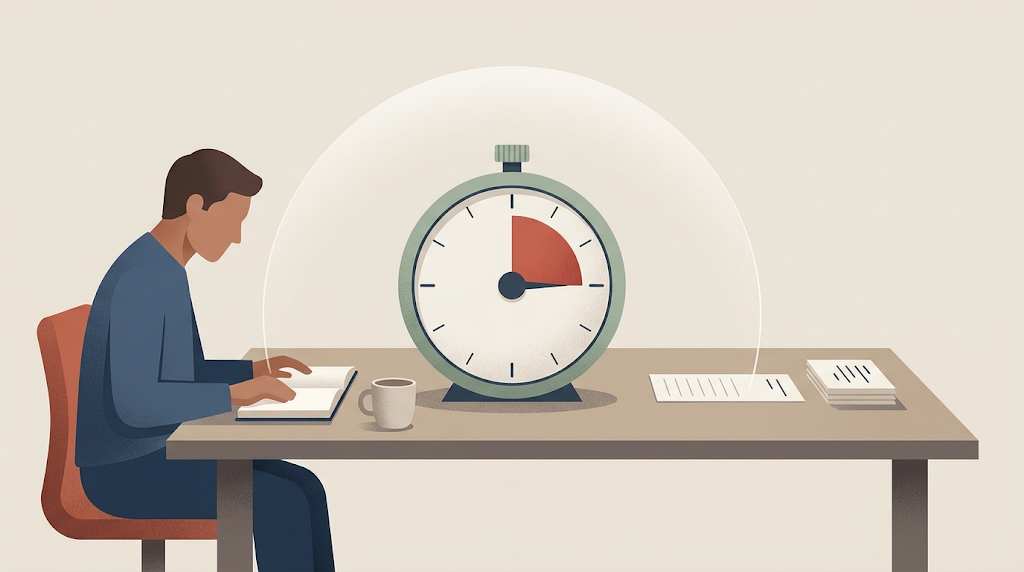
I did my reading before the 7:30 meeting this morning. Twenty-five minutes on the clock, a section of a book, and then five minutes to sit with what I’d read. The section fit the block with about twenty seconds to spare. That wasn’t luck. I planned it the day before.
The time box is the practice I’m asking people to try in the Sustainable Pace in the Age of AI program at Improving. Pick a task you think fits in 25 minutes. Decide when you’ll do it and put it on your calendar. Do the work. Take a five-minute break. Then reflect on how it went.
Two things come out of that reflection, and the second one is the one most people skip.
What pulls you away
The first lesson is awareness. During the block, did you feel a pull to check your phone, your email, something else? And how did your surroundings affect the work? A quiet house worked in my favor this morning. A noisy one changes the whole exercise.
That’s worth noticing without judgment. You’re learning what you’re up against, not grading yourself on focus.
The estimate was the real work
The second lesson is estimation, and it’s why I like this exercise so much.
You claimed a task would fit in 25 minutes. Did it? If you finished at the 10-minute mark, why did you think it would take 25? Maybe there was a tool that did the job faster. Maybe you found a shortcut. Maybe you learned something between deciding on the task and sitting down to do it. Whatever the reason, your estimate was off by more than half, and the gap tells you something.
Sometimes you finish early and you’re tempted to cancel the rest of the block. Don’t. Use what’s left to review what you did, capture the details, and write down what you learned. If there’s still time, pull in the next related task from the same job or project. If the block was for work, keep it doing work.
When you’re almost there, for two hours
The opposite case matters more.
You’re at the 20-minute mark and you know there’s no way you’re finishing in the next five. Most of us keep going. We’re almost there. We say it again twenty minutes later. Two hours later, we’re still almost there. That’s not healthy, and it’s not what the block was for.
The block only works if something else comes after it. A meeting. Another task. Something that makes the end real.
When the time runs out and the task doesn’t, spend the last five minutes writing down where you are. What you tried, what got in the way, what you learned you didn’t know. Maybe the tool failed you. Maybe you need access to something you don’t have yet. Maybe a step you thought you understood wasn’t what you thought.
Then write the next step. Maybe the next two. You’re not doing them now, just putting them on paper.
That note is what saves you later. When you come back to the task after lunch, after a three-hour meeting, or on Monday after the weekend, you don’t spend twenty minutes reloading context. You read the note and start where you stopped.
When the alarm startles you
Sometimes the timer goes off, and it surprises you. You were in flow, you lost track of time, and now the block is over mid-stride.
Take the break anyway. Step away from the screen, spend a minute writing down what you did and what comes next, then detach.
Later, when you reflect, ask what put you in that state. Was it the task itself, or a particular sequence of steps you enjoyed? Or was the task bigger than you thought and it needed deeper thinking than your breakdown suggested? Either answer is useful.
It takes repetition
None of this lands the first time. With practice you start to feel 25 minutes: the first few minutes getting into the task, then a signal near the end that it’s time to wind down and close cleanly.
It’s like walking through your house in the dark. At first you stumble into things. Eventually you count the steps and you know where you are in the room.
I’m still building that sense of time. My reading block this morning went well because I planned it the day before and the house was quiet. Next week it might not. Either way, I’ll have something to reflect on.


Leave a Reply