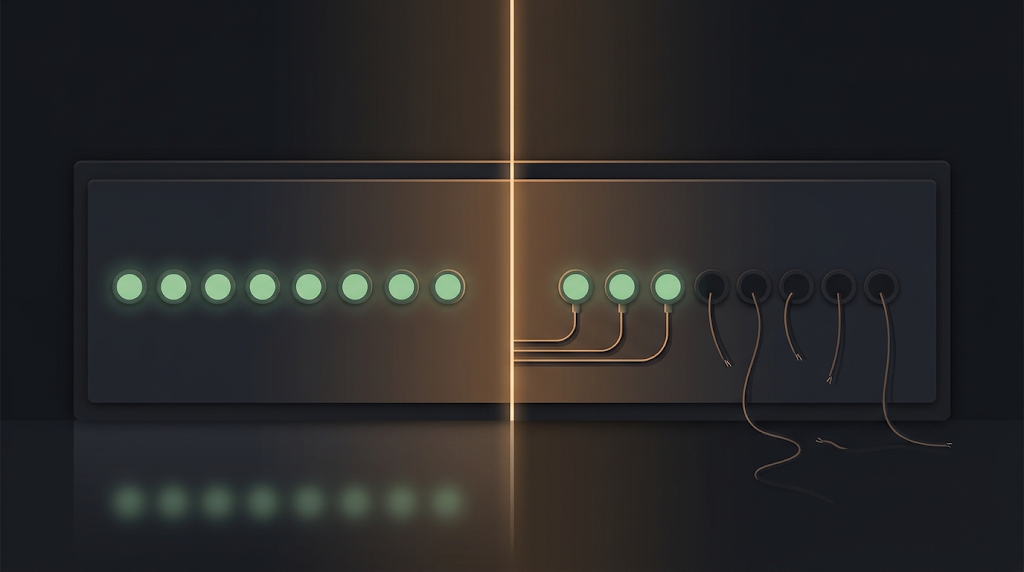
I’d evaluated it and logged the iterations. It had a results export and an activity log to prove it. I had used it extensively on real work.
It had nine test cases written down. Four of them had never run.
I found that out months later, while I was doing something else entirely. Nobody reported a bug. A model didn’t hallucinate. I just converted the skill to a different evaluation harness, and the conversion made me diff what my spec said against what my checks actually asserted. The spec said nine. The checks covered four.
I’m not going to pretend that was promptfoo’s fault, or a model’s fault, or a deadline’s fault. It was my wiring. I wrote the spec and I wrote the checks, and somewhere between the two I lost five cases and never noticed.
I also didn’t build the replacement harness to fix that bug. I built it for a different reason: I didn’t want to write the wiring at all anymore. My notes from that week say it plainly. I want to describe the need and let the tooling set itself up. I don’t want to spend my time hand-building evaluation scripts.
That’s the thing about a tool you’ve stopped wanting to touch. I’d known since Testing the Wrong Unit that I wasn’t going to learn promptfoo’s config syntax. What I didn’t realize was that the discomfort was pointing at the actual problem. The instinct and the bug had the same root: I didn’t want to be the one wiring checks by hand, and hand-wiring was precisely where the coverage had gone missing.
The choice I made to keep moving
The sequence matters to the rest of this series.
The harness was never finished. There were always more checks to write, more edge cases to cover, more semantic requirements I knew my string comparisons couldn’t express. I’d written about wanting to fix some of that, and I hadn’t yet.
And I kept building anyway. I shipped features with it, wrote skills with it, ran evaluations through it. A finished harness would have been more work than I had to spend, and the alternative was not shipping. I picked shipping.
I still think that was right. The features were real. The skills were real. When the budget ran out, the imperfect harness was the only reason there was anything to show at all.
But I don’t want to tell that story as if the trade-off was free. The cost came due later, in the form of checks that had quietly stopped checking anything, and I’d been reading their passes as evidence.
What the checks actually covered
Here’s the mechanism, and it’s a trap anyone building evaluations will fall into.
The test spec, tests.md, was the source of truth. It was written in plain language, the way I’d write a story: here’s the input, here’s what the output must contain, here’s what it must not do.
Then there was a second file, the promptfoo config, that wired assertions to test cases. Those assertions were string checks, regexes, JSON shape checks.
Two implementations of one spec. And once you have two, they drift. Mine drifted in one direction, silently, toward fewer checks.
The tell was there in the phrasing I used at the time. “The spec said one thing; the run checked less.” I wrote that down in my notes as a description of the problem, and only later noticed I’d written it as if the spec and the run were separate parties who disagreed. They were both mine.
The case that never ran at all
The review skill is the one that hurt.
tests.md had nine cases. The config had assertions for four. That’s not a subtle drift, that’s a majority of the spec being decorative. The five unwired cases are real now, but for however long that skill was in service, its validation was built on less than half of what it claimed to test.
Then there was implement-story. Its tests.md has had a case in it since August, “the prompt is generic,” which checks that the prompt has no project-specific tokens in it. The config never had an assertion for it. It wasn’t a per-run check, it was a static check on the skill itself, so it never appeared in the assertion list I was looking at. The spec said eight cases. Seven ran. Nobody could see the eighth was missing, because it was missing in the one place I never looked.
And then the one that still makes me wince: a check in the review skill that read its prompt file from a path that didn’t exist. It resolved to a nonexistent file, returned nothing, and passed. “Prompt is generic” had been vacuously true since the day I wrote it. I don’t know how long that was. Long enough that I’d stopped thinking about it.
What I’m not claiming
I’m not saying evaluation doesn’t work, or that promptfoo is a bad tool, or that I should have waited for a perfect harness.
The skills that did have real checks caught real problems. The load-bearing audit work I wrote about in Testing the Wrong Unit did exactly what it was supposed to: it told me which instructions were carrying weight and which were decoration. That work was sound. The problem was that the checks I’d written were being under-wired by a second layer I trusted more than I should have.
What I am saying is that “the eval passed” is a claim about the eval, and I had never tested the eval.
Why I’m writing this now
Because the fix was not “write better checks.” The fix was to stop wiring them by hand.
I moved every skill onto a harness where the runner parses tests.md directly. If a case is written, it runs. There is no config file to drift, because there is no config file. Every case gets a criteria file, and if a declared check isn’t implemented, the evaluator fails.
That change is the subject of the rest of this series. It’s worth saying up front what motivated it, because it wasn’t a preference for a newer tool. It was the discovery that my validations had been telling me a story about coverage that wasn’t true.
I built the harness I could build at the time, shipped real work with it, and then audited it. That order was right. Auditing it first would have meant shipping nothing, and shipping nothing has never taught me anything.
This is a post in the series “The Harness I Shipped Anyway.” It follows My Road to Stage 3: Making the Learning Visible and Beyond the Prompt: My Road to Stage 4. The evaluation work is never finished; it is a continuous improvement loop I am still in.


Leave a Reply