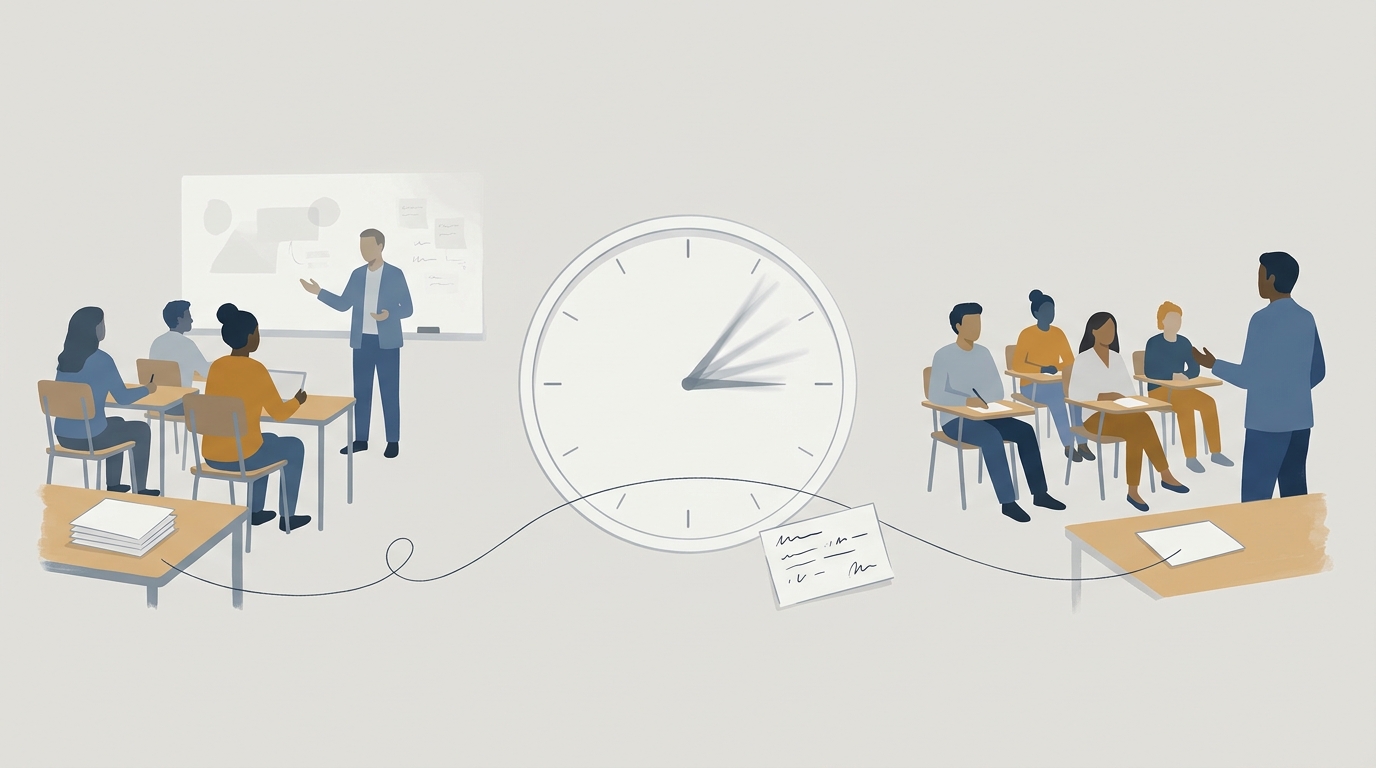
A few weeks ago I taught the same class every day for two weeks: ten groups, two teams in each, about twenty people per session. A team I taught early in that block wouldn’t come back for two weeks. This week I’ve started the next block, with the same structure.
On a schedule like that, a session ends and I move straight into the rest of the day: Engage (an internal platform) work, meetings, other conversations. Before any of that starts, I need to remember what I did, what I want to do differently, and something a person said early in the session that I haven’t processed yet. If I don’t write it down before I walk away, most of it is gone by the time I come back.
I wrote about the 25-minute time box a few weeks ago, in Deliberate Practice in the Age of AI: The 25-Minute Time Box. That post ends with a habit: when the alarm goes off, spend the last few minutes writing down what you did and what comes next. I described it as the thing that saves you when you return to the task after lunch or on Monday.
I’ve been doing that with a much bigger kind of time box, and the habit holds up. It just has more to recover.
The interruption and the time box ask the same question
Someone knocks on my door in the middle of a task. I answer, we talk for ten minutes, and then I’m back at my desk with the same question the 25-minute timer asks me: what was I doing, and what was I about to do next?
Leaving a time box is that question with a longer gap behind it. I close a session, switch to a different project, have a few conversations, run a meeting, and come back later. Coming out of the box cleanly means recording the same two things: where I stopped and where I meant to go.
The difference is scale. A short interruption loses a few minutes of context. A long time box loses hours of it.
Longer boxes lose more than the task
In a teaching block, the time box is the session itself. Between sessions I’m working on other projects, having other conversations, and answering questions that have nothing to do with the class. Every exit from a session is a context switch, and the gap before the next one is long enough that what I noticed in one session won’t still be near the surface two weeks later.
What I want to recover isn’t only the task. It’s also what I observed. Whether people seemed engaged. Whether they had their cameras on. How I felt walking out. What I’d do differently. And specific things I want to remember the next time I’m with that group, or the next time I teach the same material to a different one.
That’s too much to keep in my head across ten sessions, two weeks, and everything else on my plate.
What I capture, and how
I set up AI skills to help with two jobs: preparing for a session and logging one afterward.
The logging skill takes the transcript and my own notes. I add what the transcript can’t see: my observations about engagement, how the session felt from my side, what I thought I could do better, and anything I want to remember for the next time I’m with these people or teaching this material. I say those things out loud and they get written down.
The preparation skill runs before the next session. I tell it I’m about to teach the same class to the next group, and it pulls up what I logged about the previous ones: the challenges that came up, the examples that landed, the questions that stalled. It hands me pointers I can use in the room.
It’s a transcript, a set of notes, and a way to get them back at the moment I need them. What made it work is that I’m not relying on memory to do the retrieving.
What recency bias would have thrown away
Here’s the case that convinced me.
After the first group, I was reflecting on the session. The thing I remembered most clearly was one of the last interactions of the day, because it had just happened. Recency bias doing its normal work.
When I ran the reflection through the skill, it surfaced an interaction from almost four hours earlier. Same student, different moment. I had forgotten it completely and hadn’t connected it to that person at all.
That detail changed how I prepared for the second group. I adjusted what I planned to do and made sure I’d address what the earlier interaction pointed at.
The second session went better than the first. The third one went better still.
That was three sessions into a run of sixty, and the habit had already paid for itself.
What I’m noticing
People in the third group mentioned, at different points in the session, that the pace worked for them. They weren’t being left behind, and when someone started struggling there was room to catch up. That was gratifying to hear. It also told me the adjustments were doing what I hoped they would.
A twenty-five-minute box asks a small question at the end: what did I do, and what comes next? A two-week block of teaching asks a bigger version of the same question, and the answer is worth more than a line in a notebook. It’s the difference between walking into the next session with a fresh start and walking in with everything the previous groups taught me.
Now I’m starting the next block. The box is still bigger than twenty-five minutes, and the habit is the same one.

Leave a Reply