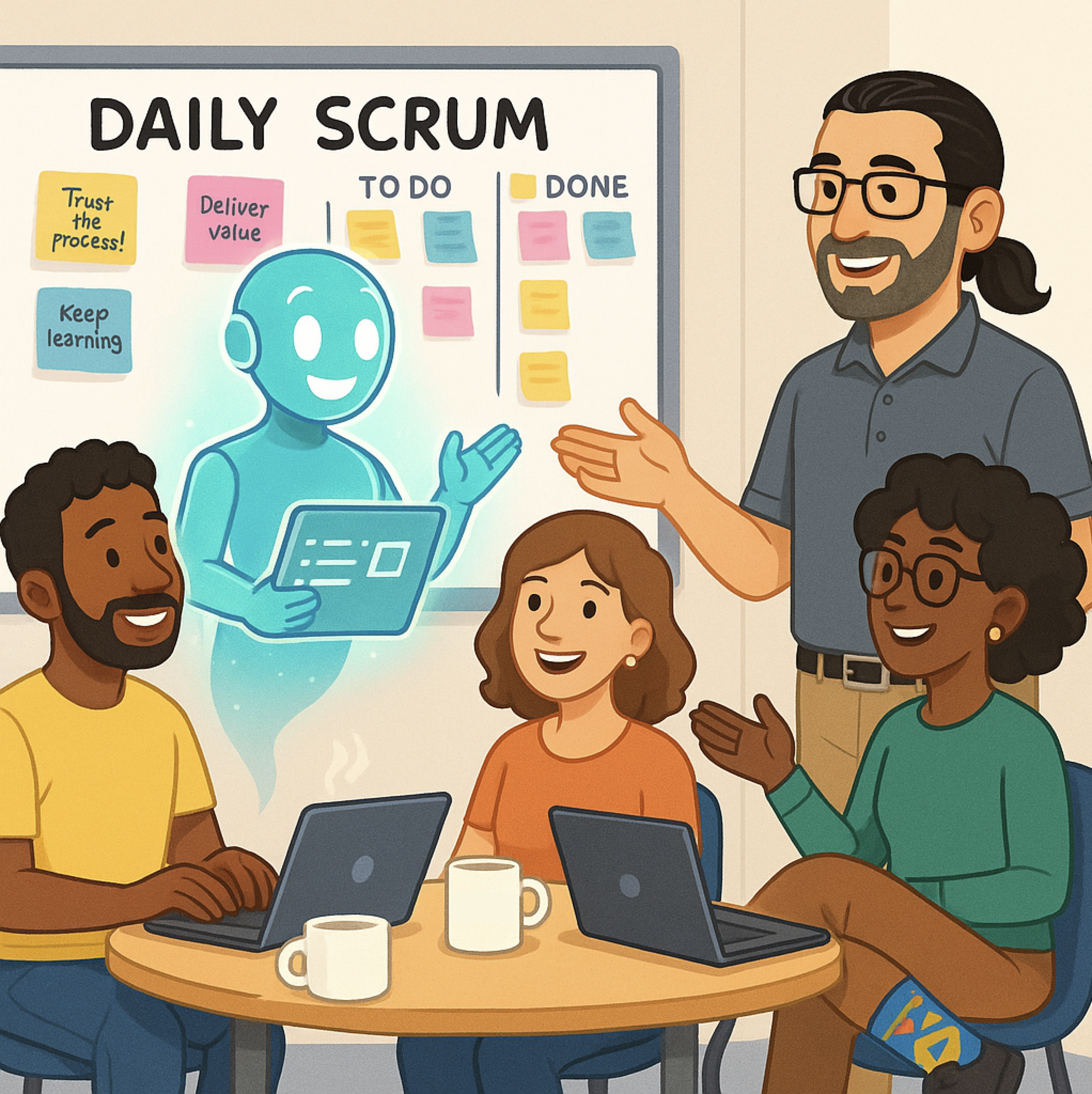
This past week, I had the privilege of giving a brand-new talk with a title that captures a question on many people’s minds: Will AI take your job—or join your standup? As someone who has spent decades working at the intersection of technology, Agile, and software craftsmanship, I wanted to explore how AI can move beyond being a shiny tool and instead become a teammate that helps us work smarter.
AI in the Sprint Room
This talk is rooted in my reflections on over two decades of adopting the values and practices of Agile, Scrum, Lean, and Extreme Programming, exploring how AI might be applied, and documenting my experiences to share with others.
A recent sprint retrospective provided me with a perfect example to illustrate these ideas. After wrapping up that conversation and just about to start our usual “lessons learned” discussion, my teammate suggested, “Why don’t we ask our AI assistant what it learned this sprint?” Brilliant! So I prompted it: “This is the last day of our two-week sprint. We are in our lessons learned session. What have you learned this sprint?”
The response blew us away. It surfaced points that mirrored my own coaching: project context matters, testing strategies are crucial, documentation saves time, and domain-driven design is essential. My teammate even commented that it sounded just like me. In that moment, it was clear: AI wasn’t replacing us, it was reflecting our values back to us and sharpening our focus.

From Tools to Teammates
One big takeaway from my journey so far is that the specific AI tool matters less than how you use it. I’ve used ChatGPT, Cursor, JetBrains Rider’s AI—you name it. All of these tools are now well-suited for both visual thinkers (like me) and verbal ones. The key is understanding what problem you’re trying to solve and picking the tool that helps you get there. And suppose you can’t yet articulate what the problem is. In that case, you can also collaborate with AI tools to find it out (as an accelerator, providing alternatives, but never replacing conversation and human collaboration).
Much like a woodworker doesn’t rely on just one chisel, but rather on many tools for different situations, we need to view AI as an evolving toolbox. Don’t get stuck in debates about which tool is “best.” Instead, ask: What am I using it for? That mindset frees you to experiment.
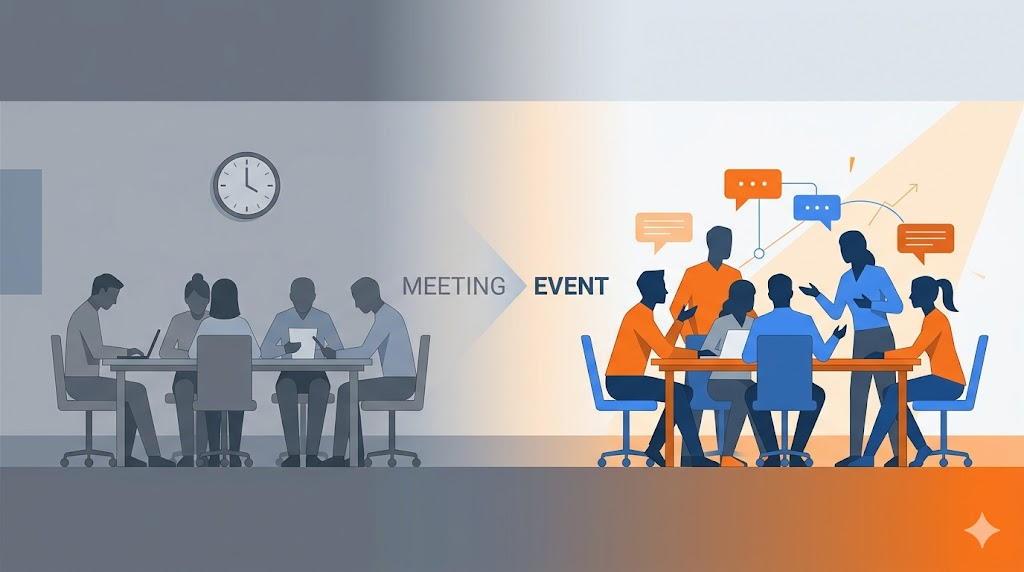
Conversations, Not Just Meetings
Agile has always been about conversations. Scrum events—planning, daily scrums, reviews, retrospectives—are only valuable if people are actually talking, collaborating, and solving problems together. AI can amplify those conversations. For example:
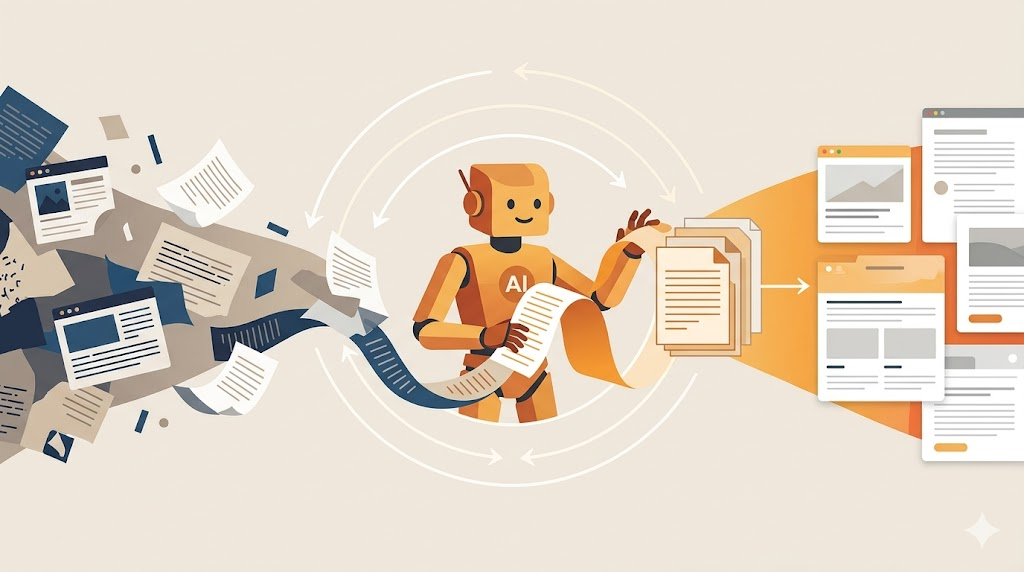
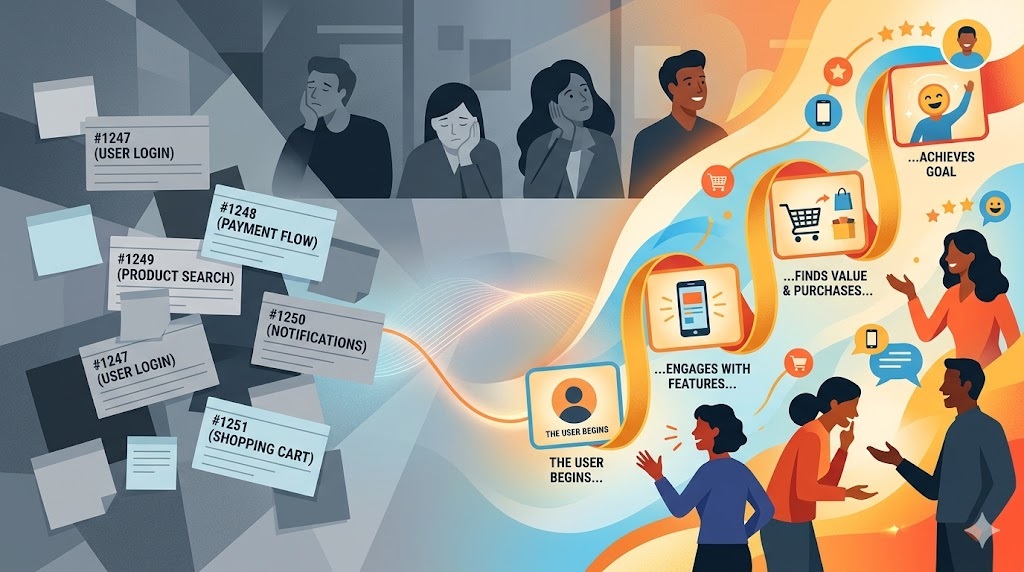
- Discovery: Record stakeholder sessions, transcribe them, and use AI to draft user stories from real conversations.
- Prototyping: Generate quick prototypes during a meeting so stakeholders can react to something tangible.
- Testing: Translate acceptance criteria directly into executable tests that anyone on the team can easily understand and read.
- Sprint Reviews: Craft presentations that focus on business value (e.g., “we reduced onboarding time by 30%”) rather than technical trivia (e.g., “we added a button”).
The shift is subtle yet powerful: AI helps maintain focus on outcomes, not outputs.
Revisiting Old Practices with Fresh Eyes
As I revisited Extreme Programming practices—pair programming, test-driven development, whole-team ownership—I realized something: working with AI is like pair programming with the most eager junior developer you’ve ever met. You need to provide it with context, constraints, and guidance. Without guardrails, it will happily “do it” and wander off track. But if you collaborate, critique its plans, and teach it your standards, it accelerates your work while reinforcing team values.
What AI Can’t Do (Yet)
It’s equally important to highlight what AI cannot do. It doesn’t read body language, sense unspoken tension, or empathize with a frustrated stakeholder. That’s still on us. The human role is irreplaceable when it comes to trust, empathy, and leadership.
A Call to Experiment
If there’s one thing I hope people walk away with, it’s this: pick one place in your process and experiment with AI. Try using it for user stories, test scaffolding, or sprint review presentations. Document what you learn. Measure the impact. Share with your team. Grow your AI literacy together.
Do this sprint after sprint, and see the results compound over time. Teams won’t ask “Will AI take my job?” anymore. They’ll ask, “How else can AI help me bring more value to my job, causing a higher positive impact?” That’s the shift that matters.
Here’s the video if you’d like to have this content in more detail.

Leave a Reply to Context Beats “Vibe Coding” | Claudio Lassala's BlogCancel reply