
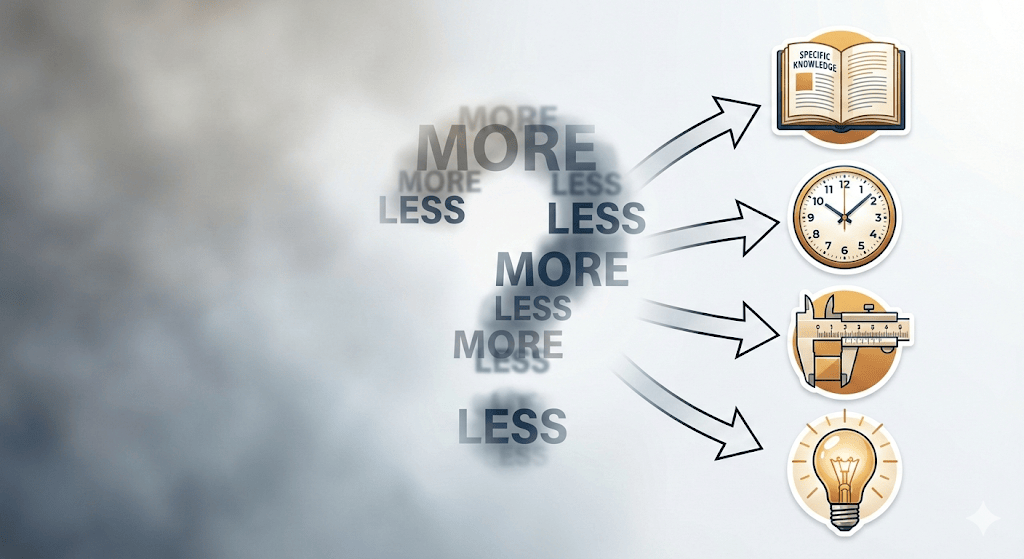
I keep hearing this phrase everywhere, especially in AI conversations: “more for less.” It sounds great. Who wouldn’t want more for less? But lately, I’ve been noticing how empty that phrase becomes when we don’t define what we mean by it.
More of what? Less of what?
The Slippery Nature of “More”
The AI hype cycle is full of promises to do more, get more, and achieve more. And yes, there’s a company out there with “more for less” as their actual motto. But when I hear it now, I immediately want to push back with questions:
-
More food for less cost?
-
More nourishment for fewer calories?
-
More features for less code?
-
More code for less time?
-
More value for less cost?
That last one is the trickiest. “More value” sounds meaningful until you try to measure it.
The Value Problem
When someone tells me a tool or approach “brings more value,” I ask, “How do we define value?” How do we know something is valuable?
If we’re talking about business value, how does the business measure what’s valuable to them? If it’s customer value, how do customers evaluate what matters? If it’s user value, what does the user actually consider valuable?
Without answers to these questions, “more value” is just noise. It can’t be defined. It can’t be measured. And if we can’t measure it, we can’t know if we’re actually getting it.
The Reading Analogy
This reminds me of something I’ve noticed on YouTube lately. There are countless videos promising to teach you how to “read more books.” But do we really need to read more books?
What if you read only one book in a year, but that book is a thousand pages long and triggers genuine critical thinking? What if it changes how you think, shifts your behavior, and creates new positive habits? Isn’t reading that one book better than skimming through ten books that leave no lasting impact?
When we say “read more,” what are we actually counting? Number of words? Time spent reading? If we speed-read through a large number of words but gain nothing in terms of improved thinking or behavior, what’s the point?
And if we slow down to actually assimilate the lessons, isn’t that better? Maybe in that case, we want to measure “more” as time invested—more minutes or hours spent reading each month than in the past.
Better Framing
Here’s what I mean by getting specific:
-
More books for less time
-
More behavioral changes for less painful lessons
-
More words for less time
-
More learning for less books
That last one is interesting. Instead of reading ten books that didn’t cause meaningful change, what if you read one book that did? Wouldn’t that be better?
The Questions That Matter
So when I hear “more for less” now, I pause and ask:
More of what for less of what?
And then: Why did we complete those sentences that way? Can we articulate it? Can we illustrate it with real examples?
These aren’t rhetorical questions. They’re the difference between chasing vague promises and actually understanding what we’re trying to achieve.
I’m not saying “more for less” is wrong. I’m saying it’s incomplete. And in a world full of tools and promises and hype, being specific about what we mean might be the most valuable thing we can do.

Leave a Reply