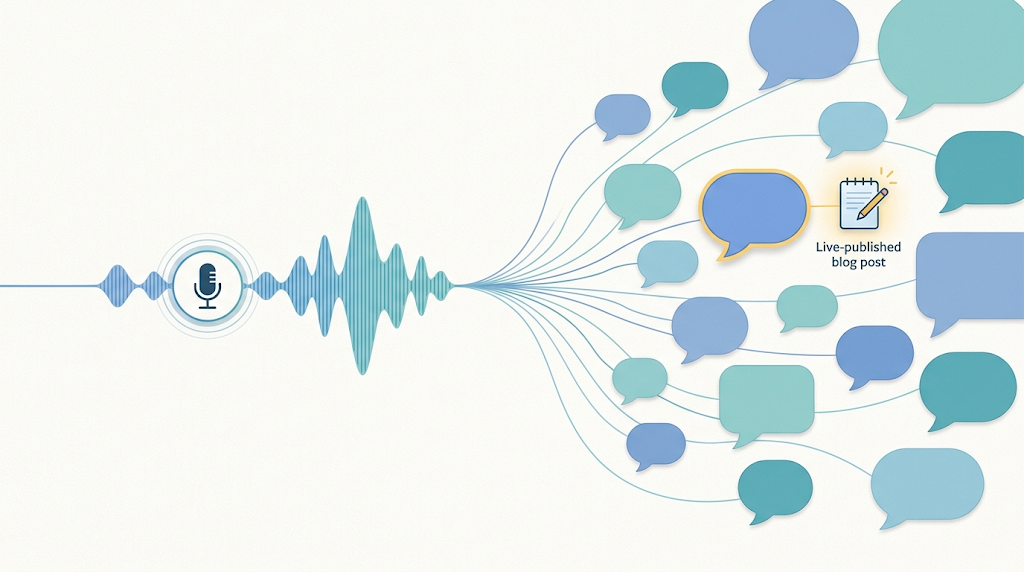
A few weeks before my tenth anniversary at Improving, I was sitting with two ideas I wanted to combine. The first was simple: I wanted to reflect on my decade, and the best way I knew was to let Improvers ask me questions and record my answers. The second was to show my blogging system working live, start to finish, and publish a post by the end of the hour.
What I did not plan for was that one hour turning into a whole series. That happened on its own, and it is the part worth writing down, because it explains how a single conversation can keep producing for months.
Why combine reflection with a demo
I have logged my involvement at Improving for years, so I knew the anniversary was coming and I knew I wanted to write about it. I also knew from people in our community that a lot of Improvers were curious about how I actually publish so much. The story I kept telling myself was that a good talk or a good post is not magic. It is a repeatable workflow: capture the source material, turn it into a draft, edit it for my voice, generate an image, publish, and promote. If I could show that loop happening in real time, I would answer the question far better than I could by describing it.
So I put together an invitation with two goals in one session. Part one was an open question-and-answer about my decade: the people, the programs like Come Together and the Involvement Program, and what kept me here. Part two was the live demo. No pre-recorded magic, as I told people. I would take the conversation from part one and push it through my real workflow, ending with a published post.
I also test-drove the idea a few days before with a small group of Improvers who meet to build in public. That dry run was important. It helped me decide the practical details: record my answers on my phone as the questions came in, pre-invite a few people to seed the conversation, and keep the demo honest rather than scripted.
The workflow, walked through live
When the day came, the plan surprised me. I had set aside the first fifteen minutes for questions, expecting that to be plenty. But Improvers kept asking, and the questions were so good that I let them run for most of the hour, recording my answers into a voice memo app on my phone as they came in. I ended up calling the Q&A short and reaching for the demo with less time than I planned. That recording is the source material. Almost everything I publish starts the same way: I speak my thoughts out loud, whether I am walking through a parking lot or driving home at the end of the day.
The part everyone wanted to see came next. I airdropped the audio to my Mac, where MacWhisper picked it up from a watched folder and transcribed it into a markdown note in Obsidian. From there I opened Alfred, my app launcher, and fired off the automation that invokes Devin. A set of scripts cleaned up the transcript, fixed names the transcriber always gets wrong, and filed the note away with tags and a summary.
Then the real editing began. I pointed the tool at the journal entry and asked for a single blog post. It set up a project folder, drafted the post, edited out the phrases that sound like AI talking, assigned categories and tags from my blog’s taxonomy, and generated an image prompt. That last part matters more than people think. Every post has an image at the top, and the prompt has to come from the content so the picture actually fits.
The tool does not invent the post. It works from what I said, as an editor and a partner. I read the entire draft out loud, which is another chance to sit with the thoughts and catch anything I would say differently. A colleague on the call flagged that two of my headings leaned on the same comparison, the kind of thing AI reaches for too often, and that was exactly the kind of note I want. The system is meant to remove friction, not to take over my judgment.
From one hour to one post
The demo pivoted partway through, and that is fine. A colleague asked about balancing work, life, and hobbies, and the question tied everything together so well that I used it as the topic for the live post. That became the “Balancing Work, Life, and Hobbies” post, published by the end of the call.
The rest of the pipeline ran the way it normally does. I took the generated image prompt into Gemini, generated the header image, uploaded the post to WordPress, set the featured image, and did a final read in the browser. Then came promotion: the tool drafted posts for LinkedIn, BlueSky, and Facebook. I keep that last step (publishing) manual on purpose. Copying the social posts by hand gives me a moment to read what people have shared and see what my network is up to. It is a deliberate slowdown, not a gap in the automation (Update: I have automated that process to handle days I’m on vacation). There is a lot more detail on the full loop in my posts From Voiced Ideas to Published Post in 20 Minutes and 93 Posts and What I Learned About Systems.
And then it became nineteen posts
The surprise came after the call ended. As I listened back to the recording and looked at the questions, I realized the conversation had produced far more than one post. Every question deserved an answer of its own. A colleague asked whether blogging and public speaking feed each other. Another asked why I started blogging and how I have stayed consistent for 21 years. Each of those became a separate installment in this series.
That is the part I did not plan. I had been using a multi-post project mode that takes a long transcript, like a one-hour talk, and derives a cohesive series of posts from it, with callbacks and payoffs instead of repetition. What I had not fully appreciated until that day was that a Q&A works the same way. A good conversation is not a single source. It is a bundle of sources, one per question, and each one is a post waiting to happen.
So a Lunch & Learn became a published post, and a published post became a series. The hour itself was one session, but it seeded nineteen.
The session did what I hoped, and then some. The people who joined saw that a blog post does not appear out of thin air. It comes from capture, drafting, editing, image, publishing, and promotion, and each step is deliberate. But the bigger lesson was about the conversation itself. Reflection works best when the questions come from other people. When Improvers ask good questions, the answers stick with me in a way my own solo reflection sometimes does not. One hour of questions became a month of writing, and I did not have to force any of it. I just had to listen back and let each question find its own post.
That is why this series exists. The anniversary post that opened it was only the beginning. Each question from that room gets answered in full.




Leave a Reply