Episode 24 of Reflective Practice Radio starts with us trying to remember which episode we’re on. The number doesn’t matter much. What does matter is that the conversation keeps circling back to the same idea: when everything moves fast, it helps to stop and figure out where you actually are.
I gave a talk at Improving this week about evaluating our place on the company’s eight-stage AI maturity scale. Matthew and I dig into why that self-evaluation feels so uncomfortable, how community helps, and what happens when we stop trying to absorb every AI headline and start focusing on the signal instead of the noise.
We also celebrate Matthew’s recent Come Together talk, reflect on my six-month streak of daily blogging, and end with a conversation about why the most expensive AI model is rarely the right one for the job.
Journaling as a Mirror for AI Maturity
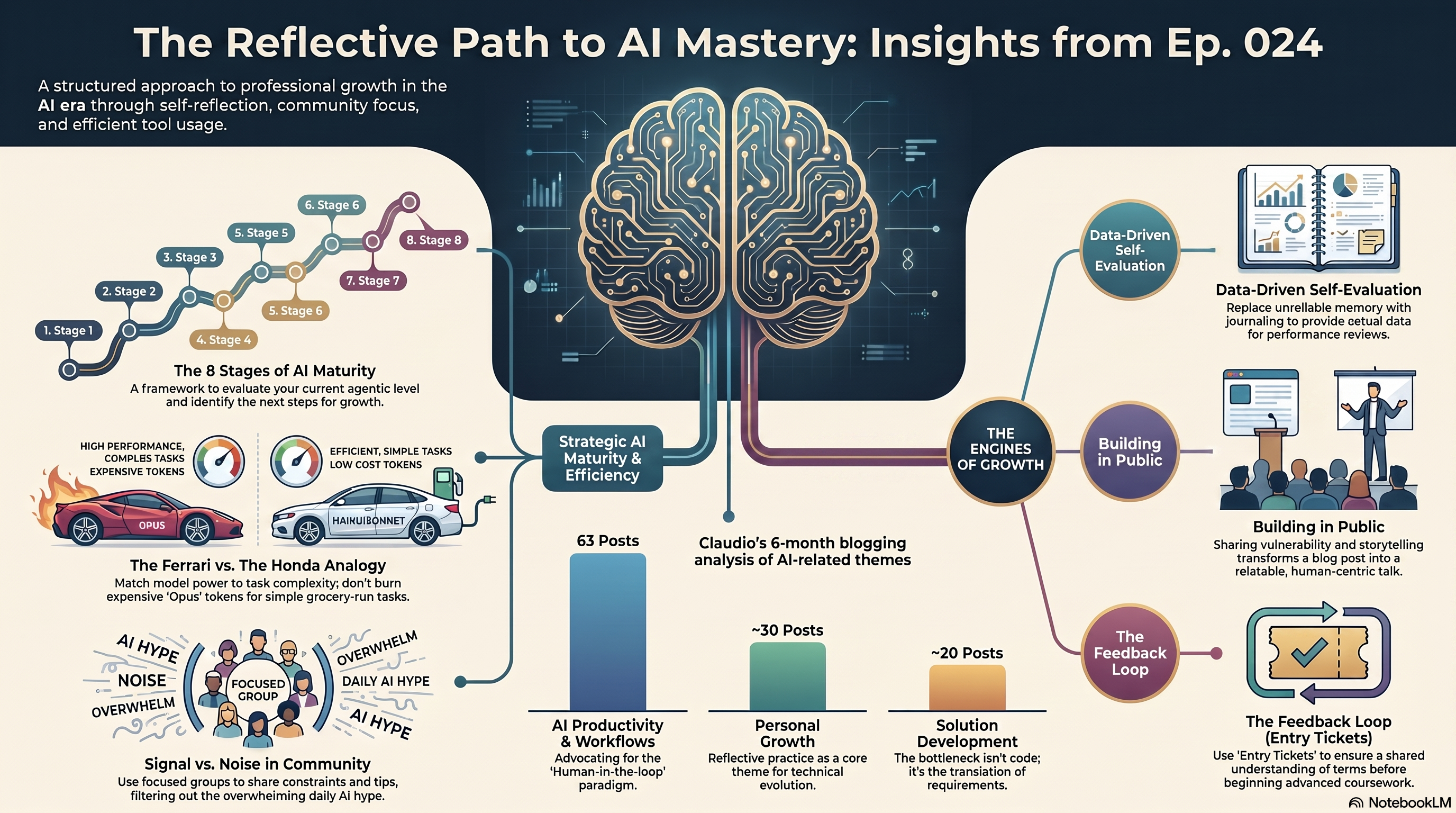
Matthew picks up on something I mentioned in my talk: the fear and discomfort of being asked where you are on a scale of one to eight. If someone asks me to rate myself, I might say two. Other people immediately reject that because of what they have seen me do. But the level is what it is. We should have a better way of determining it than relying on memory.
Journaling is that better way. When you capture what you are working on, what you are learning, and where you are stuck, you build a record of actual data. Later, when it is time to evaluate yourself, you can look back at real evidence instead of guessing.
That reframes self-assessment. It stops being a confidence exercise and becomes a review exercise. The evidence is right there.
The AI Maturity Focus Group
The talk led to a new group at Improving: the AI Maturity Focus Group. The group creates a small, safe space for people at different maturity levels to share tips, talk about client constraints, and sort out how to keep moving forward.
I started it because our general AI collaboration channel sometimes feels like a fire hose. It jumps from “how do I prompt this?” to “here is the newest model that just dropped.” Useful, but overwhelming. When you are trying to serve clients, you do not need more noise. You need signal.
Matthew says it more cleanly. A focused group with less noise clears room to learn. It also lowers the stakes for admitting where you are without worrying about judgment or shame. Admitting where you are is the only way to move forward.
Matthew’s Breakthrough on Stage
We spend good time on Matthew’s recent presentation at our Come Together initiative. He gave a deeply personal talk about his journey, and I watched it a few days later and was genuinely moved. The storytelling, the vulnerability, and the warmth all came through.
Matthew talks about the nervousness that never fully goes away. This was his largest virtual audience, and even though he was speaking from the comfort of his home, the number of people made it feel different. What carried him through was the back-and-forth with the audience, the questions, and the human connection.
The talk came from a blog post he had written. I had told him the post needed to become a talk. Reading someone’s words is one thing. Seeing their face and hearing their voice as they tell the story is another. He made it his own, and it worked.
Building in Public as a Practice
Matthew traces his public speaking journey back to Build in Public, the weekly meeting we started at Improving for people to share what they are working on. He wandered into one session almost by accident, realized he did not have answers to basic questions about his own work, and decided to change that.
That discomfort led to our first duo talk, and eventually to Matthew running Build in Public himself. The cycle keeps feeding itself. Someone shares an idea, gets feedback, refines it, and brings it to a larger stage. Then other people see that and think, maybe I could do that too.
Matthew also describes the workflow he uses to create PDF summaries of these meetings. He pairs the transcript with timestamps, spins up a headless browser, grabs screenshots of the video at the right moments, and assembles everything into a readable document. The tool just packages what people already said. The value comes from the conversation, not the capture.
Six Months of Daily Blogging
I hit a personal milestone yesterday: six uninterrupted months of daily blogging. What started as a one-week experiment stretched into a month, then a quarter, and now half a year. I kept telling myself that if I had to stop, I would document why. But the streak held.
To make sense of all that output, I exported my posts, combined them by month, and fed them into NotebookLM. The analysis confirmed what I felt: the bulk of my writing falls into themes like AI productivity, human stories over user stories, slow down to go fast, and reflective practice.
The part that got me was the visual output. NotebookLM generated a mind map and an infographic that captured the shape of my thinking. Matthew noticed the quality of the art first. The brain in the center was perfectly symmetrical, the text was legible, and everything looked intentional. I did not give the tool elaborate prompts. The quality came from six months of captured context.
Teaching AI with Better Analogies
Matthew shares a project he has been working on with our colleague Jesse: building educational tools to explain the eight levels of agentic AI development. They use Bloom’s taxonomy and simple analogies to make the concepts stick.
The factory analogy is one of his favorites. You start as an artisan doing everything by hand. Then you get tools. Eventually you are managing the whole factory. The sandwich assembly line is another one: what are the rules, skills, and hooks at each step of making a sandwich?
The harder part is feedback. You can build what you think is a perfect training tool, but if it does not land with everyone in the room, it fails. The only way to reach more people is to ask for feedback, even when that feels awkward. Ask the quiet person what they got out of it. Ask what would make the material work better for them. Then iterate.
The Ferrari Grocery Getter
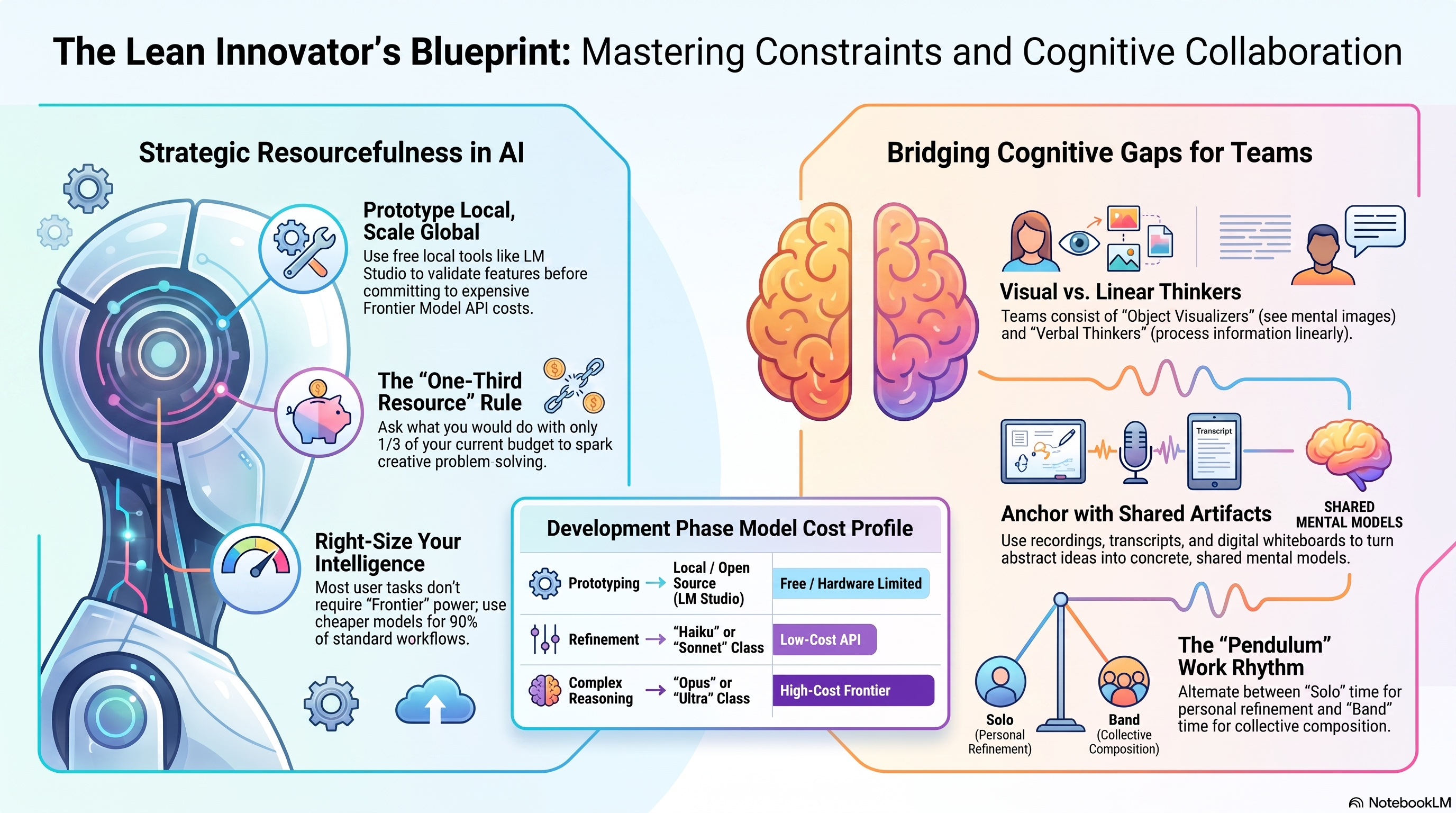
We end with a practical conversation about model selection. At Improving, some of us have lost access to Claude Opus on our enterprise plan. A constraint, but constraints can be good. They force you to think about whether you really need the most expensive tool for every task.
I compare using Opus to summarize a two-sentence email to taking a Ferrari to the grocery store. It can get the milk. It is a very expensive way to do it. And if the trip fails, you do not get those tokens back.
The alternative is to learn the smaller models. Haiku and Sonnet are very capable. Cursor, Windsurf, and other tools have free models that can handle a lot of everyday work. The trick is matching the model to the work. Take out the Honda. It might require a few manual operations, but the work gets done and it gets done inexpensively.
The Thread That Holds It Together
Community keeps showing up as the through-line. Whether it is the AI Maturity Focus Group, Build in Public, or a Learning Circle, these spaces soften the hard parts of growth. They give us a place to test ideas, admit confusion, and learn from people who are a few steps ahead or behind.
If you want to hear the full conversation, including the parts that are harder to capture in text, watch the episode above. And if you want more of Matthew’s writing, it is at quietpublish.substack.com.



Leave a Reply