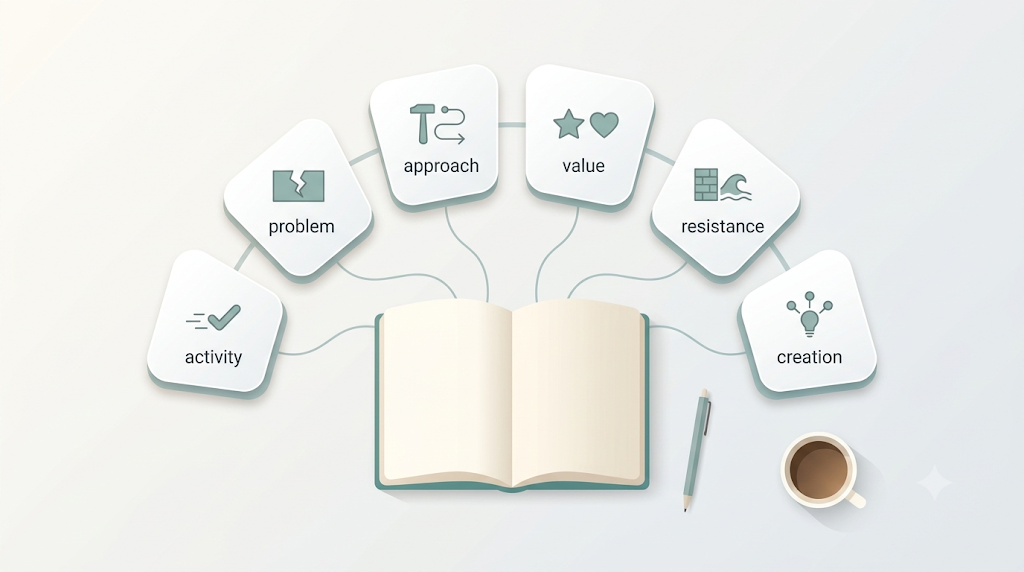
Once you can describe work with the Need → Problem → Solution framework, the next step is to expand the reflection. Six questions are enough to capture almost any experience in a useful way.
These questions build on the Need → Problem → Solution framework from the previous post. They are not meant to be answered in order every time. They are a checklist you can run through when you have a few minutes and want to turn an experience into real learning.
1. What Did You Do Today?
Record the main activities or tasks. Include the project or context. If this is a continuation of yesterday, note the progress you made.
-
What did I work on?
-
What context or project was it in?
-
If continuing from yesterday, what changed?
This question grounds the entry. It is the headline. The rest of the questions add meaning.
2. What Problem Were You Trying to Solve?
This is the Need and Problem from the earlier framework. What need or challenge prompted this work? Who was impacted? Why did it matter?
If you do not know why the work mattered, the entry is a task log. That is okay for a quick capture, but it is not a reflection yet.
3. What Tool, Approach, or Technique Did You Use?
Be specific. Name the tools, frameworks, or methods.
-
Why this particular approach?
-
Was this new or familiar?
-
If I have used this before, what was different this time?
This question builds your personal inventory of techniques. Over time, you will see which methods you rely on, which ones you are avoiding, and where you are growing.
4. What Value Did You Perceive From This Work?
Identify the positive outcomes and insights.
-
How did this help solve the problem?
-
Who else benefited? Teammates, stakeholders, clients?
-
Did I share it? How?
This question trains you to see impact. It is also the seed of future resumes, talks, and blog posts.
5. What Resistance or Challenges Did You Face?
Do not skip the hard part.
-
What was difficult?
-
What would I do differently?
-
If this keeps happening, have I found new approaches?
This is where most of the learning lives. The mistakes, dead ends, and surprises are more instructive than the smooth successes.
6. Reflect, Relate, Create
The last question has three parts.
Reflect: What did I learn from this experience?
State it plainly. Not a summary of events. A lesson.
Relate: How does this connect to other things I know or have experienced?
This is where notes become knowledge. Connect this entry to previous entries, books, conversations, or patterns you have seen elsewhere.
Create: What could I build, share, or do differently based on these insights?
This turns learning into action. It could be a blog post, a team process, a tool improvement, or a conversation with a colleague.
Note: I borrowed Reflect, Relate, Create from the great little book Testing the Inner Compass – Cultivating the Courage to Trust Yourself.
A Lightweight Entry
You do not need to answer all six every time. A minimum useful entry might answer:
-
What did I do?
-
What did I learn?
-
What will I do differently?
That is enough. The full framework is for when you have ten minutes and want to mine an experience for everything it can teach you.
Build the Habit First
If answering six questions feels like too much, start with one. The most important is: What did I learn? Add the others when the habit is already in place.
The value of the six questions is not in the answers. It is in the practice of asking them.
Related posts




Leave a Reply