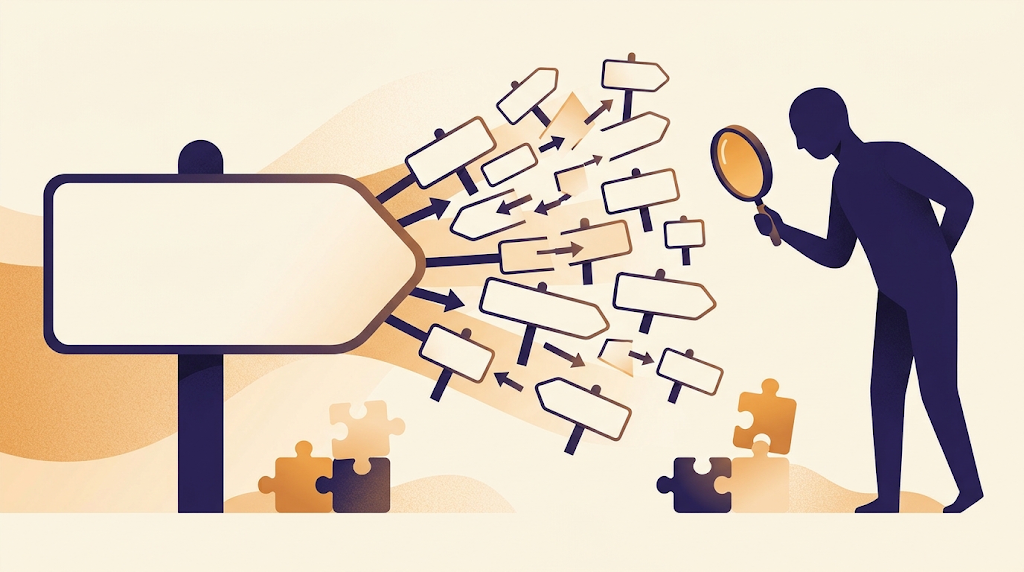
People still ask developers to “delete” orders all the time. I wrote about why that is the wrong word a few months ago, and I traced it back to a post I wrote in 2010, where the question was whether anyone had ever had an employer walk up and say “you have been deleted.” Nobody has. Employees get fired, transferred, or promoted.
The word survives because we shipped it first. Every app we built had a Delete button, so people learned to reach for that one word whenever they wanted something out of the way, even when what they wanted was to cancel, hold, or transfer it. Now we spend time retraining people in the vocabulary we gave them.
I keep finding the same pattern in other places. A word goes out, people adopt it, and the word quietly decides how they think about the thing behind it.
Git blame is an accusation, not a question
Git has the same problem, and it has it in a command name.
git blame tells you who last changed each line of a file. I use it occasionally. I also dislike it every time I type it. The word frames the thing I am trying to do as an accusation: who is to blame for this? Somebody did it, and now we are pointing.
That is not what I am usually doing. Most of the time, I am trying to understand a change. It might have been a great change, and I want to know what it was solving so I do not undo it. It might be a change I would have made differently, and I want to know what the person was dealing with so I can ask a useful question instead of a defensive one. Either way, there is something to learn in that history.
“Who can we learn from about this change?” That is the question I actually have. It would be a better command name, and it would be a better thing to say in a code review, in a postmortem, and in a conversation with the person who wrote the line.
Jordan Peterson’s ninth rule in 12 Rules for Life is “Assume that the person you are listening to might know something you don’t.” That rule is the right posture for reading a diff. The person who wrote the line knew something about the system that I do not, and the only way to find out is to approach the history expecting to learn.
Blame does more than describe the search. It shapes how the person on the other side of it feels about being found.
Porcelain, and the cost of guessing
Not every bad name is loaded. Some are just opaque.
Before Git I used Mercurial. The commands made sense. They related to what I was trying to achieve, and I did not have to think about them. When I moved to Git, I spent a long time with one of those comparison tables open on a second monitor, mapping the words I wanted to the words Git had.
I still look commands up. One I met recently was porcelain. When I first read it, I thought fragile. Or pristine: something original, untouched. Neither had anything to do with what was happening in the context. The only way to know was to ask. Porcelain is an option that changes a command’s output so it is optimized for a program to read instead of a person. I had to verify that, because nothing in the word pointed me toward it.
The real cost of a name like that is not that it is wrong. It is that it is unguessable. I could not infer the meaning, so I had to go look it up.
Azure, the color of a cloudless sky
My favorite example is the one I cannot do anything about. Azure is the color of a cloudless sky. Microsoft Azure is a cloud offering. I have made that joke for years and I will keep making it. The name of a clear blue sky, on a product that only exists somewhere behind the clouds.
The people who name things are not always thinking about the people who have to say them. They are thinking about a brand, a market, a metaphor that felt right in a conference room. The word ships anyway, and the rest of us live with it.
What I try to do instead
I try to be deliberate about this when I build things. When I name a button, a field, a command, or a feature, I ask a few questions.
- What is the person trying to achieve, and does this word match that? If they want to stop an order, the action may be “cancel” or “put it on hold”, not delete.
- Could someone infer what this means from the word and the context around it? If not, the name is going to cost them a lookup.
- Is this word accurate for what actually happens? A soft delete is not a delete, and calling it one makes everybody’s mental model slightly wrong.
- What does this word make people feel about the work? Blame puts someone on the defensive before the conversation starts.
None of that is difficult and none of it is new. It is easy to skip when you are moving fast and the name is the last thing you write.
Optimizing for communication
So many problems come from miscommunication. A user asks to delete an order when they mean cancel, and we build the wrong thing. A developer sees git blame and assumes they are about to be scolded. Someone reads porcelain and has no idea what it does, so they avoid it or use it wrong. Those are vocabulary problems, and they all cost time.
We optimize for performance, for scalability, for maintainability, and for test coverage. Optimizing for communication is cheaper than all of them. It means choosing words people can infer, checking what a word means instead of guessing, and remembering that the language we ship outlives the feature it was attached to.
I have been writing software for a long time, and the parts I am proudest of are not the clever algorithms. They are the moments when someone used a thing I built without having to ask me what it meant. That is the goal, as far as I can tell: not to be understood by developers, but to be understood by everyone who has to live with what we ship.


Leave a Reply